

Promoting active school mobility presents a complex challenge that requires a close integration of infrastructural measures, behavioral change, and educational content. At the core is the design of safe and attractive routes to school, achieved through targeted allocation of public space, priority regulations, and child-friendly street design. Equally important is the mobility behavior of families, particularly encouraging children to walk, cycle, or use scooters, as well as fostering mutual consideration among all road users. In addition, mobility education is a vital component of school curricula, aiming to sustainably strengthen traffic safety and environmental awareness.
The implementation of these objectives involves a multifaceted network of stakeholders with varying responsibilities. The District of Eimsbüttel, City of Hamburg, acts as a main agent for infrastructural measures and is also responsible for climate protection and the mobility transition. Schools, parents, and children are key actors in driving behavioral change and promoting active mobility. Other institutions, such as specialist authorities (both transport authorities and school authorities), the police, and the Hamburg public transport association (hvv) with its diverse mobility projects, are also involved. It is important to consider different timeframes: while educational and informational measures can be implemented quickly, infrastructural planning and execution often require lengthy processes.
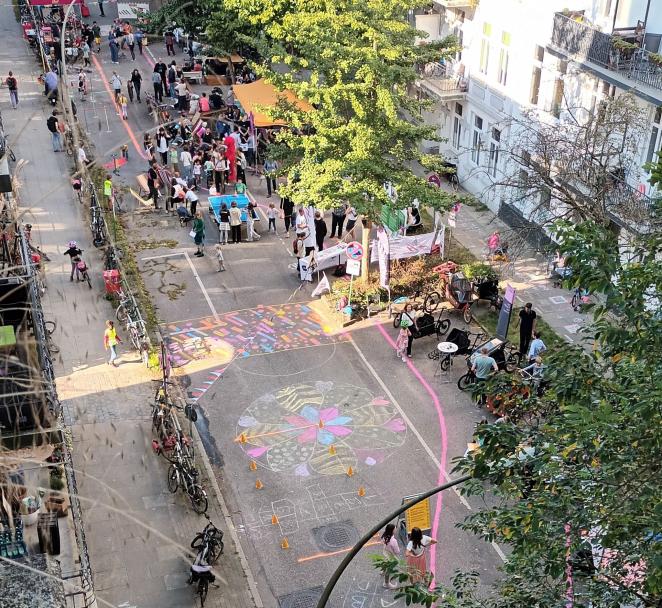
In Hamburg, and specifically in the district of Eimsbüttel, various initiatives and pilot projects are already underway to promote safe and attractive school routes. One example is Rellinger Straße, which is being implemented as a pilot project within the framework of the EU-funded Active Cities project. A broad participation process included an day of action featuring activities such as cycling and scooter courses, cargo bike trials, surveys on school route experiences, and playful activities like a smoothie bike to boost motivation for active mobility. In addition to numerous workshops during the planning phase with all stakeholders (schoolchildren, parents, school staff, local residents, and others), an information event was held shortly before construction began, targeting new parents during the school’s open day in December to further raise awareness and engagement. The idea was to reach people at the school site who had not previously attended participation events. Topics discussed included the reactivation of “walking buses” and the evaluation of kiss-and-ride zones.
In summary, promoting active school mobility requires a holistic approach that combines information, education, infrastructure, and behavioral change. Continuous, cross-departmental collaboration and a trusting network among all stakeholders are essential to achieve sustainable improvements. The district of Eimsbüttel is taking a pioneering role by intensifying its activities, sharing experiences, and providing support to other districts. The long-term goal is to create healthy, safe, and attractive school routes that motivate families to choose active mobility, thereby making a significant contribution to the mobility transition and climate protection.