

Hamburg Wasser has successfully commissioned and optimized a pilot membrane plant for greywater treatment in the Jenfelder Au district, demonstrating how decentralized water reuse can significantly reduce potable water demand in urban neighborhoods.
The project, presented at the 16th Aachen Conference on Water Technology, forms part of the HAMBURG WATER Cycle®, an innovative approach to circular water management. Installed in the Jenfelder Au residential quarter, the system serves 835 housing units or 2000 residents.
Turning Greywater into a Resource
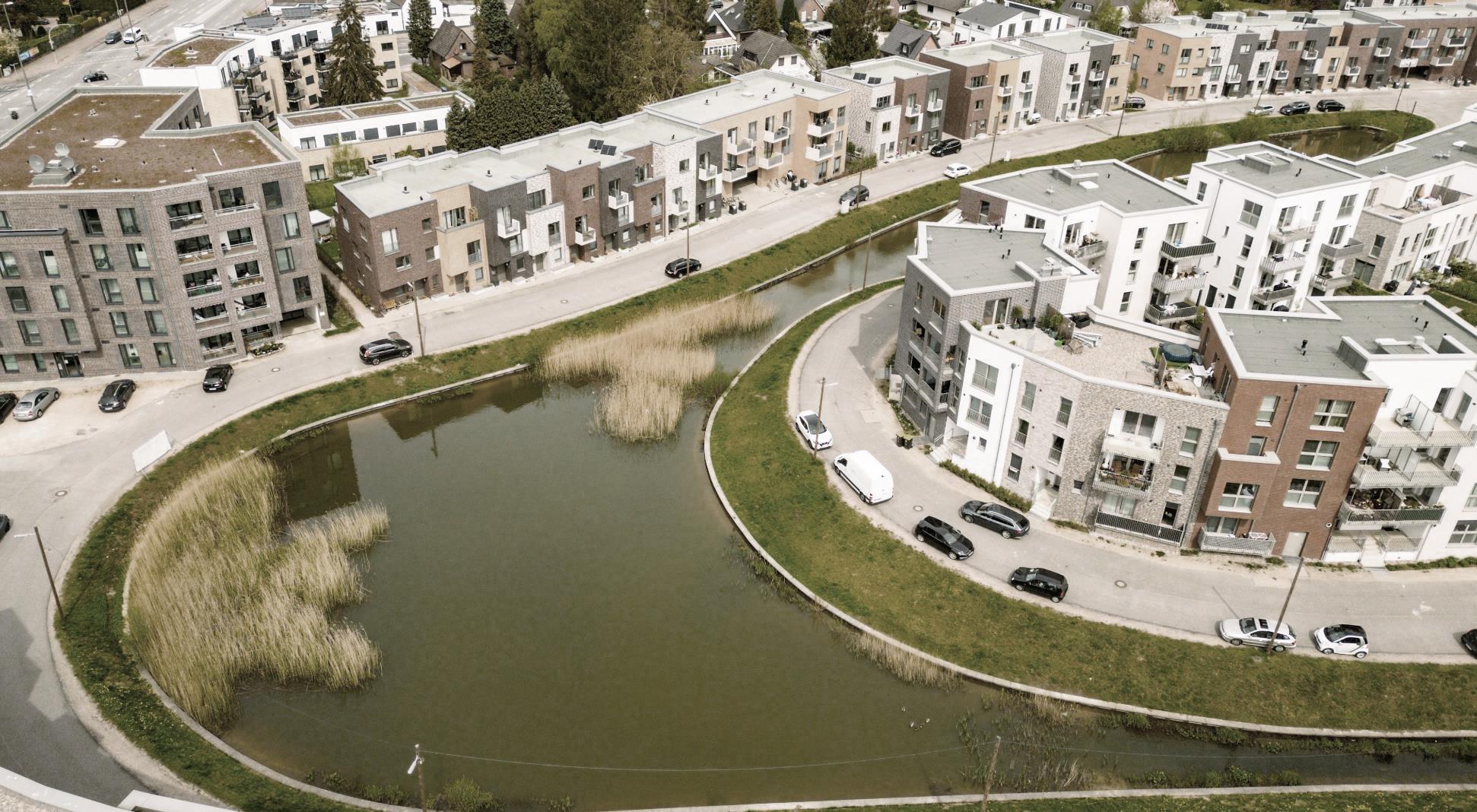
Greywater from showers, washbasins, washing machines, and kitchens is collected and treated locally using a fixed-bed bioreactor together with submerged hollow-fiber ultrafiltration membranes made of PVDF. Two membrane modules with a total surface area of nearly 56 m² were tested under real operating conditions. The treated greywater quality meets the standards for toilet flushing and irrigation. However, in within the European INTERREG NSR project ANCHOR, the treated greywater is pumped via a 200 m long pipeline to the rainwater basin (Kühnbachteich) which is designed as a pond. This ensures the rainwater pond maintains a stable water level during dry periods, improving the appearance, supporting the aquatic life and helping to reduce the heat island effect.
Stable Operation Through Targeted Optimization
Researchers conducted multiple test series with the new membrane plant, including greywater characterization, flux variation, cycle-time optimization, chemical cleaning strategies, and energy assessments. The study identified optimal operating conditions, such as a filtration flux of 13.6–16 litres per square metre per hour and a weekly chemical cleaning regime using sodium hypochlorite (NaOCl).
Despite challenges such as sludge bulking caused by filamentous bacteria – linked to low phosphorus levels and low sludge loading – the system remained stable. Further measures to control sludge formation are currently under evaluation.
High Water Quality and Hygiene Standards
The treated greywater consistently met or exceeded the requirements of DWA Guideline M 277 (Reuse Class C2). Turbidity remained below 0.07 NTU, organic pollutants were reduced, and pathogenic bacteria such as E. coli and Pseudomonas aeruginosa were below guideline thresholds.
“These results confirm that membrane-based greywater treatment can deliver hygienically safe and high-quality service water under everyday conditions,” said Hamburg Wasser project lead Gregor Rudolph-Schöpping.
Energy Demand Within Expected Range
Energy consumption varied seasonally, and aligned well with values reported in scientific literature for decentralized greywater systems.
A Blueprint for Future Cities
With growing urban populations and increasing climate pressures, Hamburg Wasser views decentralized greywater reuse as a key building block for sustainable water infrastructure. The Jenfelder Au project demonstrates that local water cycles can be reliably implemented at neighborhood scale—technically and hygienically.
Further work will focus on long-term energy efficiency, automated monitoring, and cost optimization. As cities search for resilient solutions to water scarcity, Hamburg’s district-wide membrane-based greywater system offers a compelling model for future urban development.