

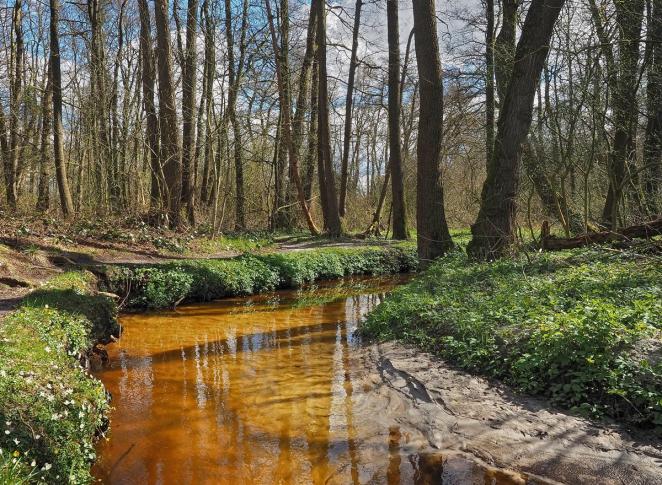
In the heart of the Drentsche Aa National Park lies the Anloërdiepje: a dynamic landscape where agriculture and protected nature are closely connected. Over the past years, farmers, Prolander, the Province of Drenthe and the Hunze en Aa’s Water Authority have worked together on a pilot here as part of Blue Transition. Their shared goal is to build a climate-resilient water system in times of increasing drought, heavier rainfall and rising demands on water quality.
Understanding the system
Hydrological research has shown that the water system in the area around the Anloërdiepje is quite complex. To provide a clear understanding of the area’s water management, it was decided to create an informative brochure that explains the soil layers and the groundwater. The brochure is primarily intended for landowners and land users, but is also interesting for other interested parties in the catchment area Drentsche Aa. It is also a good practice example for other Blue Transition partners in terms of communication with local and regional stakeholders.
You can find a short synopsis below as well as the brochure in Dutch and the Eglish translation
Why this research?
Recent droughts have shown how vulnerable the area is. The pilot project therefore focuses on two main tracks:
1. Hydrological research
Sweco mapped the local water system in detail. By analysing soil layers, elevation differences and groundwater flow, the study explains why some fields remain persistently wet while others dry out quickly. The research builds on:
- SkyTEM subsurface measurements from the air
- monitoring wells
- field expertise shared by farmers
- soil data from TNO (Netherlands institute for research)
Together, these sources create a clear picture of where water stagnates, where it drains away, and which measures could strengthen the system.
2. Water in the Topsoil
In collaboration with farmers, practical soil measures are tested to improve soil structure, water retention and reduce leaching of nutrients and crop protection products. The resulting insights support farmers, nature organisations and public authorities.
What did we find?
The Anloërdiepje shows large differences between wet and dry conditions — sometimes within only a few dozen metres. This is caused by:
- Shallow layers of pot clay and boulder clay
- Significant elevation differences
- Rapid drainage through ditches and pipes
- Deeper downward seepage on higher sandy ridges
These conditions create several recurring challenges:
- Long-lasting standing water on fields due to shallow clay layers
- Rapid drying of higher sandy areas
- Runoff risks on slopes, carrying nutrients and crop protection products
- Limited options for irrigation due to nature protection rules and poorly permeable deep soil layers
The findings confirm what many farmers already observe in practice and emphasise the hydrological complexity of the area.
What’s next?
Climate change is expected to intensify both drought and waterlogging. That is why partners in the Anloërdiepje are developing a long-term strategy for more robust water management, supported by continuous groundwater monitoring and practical pilot measures. The aim is a water system that is future-proof — for agriculture, nature and drinking water production.