

Data centres are emerging as the backbone of Europe's digital economy, and an important component of the continent's sustainable energy future. It is estimated that data-centre electricity consumption in Europe can increase from 76,8 TWh up to 160 TWh by 2030, roughly equivalent to the entire annual electricity consumption of Sweden. Driven by AI and digitalization, their rising electricity use creates both opportunities and concerns for local grids and grid operators.
To order to maximize the potential of the local energy economy for homes, cities, and business across Europe’s North Sea Region (NSR), the BRAVE partnership including academic institutions, regional public authorities, and private cleantech cluster organisations are involved in collaboration and innovation. Within BRAVE, The University of South-Eastern Norway (USN) is exploring the specific impact of data centres on local energy systems, and new models of governance and collaboration needed to leverage their unique opportunities.
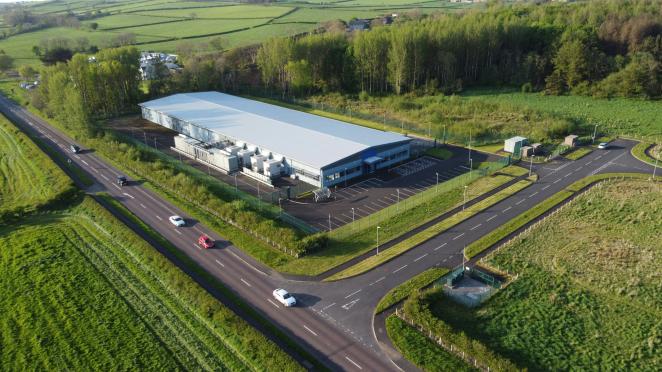
From High Energy Use to High Community Value
Modern data centres are not just serving as digital processing hubs, but also have the potential to supply low-carbon surplus heat to district heating networks, provide grid balancing and demand response services, incorporate on-site renewables, and stabilize local power systems. In doing so, data centres can represent strategic partners for municipalities and utilities in contributing to resilient regional energy systems and economies. This opportunity is driven by new EU-level laws, including the Energy Efficiency Directive, heat-reuse mandates, increased efficiency requirements, and required sustainability reporting. These factors combine to build momentum for a new generation of investment models that better connect digital expansion with regional climate goals. As these digital regulations change, partner USN within BRAVE seeks to translate EU expectations into regional investment frameworks and local pilot initiatives that can be reproduced throughout the North Sea region.
BRAVE’s Multi-Level Framework
BRAVE uses a multi-level governance framework that considers simultaneously local implementation, regional planning, and national policies to facilitate the local energy transition. This ensures that EU mandates are translated into regional investment instruments and into strategically relevant and valuable projects with tangible benefit for communities, businesses, and households.
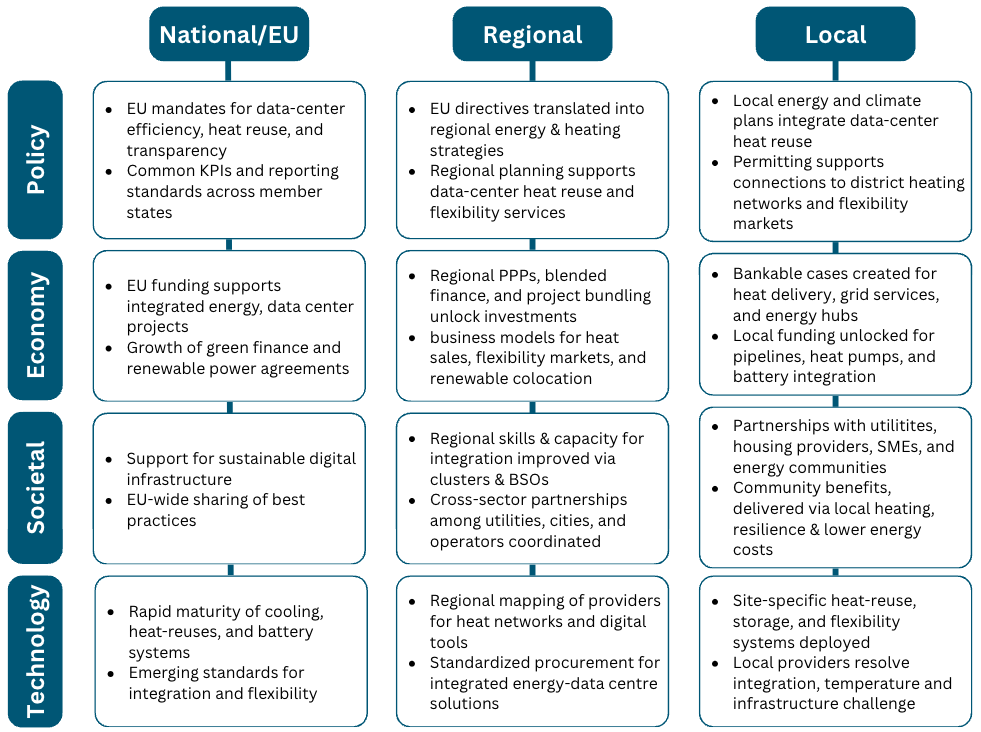
This multi-level architecture shows how local action, regional coordination, and trans-national policy can work together to scale integrated data-centre solutions. While local projects demonstrate tangible benefits for communities, grids, and operators, regional public authorities translate EU regulations into investment models and partnerships. Heat-reuse, flexibility, and renewable-integration technologies are already well developed; the next step is to make these solutions reproducible and bankable. BRAVE supports regions to implement local energy generation, flexibility, and mobility projects that reduce emissions, improve grid resilience, and deliver community value by strengthening cooperation between public authorities and private finance.
USN’s Contribution: Analytics and Innovation
Together with the BRAVE partnership across Europe, the University of Southern Norway (USN) is helping to overcome commercialization barriers for local clean energy technologies. USN’s work addresses challenges such as scalability, feasibility, and bankability, which are essential for bringing innovative solutions to market. USN contributes by:
Validating and monitoring collaborative investment strategies and commercial analytics from the BRAVE project’s eight NSR pilot sites
Supporting the integration of BRAVE findings into regional climate-strategy roadmaps, with replicability for future governments, SMEs, and regional public-private development agencies
In September 2025, USN hosted a dedicated seminar on Data Centres & Local Energy Systems, bringing together municipalities, utilities, SMEs, and researchers. The seminar discussed heat reuse, flexibility markets, policy, and the technical opportunities for integrating data centres with local grids and energy systems. Participants emphasized Norway's strategic advantages, such as a rapidly expanding digital infrastructure industry, a favourable environment, and an abundance of clean renewable power.
By bridging research, regional strategies, and practical innovation, USN helps ensure that ideas become actionable solutions for public authorities, investors, and operators.

Looking forward
As Europe's digital-energy landscape changes, USN will continue to hold events, exchange views, and work with local authorities. New prospects for local energy integration and sustainable data centre growth will be explored in upcoming USN publications and seminars. USN is targeting the International Conference on the European Energy Market (EEM) 2026, to be held in June 2026 at NTNU, Trondheim.
By better integration within local energy systems, data centres can provide tangible community benefits by delivering affordable heating and greater energy system resilience. Coordinated action across policy, business, and innovation domains is essential to scale these solutions and ensure contribution to Europe’s clean and resilient digital economy.