

Boosting local collaboration and sharing information is key to the mission of Interreg. CTB's French and Flemish partners took this aim upon themselves as collaborators from CD2E, ENSAPL, HABITER2030, City of Roeselare, and SURA met up in Roeselare to discuss circularity in this region. A first of its kind, partners met with great optimism and options were brainstormed about how to approach and utilise such meetings in the future.
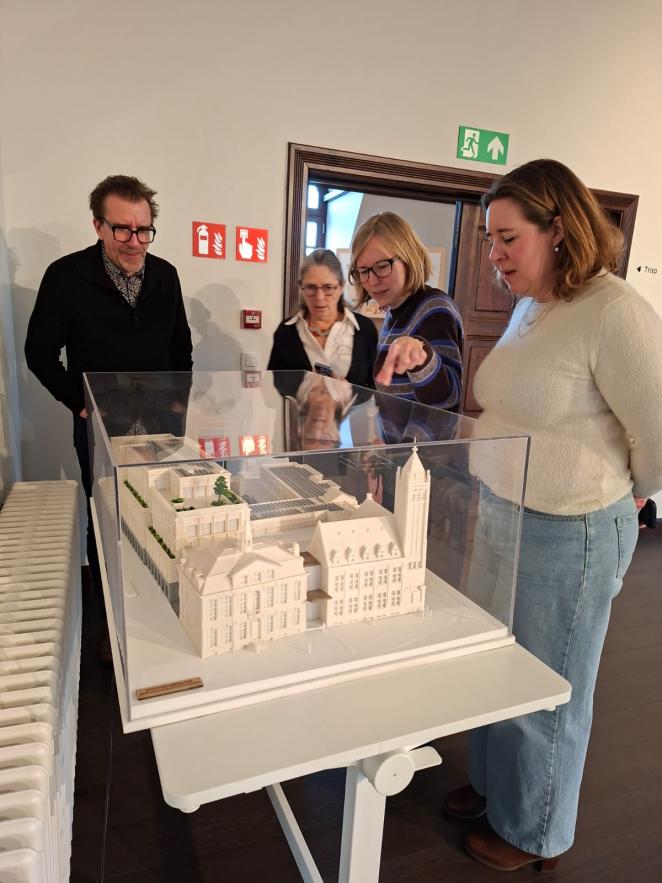
CTB partners observe and discuss a model building.
Common Ground
With eyes on the future these partners met to discuss what is in store. Both the northern French region and Flanders exist upon clay grounds, which means the same struggles and opportunities exist and this allows for a fruitful exchange. Specifically, discussions were held about cement, ceramics, and brick building materials and how to use these in circular construction. Resources and knowledge specifically about concrete were shared from the French side.
The following topics were deliberated:
- Social housing ambition,
- Sediment issues,
- Circular Concrete Centre,
- Frugality promotion,
- Academic collaboration and cross-border thematic webinars,
- Multi-stakeholder professional network,
- Reuse Working Groups related to bricks and logistics,
Additionally, partners considered the necessities and circumstances of stakeholders for binders performing similar tasks to cement such as knowledge, obstacles, opportunities, and interests in cross-bordered networking. Possible alternatives contemplated were blast furnace slag (GGBS), fly ash, calcined clays (LC3), natural pozzolans, geopolymers, lime (in some concretes/mortars), ceramics (sanitary ware, tiles, etc.), and clay (bricks, etc.).
It is of important value to continue working on reusing, recycling, and other circular economy levers. Local exchange is incredibly valuable and will help CTB achieve its goal of reducing emissions in the building sector. These CTB partners are planning to meet up again at the end of March in Lille for more exchange of knowledge.