

All throughout 2025 GRITH's partners stayed in motion. Velje deep dives into 2025 developments, obstacles, and opportunities in the municipality. This post will inform of developments in Vejle South, Vejle North, energy parks in Give and Thyregod as well as general GRITH visions in Vejle.
2025 marked a turning point for the local energy transition in Vejle Municipality. The municipality and its partners moved from isolated energy measures to coordinated, cross-sectoral partnerships between businesses, the municipality, citizens, and international actors. Through workshops, technical and economic analyses, and systematic knowledge sharing, GRITH has strengthened the professional capacity of all partners and aligned local stakeholders around one shared ambition: to accelerate the green transition and support Vejle Municipality’s climate targets through concrete, place-based energy solutions.
GRITH Impact
Across several industrial and peri-urban areas in Vejle, GRITH has functioned as a framework for:
- Developing area-based energy concepts rather than single-site optimisations,
- Bringing together companies, utilities, technology institutes, and local government,
- Testing new forms of governance around energy communities and large-scale energy parks,
This integrated approach has ensured that technical solutions are combined with organisational models and local ownership, which is essential for long-term implementation and scaling.

Vejle South: meeting where possibilities and solutions were discussed
Vejle South & Vejle North
Vejle South: Energy Community with Strong Potential
In Vejle South, the autumn of 2025 was marked by the completion of a pre-feasibility project under the Afkobling 2030 programme, implemented in collaboration with the Danish Technological Institute and the Alexandra Institute. Several local companies and a non-profit housing association have, through the EU-funded GRITH project, examined how shared energy solutions—such as solar power, energy sharing, and flexible energy systems—can strengthen both the green transition and business competitiveness. The analyses point to significant potential, but also to substantial challenges that currently make it difficult for companies to participate in energy communities and electrify their production processes.
These challenges include:
- The need to convert production processes and plant from fossil fuels to electricity,
- High connection fees and grid-related costs,
- A complex and evolving regulatory framework for energy communities,
Despite these barriers, the conclusions are clear: GRITH shows that joint investments in solar energy could reduce CO₂ emissions by nearly 2,000 tonnes annually while providing participants with stable and affordable green electricity, collaboration generates value, and the business case is promising for companies that are ready to take the next step in electrifying their operations.
Vejle North: The Energy Park Back on Track
In Vejle North, 2025 became a genuine turning point. After a prolonged standstill due to the bankruptcy of a previous project developer, Eurowind entered the project and conducted a full technical and economic review of the planned energy park.
The key findings were presented in November to the core partners in Climate Partnership Vejle North. The feedback was unambiguous: work on the energy park should continue.
Going forward, the focus is on developing a modern energy park combining:
- Large-scale solar PV,
- Onshore wind turbines,
The park is expected to supply substantial volumes of local renewable electricity and create new synergies for businesses in the area, including opportunities for sector coupling and flexible demand.
Additionally, Vejle North is part of a large-scale surplus heat project between an international company and the local district heating plant Tvisværket is in an advanced planning stage. Comprehensive technical analyses are in place for both partners, and the project is now awaiting final approval from the company’s parent organisation.
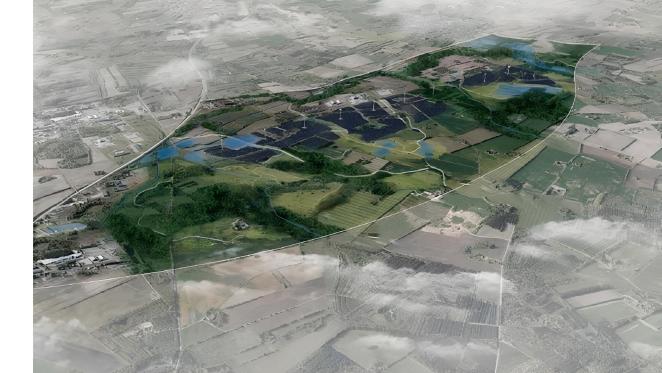
Give/Thyregod area. Give town left – Thyregod village in the right of the visualisation. Visualisation production: Eurowind A/S.
Energy Park Developments
Give/Thyregod: Ambitious Energy Park with Intelligent Energy Solutions:
In the Give/Thyregod area, partners are working intensively on a large-scale integrated energy park based on both wind and solar. The concept combines several advanced technologies:
- Battery storage to balance fluctuating renewable production,
- Hydrogen production to enable sector coupling and industrial use,
- Direct utilisation of surplus heat into the Give District Heating network,
Citizens are actively involved in the planning processes, ensuring local anchoring and transparency. The project is expected to:
- Act as a driver for new business areas and green industrial development,
- Contribute to a robust, flexible energy system for both companies and residents,
- Demonstrate how local energy production can be linked directly to local demand,
Just like Vejle North, Give is part of a project related to industrial surplus heat: A local food-processing company is close to full implementation of a project that will return surplus heat to the Give District Heating system. This will reduce both fuel consumption and CO₂ emissions in the heating sector.
Øster Starup: The Most Advanced Energy Park in Planning
Øster Starup is the third of the municipally designated areas with potential for an energy park combining solar PV and wind turbines. This energy park is currently the most advanced in terms of spatial and regulatory planning. Unlike the other cases, the area is not directly adjacent to existing industrial zones. However, it plays a key strategic role by:
- Distributing the location of energy parks across the municipality, so that all parts of Vejle contribute to renewable energy production
- Providing capacity that can help cover parts of the electricity demand from companies in Vejle South
In this way, Øster Starup Energy Park forms an important link in the municipality’s overall spatial and energy planning.
Development, Focus, Obstacles, Goals
Briefly mentioned already are the developing projects related to industrial surplus heat, this is seen as a central component in energy solutions for the business areas across Vejle as it both utilises surplus heat from companies more systematically in district heating networks and also extends the business heating infrastructure. This approach supports cost-effective decarbonisation of heating and enhances energy security by linking production, consumption, and storage across sectors.
A new focus area has arisen in Vejle as an increased focus on biodiversity in parallel with the developing energy initiatives. Partners are exploring how large, coherent natural areas can be developed in connection with energy infrastructure, how renewable energy projects can be designed to support ecosystem services and landscape quality, and how biodiversity measures can be integrated as standard components in future energy and business development.
Current Obstacles
Companies report struggling with high grid-connection costs. For some, electrification involves not only investing in solar installations but also in new electricity-based production equipment that in some cases still needs to be developed. Participants also highlight the complexity of legislation governing energy communities across property boundaries. Current regulations require extensive legal arrangements for larger companies wishing to share energy production and optimize consumption across local partners.
If Denmark is to scale up energy communities, more flexible and predictable regulatory frameworks will be essential. A more transparent dialogue with grid operators, along with simplified tariffs and connection rules, would greatly improve the conditions under which companies can invest in shared energy solutions. Despite the challenges, the project has established a strong foundation for continued work. Companies in Vejle South now have a consolidated overview of the technical, legal, and economic opportunities available, enabling the development of concrete models for investment, organization, and operation ahead of the project’s conclusion in October 2026.
Looking Ahead
The experience from 2025 demonstrates that strong business communities, solid technical insight, and active local engagement can significantly accelerate the energy transition and climate action at municipal level. Vejle Municipality and its partners wish to extend a sincere thank you to all companies and collaborators, both national and international, who have contributed to analyses, dialogues, and projects throughout 2025.
The work on local projects and the GRITH initiative will continue in 2026 with the same ambition:
- More green, integrated energy solutions
- Stronger and more resilient business development
- Local energy projects that make a tangible difference for climate, companies, and citizens
Participants see new opportunities, including battery storage and joint procurement of wind energy, which could enhance flexibility and strengthen energy security. Developments for a model that enables both small and large companies to participate in energy communities are underway.

Contact
For further information about GRITH activities in Vejle and ongoing energy projects, please contact:
Vejle Erhverv
Att.: Jens Jørn Josefsen
E-mail: jejjo@vejle.dk