

As we kick off the new year, SHARE-North Squared brings you a fresh perspective on the intersection of architecture, housing, and sustainable transit. Architect Rafael Fernandez (IPR) discusses how rethinking parking norms and spatial design can break car dependency in new housing developments.
He discusses the most common mistakes in urban planning, design challenges, and how real estate developers and cities can be persuaded to swap "dead concrete" for vibrant, liveable housing. Because every square metre counts.
Welcome, Rafael! Tell us a bit more about yourself.
My name is Rafael Fernandez and I am an architect with over twenty years of experience working on housing and transportation projects in Asia, Latin America and the United States. I am currently completing an assignment at the Institut Paris Région, where I am finalising a master’s thesis on residential car sharing as part of a Master’s programme in Transport and Sustainable Development at the École nationale des ponts et chaussées in Paris (ENPC).
In parallel, through my work at the Department of Mobility and Transportation at the Institut, I was able to participate in the STEER-NWE project, which focuses on developing and testing electric car sharing implementation programmes in several Northern European cities, including Amsterdam, Brussels, and Stuttgart, among others.
Rafael Fernandez is an architect working on housing and transportation projects in Asia, Latin America and the United States.
You participated in the SN² session at Shared Mobility Rocks last autumn. How did you discover our project?
In autumn, I was in the middle of my research for my thesis and did a deep dive into SHARE-North Squared and the Dutch national shared mobility programme – Natuurlijk!Deelmobiliteit. I saw that they organised Shared Mobility Rocks in Amersfoort. I literally learned about it on Thursday, and the event was taking place the following Monday. Therefore, I made the snap decision to book my tickets so that I could join.
The main reason for being there was to get a better understanding of the parking policies in Bremen, which seem to be at the vanguard in this type of policy implementation.
That brings us to parking policy and urban planning. What do you see as the most common mistakes in urban planning?
There is a lot of literature already written about this, but I think there are three main challenges in contemporary urban planning. First, in a free market, housing developments sometimes unfortunately become nothing but rental schemes: the people or the corporations who own the residences do not live there. Thus, the people who end up renting units may feel detached from the place where they live or with not enough agency to control their own future due to rent prices fluctuations and even gentrification. Second, legislation and strict environmental requirements make it easier to build something new than to retrofit an existing building. This is not ecological, and it accelerates urban sprawl. Third, because of this urban sprawl, people become more car-dependent, and planning efficient public transport links becomes complicated.
What I find relevant about SN² is the research you do and the way you communicate about it, via webinars or documents on your website, for instance. From a policy perspective, I find Bremen’s approach inspiring: they divide the city into three zones and stipulate the percentage of parking spaces (25-75%) that must be replaced by a mobility management scheme in the project. The parking norm is taken as a baseline to calculate the reduction and depends on the building and its use. In my opinion, every large city should differentiate its parking norms by dividing the city into different areas, as Bremen does.
I find the work of Mpact inspiring as well, namely assisting cohousing projects to start peer-to-peer vehicle sharing. This is quite unique, as scientific literature suggests that you need a widespread car sharing systems that are accessible to many people at the same time. I think that in the overall car sharing universe, this is a great complementary option.
In new housing developments, should we prioritise public transport or shared mobility?
I have come to learn that public transport can be one of the main potentiators of car sharing: the absence of a reliable public transport system will decrease the chances of replacing or reducing car ownership. The first step when developing new neighbourhoods is to develop good public transport. The second step is adding more flexible solutions to that, such as car or bike sharing.
Interestingly, during Shared Mobility Rocks, a representative of a well-established car sharing operator company was asked if car sharing could work in social housing. To my surprise, he said "no" and stated that we should focus on public transportation in these neighbourhoods. The big advantage of public transport, he argued, is that it is predictable. You know it is there, and you know when it will be there. For a shared car, this is not always the case. Moreover, people living in these neighbourhoods will not use car sharing to go to work, but public transport. Still, I believe that car sharing can be an interesting add-on for social housing neighbourhoods for errands within a certain kilometre range.
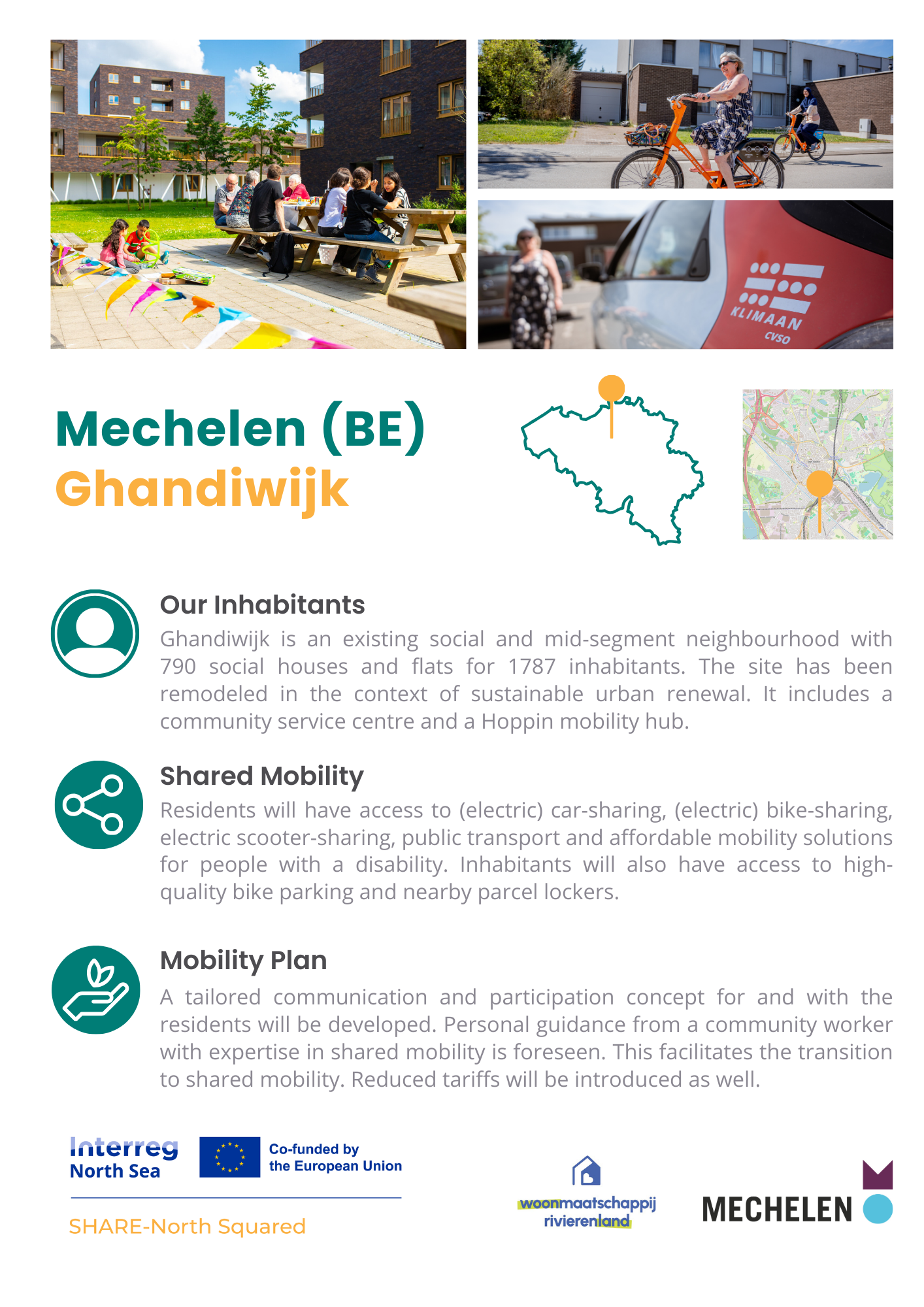
The social housing neighbourhood 'Ghandiwijk' in Mechelen offers both public transport and shared mobility to its residents.
Given that shared mobility is an add-on, do you believe that integrating these offers directly into housing developments can truly change resident behaviour?
I do. When you are planning a building, you encounter several challenges. Some of them are of a technical nature, such as implementing charging stations if you want to offer a shared e-car in a building. This can be mitigated through engineering. The location of the vehicle is another challenge. This is where architects come in.
To have enough users, the car is sometimes placed outside the building on the public domain. That often has the consequence that the vehicle is no longer used by the people living inside. In other cases, the car is installed in an underground garage, but that is not good for visibility and may lead to upsetting building residents as 'strangers' may enter their private car park. Thus, architects can focus on designing the project in such a way that the shared mobility offer is placed in a highly visible location, beyond the car park but not on the street, and ensure that the shared vehicle is sufficiently visible.
From a behavioural point of view, change does not seem to come from the mobility service alone, but rather from the way it is embedded in everyday residential routines and spatial design. None of this guarantees success, but it can certainly act as one component of a more sustainable lifestyle. If cities and the various actors involved are careful about how and where these systems are implemented, they may be able to take root, mature, and eventually be replicated.
From a behavioural point of view, change does not seem to come from the mobility service alone, but rather from the way it is embedded in everyday residential routines and spatial design.
Architects can solve these design challenges. But are project developers open to integrating shared mobility in their projects, considering their core business is selling units?
I believe that a developer's priority goal is to make an advantageous return on investment for their project. Therefore, they must follow market trends. If a behavioural trend begins among their target group, the project developer will adapt to that. So, if there is increased demand for shared mobility offers in real estate, the developer will adapt to this demand. This is why projects like SN² are so important: they showcase that different lifestyles are possible.
If there is increased demand for shared mobility offers in real estate, the developer will adapt to this demand.
For example, I work quite a lot with developers in Panama. About ten years ago, it was my impression that there was very little, if any, awareness among developers of pedestrian accessibility around their projects. More recently, by contrast, as the public has become more aware of how much difference a well-located, walkable setting can make, developers would likely have a much harder time finding buyers for projects where people cannot easily move around.
Construction cost is an important part of the discussion as well. You may end up needing around 28m² of space per car park unit: not just the parking space itself, but also the roads leading to it. That is a substantial cost which many developers would like to eliminate. Moreover, due to lower construction costs, housing will become more affordable. Although the price savings might not trickle down to consumers since these prices are usually set by market prices and not the amount of m² built, what can happen is that at the very least there could be more units available per project. However, when you transpose this onto non-profit actors in residential development the results could even be more substantial.
I can imagine that this also changes the way in which architects design future buildings?
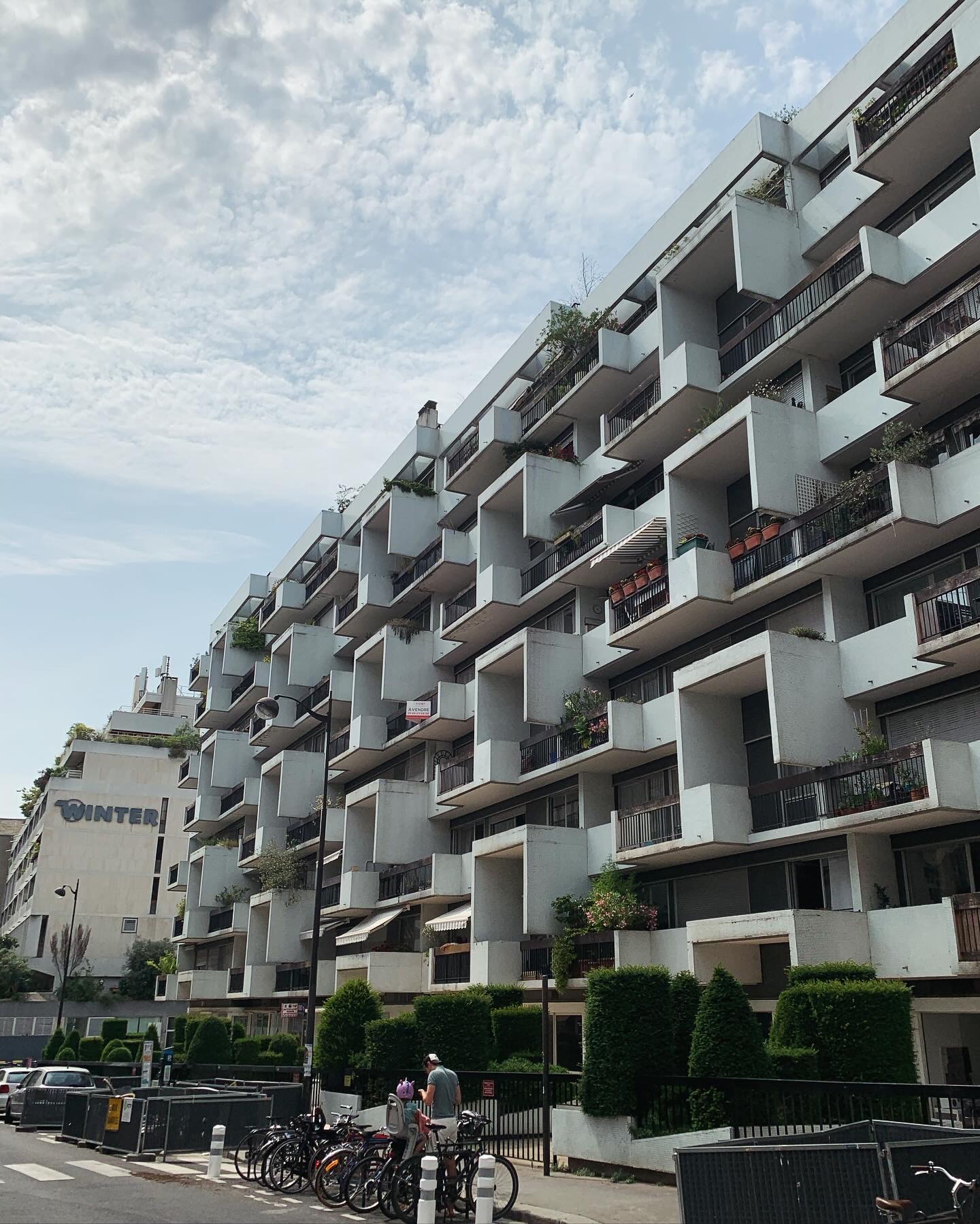
The building in Paris Rue Saint-Ambroise 33-35, Paris, designed by Architect Roger Angers (1969) is, according to Rafael Fernandez, a nice example of what an apartment block can look like: balconies, greenery, life, instead of large void parking lot structures (picture by Rafael Fernandez).
Indeed. When you design a building, you are not just designing the structure, but also the parking infrastructure. You need to integrate the entrance to the underground basement into your design, and sometimes you need parking spots next to the building as well. As an architect, you want to come up with the best possible design and make it fit into the urban landscape. The fewer parking spots, motorisation, entrances to car parks, and roads you must deal with, the better.
In the end, what I want to see when looking at a building are people, balconies, and greenery. I think this makes a better addition to our cities than having to look at dead concrete parking lot structures and moving pieces of metal. Moreover, given the housing crisis in Europe, one could argue that every square metre counts: the less surface area we must devote to parking and roads, the more we can use for housing units.
What I want to see when looking at a building are people, balconies, and greenery. I think this makes a better addition to our cities than having to look at dead concrete parking lot structures.
To conclude, how can we convince cities to adopt innovative parking bylaws and rethink their policies?
Convincing cities to rethink parking policies and the place of the car in our towns is a worldwide challenge. However, I think there are several strategies that can be effective across different contexts. First, visualisation tools can be very powerful in helping decision-makers and residents imagine what a city could look like with less parking pressure, particularly through before-and-after scenarios that show how existing public space might be reallocated.
Second, it is important to emphasize the very tangible safety risks associated with cars, such as collisions and casualties. These statistics are often underestimated or overlooked, even though they are a major concern for anyone involved in public policy. As cars become larger and occupy more space, stressing the need to reduce the overall number of vehicles becomes increasingly relevant. As a general principle, fewer cars tend to be associated with fewer accidents.
Finally, I think it is crucial to work with local ambassadors who can demonstrate how shared mobility works in practice, especially at a micro scale, such as within neighbourhoods or residential buildings. From my research, behavioural acceptance often seems to depend less on abstract policy goals and more on everyday social proof and lived experience. Ambassadors can therefore play a key role in engaging more sceptical audiences, particularly when it comes to reducing car ownership and parking supply. In that sense, shared mobility can act as a transitional tool, helping cities and residents experiment with reduced car dependence without forcing an abrupt break from existing habits.
Thank you for sharing your insights, Rafael. And keep up the work because every square metre counts!
Interview by Jelten Baguet (Mpact)
Banner picture taken by Jelten Baguet: the 'Mountain Dwellings' in Copenhagen, a former parking lot converted into flats.