

Humans are creatures of habit, also when it comes to the way we get from A to B. But there is a way to change our deeply-rooted behaviour: by communicating about mobility alternatives during life-changing moments. Let us explore how the City of Bremen fosters behavioural change by communicating about mobility concepts in real estate developments!
Humans and their habits
If David Attenborough had to describe us, humans, as a species, his narrative could sound like this: “Have you heard of this species called ‘humans’? They truly are creatures of habit: they wake up at 06:30, leave for work one hour later, have their first meeting at around 9, grab a sandwich around noon, commute back home by five-ish, cook, watch some television, and then it is off to bed because the next day... they start it all over again!”
For us humans, change is very difficult and often requires a great deal of effort. Once a certain behavioural pattern has been established, we tend to stick to it. Whether it is about food, daily routines, clothing, or mobility, we reproduce our long-established habits. It is said that 95% of our daily decisions are made by the ‘unconscious brain’, and only 5% of our behaviours and choices are truly rational and conscious. So, if we are used to taking the car every day, this behaviour will continue until we reach a life-changing moment, when external circumstances shift just enough to make us consciously reconsider our routines. Examples are starting a new job, having a child, or moving into a new house.
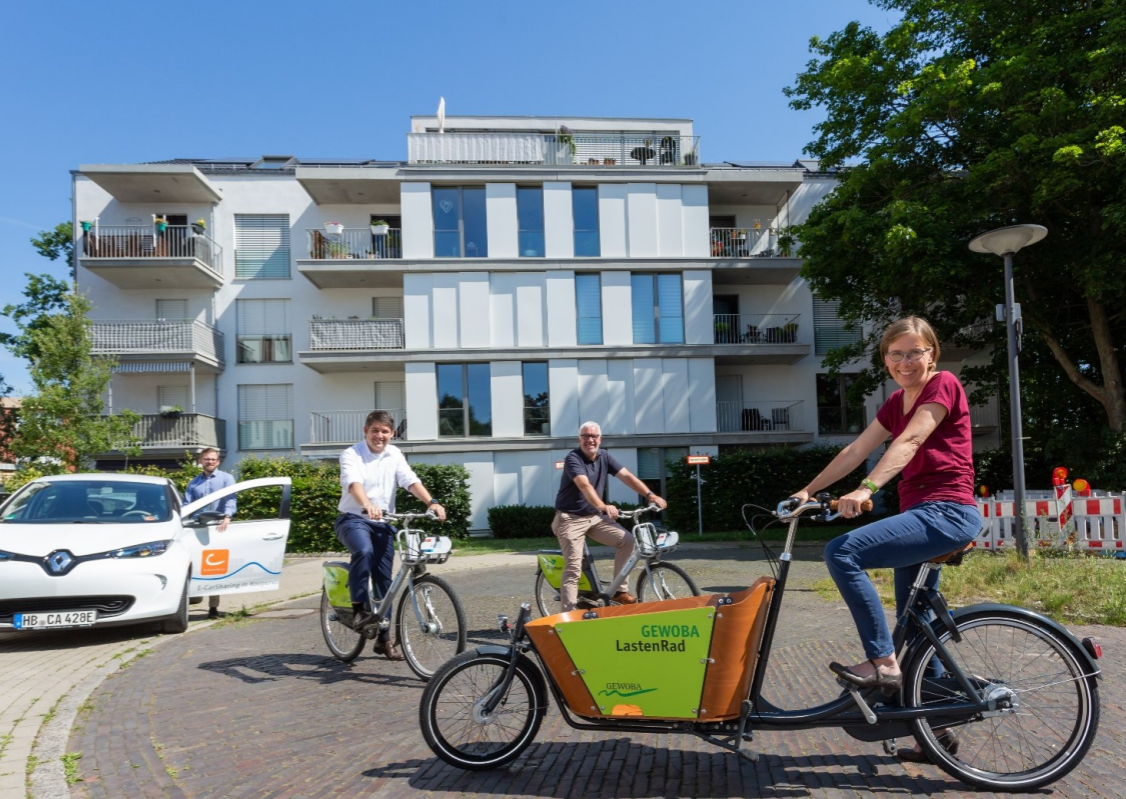
Some of the shared mobility offers in the City of Bremen (picture: GEWOBA).
Changing human behaviour
The City of Bremen has understood that you can change human behaviour when you create the right circumstances and communicate about them at the right time. To foster a shift from travel by private car to shared and sustainable mobility, Bremen issued an innovative parking bylaw – the MobBauOG – which stipulates that a certain number of parking spaces must be converted into mobility budgets supported by a mobility-management concept. This ensures that all mobility needs of a building’s users can be met. And because people can only use what they know, developers are also required to create a coherent communication concept that explains these mobility offers—not only what is available and how, but also when users need this information most.
It is essential to communicate about the communication concepts, both towards the real estate developers who have to implement these concepts, and towards future residents who will make use of the offer. This makes sense: few people even know what mobility-management concepts are, let alone have already benefited from or used them. Therefore, the City of Bremen organised a course series on ‘Mobility Management according to the MobBauOG’. On the 19th of November 2025, they delivered a course on ‘Communication Concepts’. These courses are given at the Chamber of Architects and Planners in Bremen.
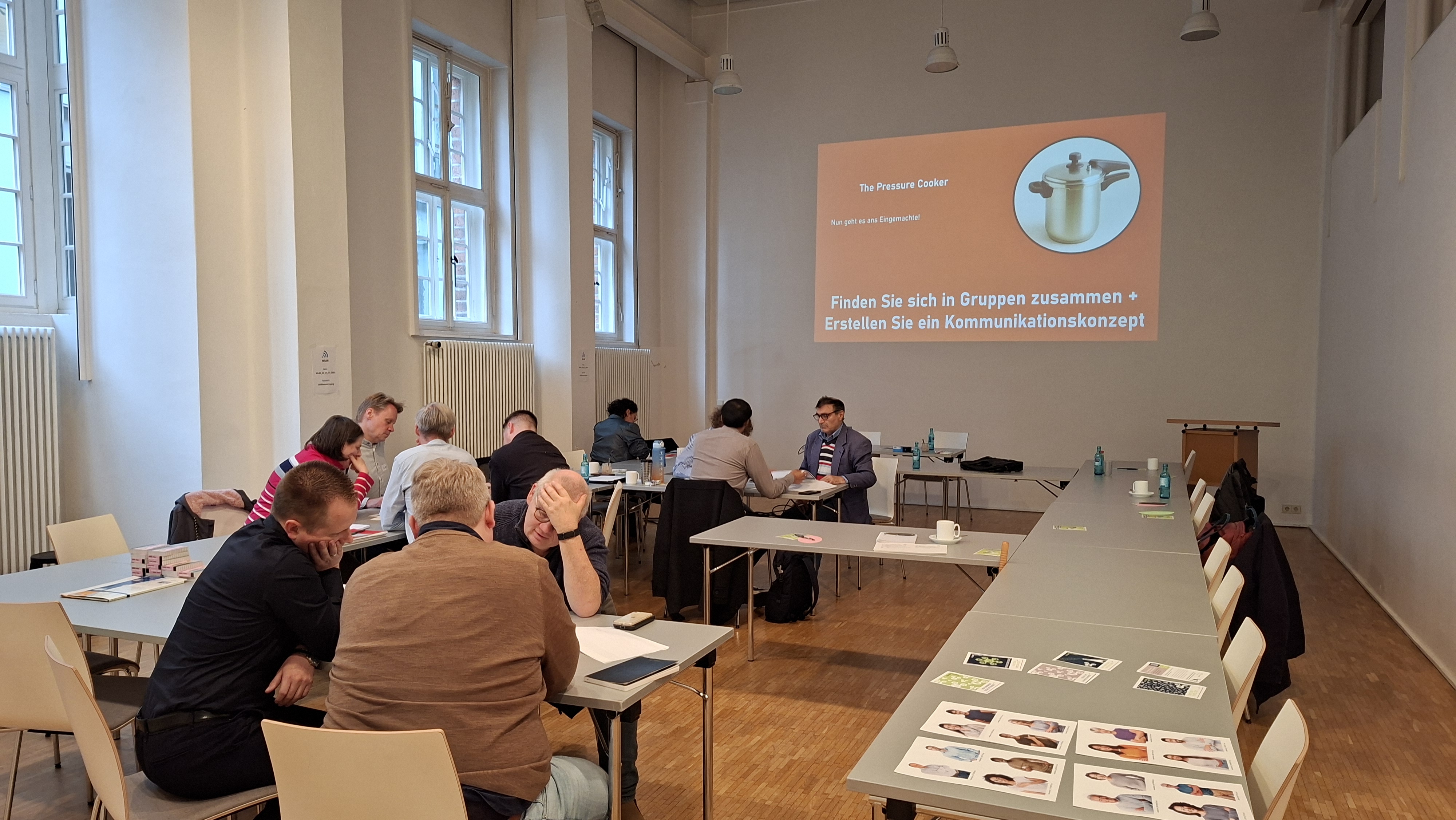
The communication seminar focused on interaction and learning by doing. Here, the participants are designing a communication concept.
Communication Matters!
Led by Cornelia Cordes and Rebecca Karbaumer, the seminar focused on a central question:
“How can mobility concepts in real estate developments be communicated in a way that resonates with different target groups?"
Why is it so difficult to reach people, and why is the moment of moving into a new home or starting a new job exactly the right time to provide information about mobility options? To answer these questions, the speakers drew on cutting-edge behavioural-change science.
Participants walked away with several key insights:
Firstly, human behaviour is dominated by unconscious processes, which can only be influenced effectively through nudging.
Secondly, new rational choices and new habits are most likely to emerge during life-changing moments.
And thirdly, communication about mobility options in real-estate developments must be timely and aligned with the critical phases one goes through when moving into a new house:
- Orientation phase: where do I/we want to live?
- Decision-making phase: I buy/rent the place!
- Receiving the keys: Yes, it is getting real now!
- Moving in / changing office: time to settle :-)
- Trying out new mobility habits: this shared bike looks nice. Should I try it?
- Consolidation of new habits: this shared bike really is nice... and handy! I use it on a weekly basis now.
In other words: if we want communication to truly influence people’s behaviour, we must first understand how the creature of habit works and align our communication campaigns to it!
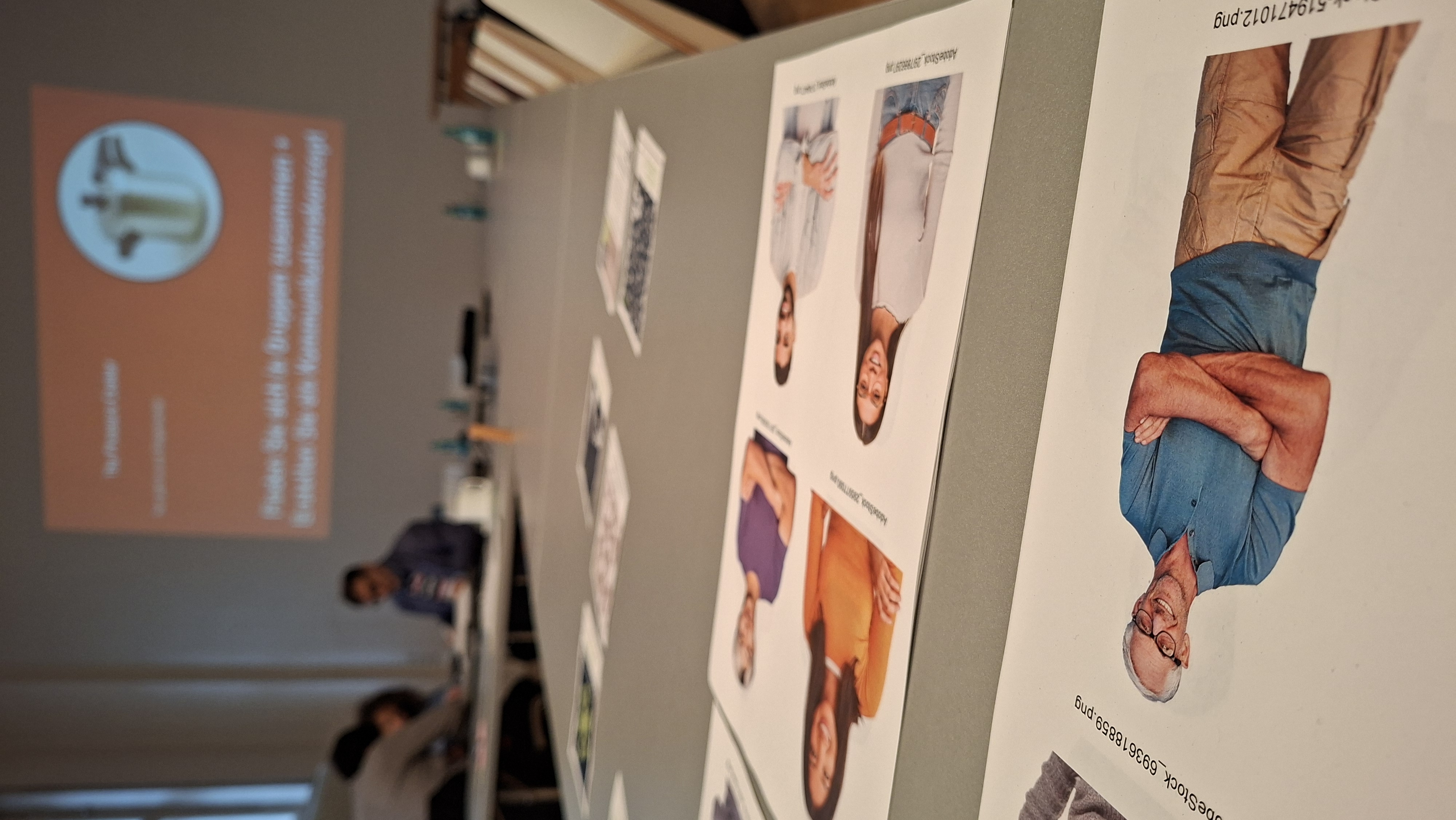
Communication should be tailored to your target group. Working with persona’s is therefore extremely important when designing a communication concept.
It would take at least a few Ph.D.s to explain how behavioural change works. So let us list a few examples of what we do in Bremen to mainstream shared mobility:
- The City provides adaptable templates to inform the (future) users about the shared mobility offer.
- The City also provides postcards that can be sent to residents in neighbourhoods with a new shared mobility offer.
- Cambio Car Sharing organises practical ‘How-To’ sessions for (future) users that want to drive electrically.
- The GEWOBA (social housing provider in Bremen) organises cycling courses for Bremen.
- The GEWOBA and the City of Bremen organise testing events where you can try shared (cargo) bikes and cars.
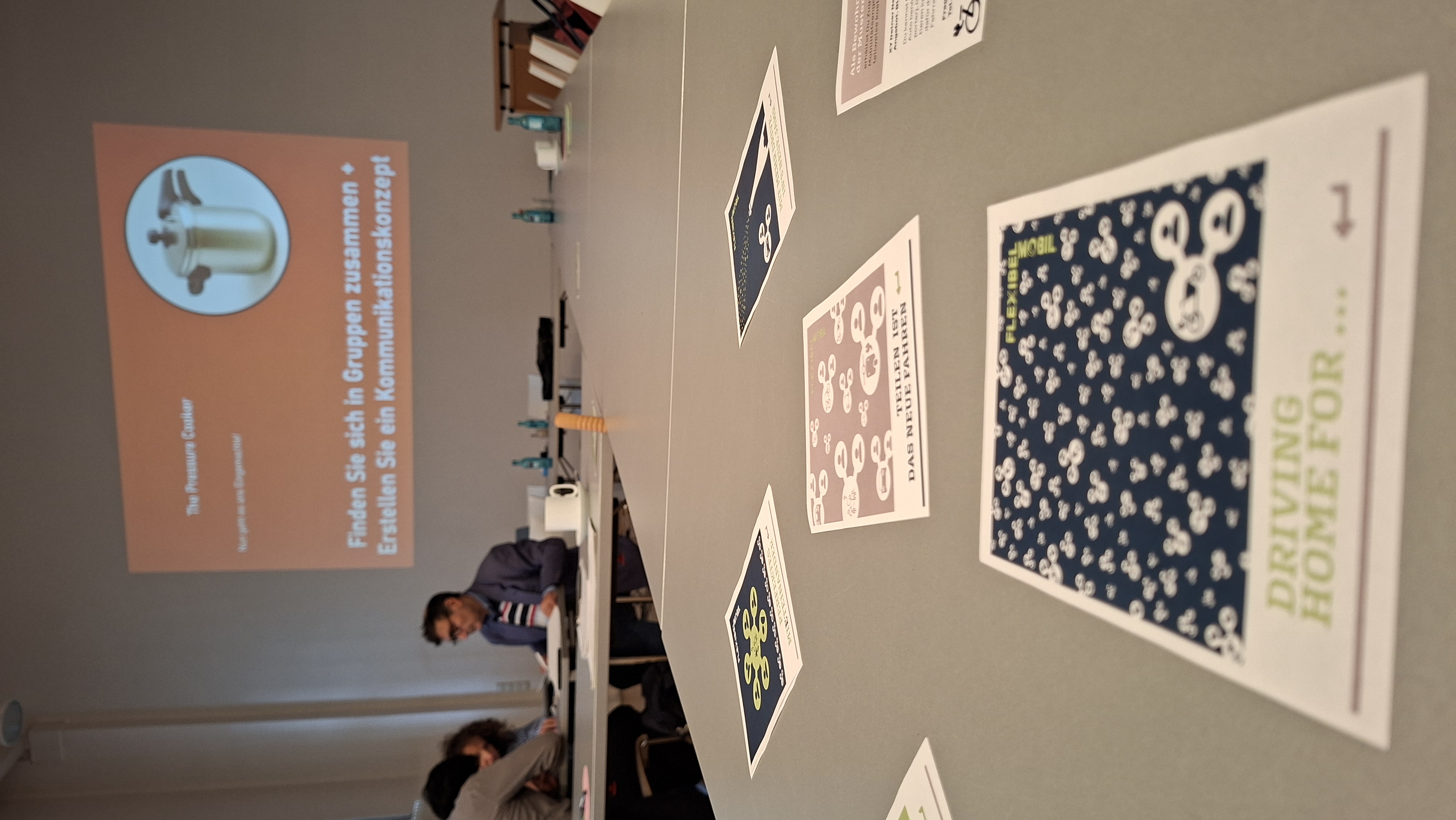
Some of the communication materials provided by the City of Bremen!
How can we help you?
Are you a real-estate developer or housing company? Do you want to communicate your mobility offer to your residents?
Then we have the solution for you: Adaptable templates to communicate your mobility offer!
You can order them by a simple email to share-north@umwelt.bremen.de!
Credits
Text by Cornelia Cordes (City of Bremen)
Edited by Jelten Baguet (Mpact)
Pictures by Cornelia Cordes unless stated differently.