

The 2025 Eurobarometer reveals that housing affordability remains a primary concern for Europeans. At SN², we share this concern and actively strive to make housing more affordable by reducing the necessity of car ownership. We delivered this message at the Decarbonisation Summit in Brussels on 3 December 2025, which our partner, Housing Europe, organised.
Jelten Baguet from Mpact (also an SN² partner) moderated our session regarding reduced parking for affordable housing. This session successfully brought experts from the mobility and housing sectors together in the same room.
In this longread, we highlight our speakers and their core messages. We also explore the findings from our round table discussion, which featured our SN² dice.
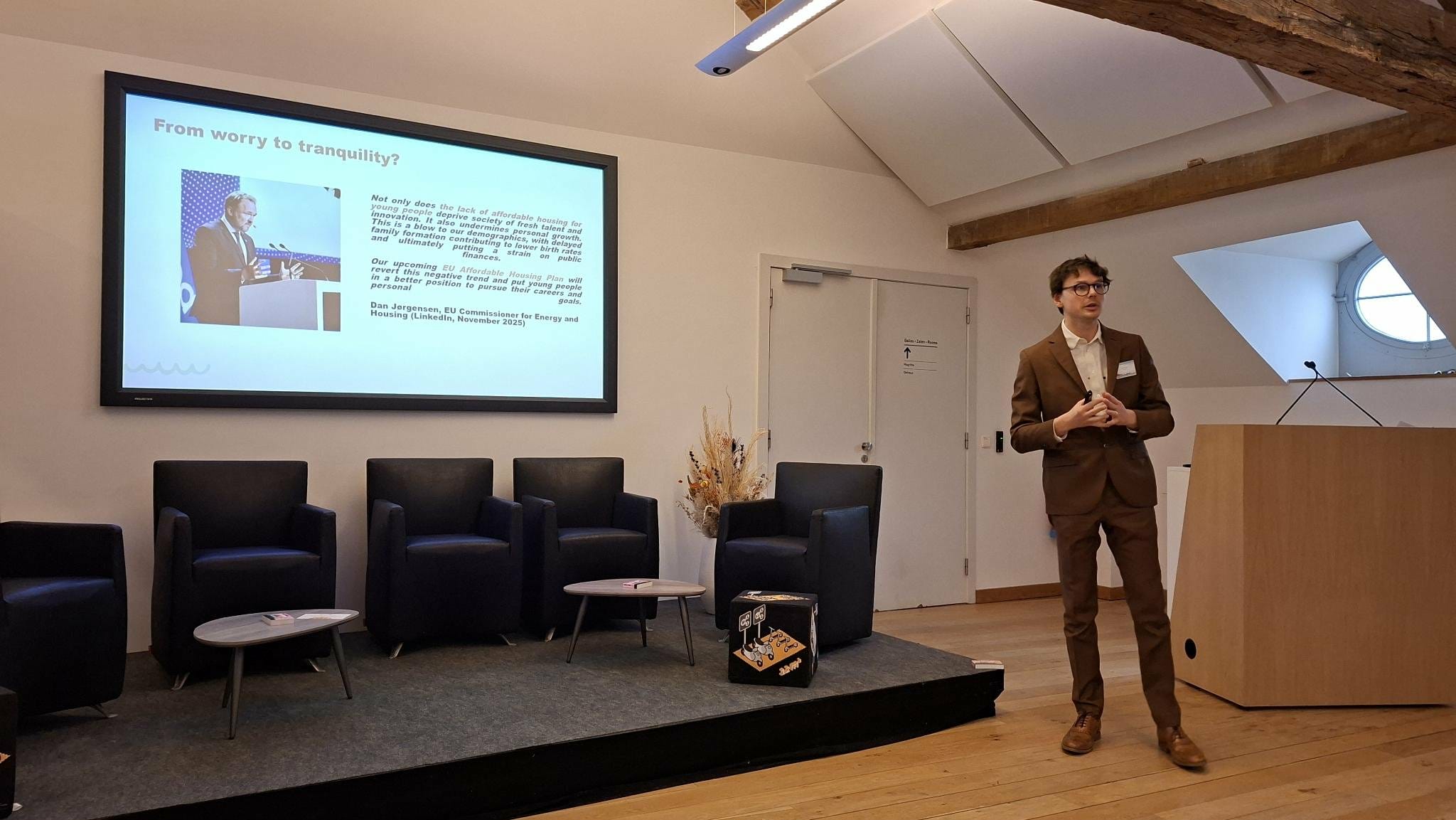
Jelten Baguet (Mpact) introducing the topic.
The Core Messages
An ecological and inclusive transition – Constantin Heitzer, DG CLIMA
Constantin Heitzer started the session by introducing the Social Climate Fund (SCF): an €86.7 billion instrument to cushion the social impacts of the new ETS2 system, which prices emissions from buildings and road transport. Energy-poor households, transport-poor populations, and micro-enterprises are the fund’s core target.
Member States with higher levels of energy and transport poverty receive higher sums from the fund. This results in proportionally larger envelopes for countries in Eastern and Southern Europe.
The SCF is not a ‘blank cheque’: Member States must submit plans in which they detail how investments with money from the SCF will be used to cushion the effects of ETS2 for the most vulnerable groups in society. He detailed that most Member States favour renovation investments (family houses, multi-apartment buildings, social housing); others are exploring zero- & low-emission mobility and transport, including public transport vouchers or on-demand transport. A smaller number plan direct income support, reflecting concerns about its temporary nature. He encouraged stakeholders to engage in consultations - still upcoming in several countries - to ensure mobility and housing needs are properly integrated.
Berlin's hidden parking infrastructure – Alexander Czeh, Buro Happold
Alexander Czeh presented his research that quantifies the off-street land consumption of car infrastructure in Berlin. He finds that 22 km² of car-related land (car dealerships, private garages, rooftop parking, petrol stations, and surface lots) are hidden across the city. This area exceeds the size of an entire Berlin district home to 290,000 people! Strikingly, only 5% of this land is officially classified as ‘traffic infrastructure’.
Through his research, Alexander found that repurposing this surplus car infrastructure could enable the construction of 107,000 new homes, enough for more than 193,000 people, without adding a single square metre of concrete! His conclusion: the mobility transition is itself a housing strategy. Reducing car dependency does not simply free space: it unlocks centrally located, utility-connected land at a time when cities claim to have “no space left” for affordable housing.
May the SUMP be with you – Ivo Cré, POLIS Network
Ivo Cré reframed parking as an essential but overlooked driver of unsustainable mobility and unaffordable housing. For the POLIS Policy Director, parking minimums lock cities into car dependency, even though (work) travel distances can be covered without cars when decent cycling or public transport is provided. Parking also consumes substantial budgets: underground spaces can cost €25,000–€50,000 each, often ending up as storage rather than parking, representing a poor use of public funds.
Sustainable Urban Mobility Plans (SUMPs) are crucial to mitigate the parking problem: they encourage mixed-use of (existing) infrastructure, 15-minute city principles, neighbourhood mobility hubs, pooled parking facilities, and park-sharing models. For housing providers, SUMPs create the governance structure necessary to align mobility innovations with long-term neighbourhood planning.
The BMW: “The Bremen Model Wins” – Cornelia Cordes, City of Bremen
Cornelia Cordes presented Bremen’s pioneering MobilitätsBauOrdnungsGesetz, a mobility-oriented building regulation that shifts focus from mandatory parking supply to mandatory mobility management. Instead of requiring developers to build a fixed number of parking spaces, Bremen allows 25–75% of those spaces to be replaced with car-sharing stations, memberships, or credits; high-quality bicycle parking; public transport passes; or other sustainable transport measures. Crucially, developers must also provide a communication strategy, ensuring residents understand and adopt new mobility options.
Early evaluations show strong results: in buildings with mobility concepts, car-free households doubled, rising from 16% to 34%.
Cornelia illustrated this with the Q45 redevelopment by GEWOBA, a public housing project implementing the pioneering MobilitätsBauOrdnungsGesetz in close collaboration with the city. Here, removing 96 planned parking spaces freed resources for 10 years of shared mobility services, substantial bike infrastructure, and a long-term behavioural shift. The model demonstrates that reducing parking does not diminish quality of life but improves it by providing services that people use.
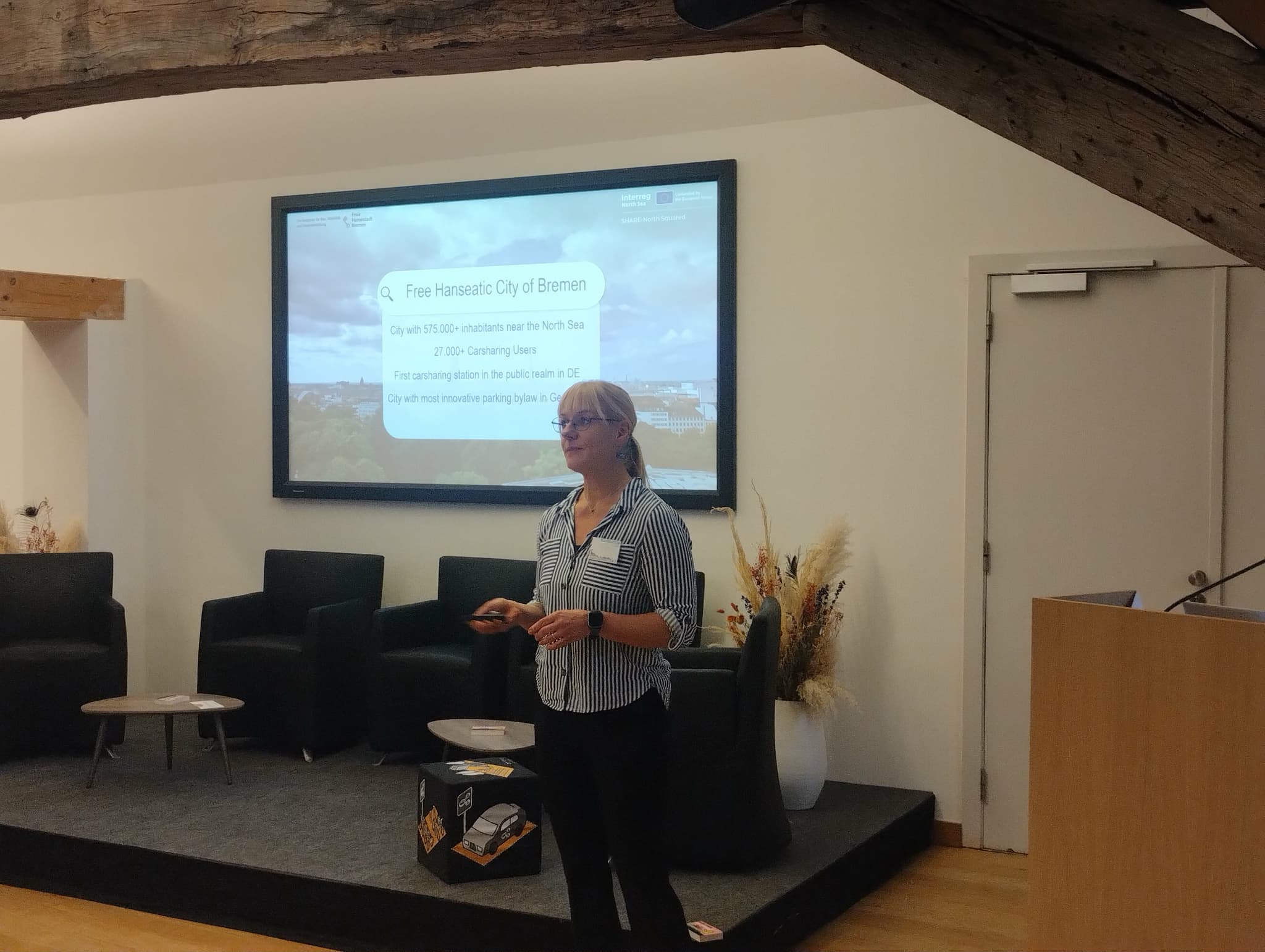
Cornelia Cordes, City of Bremen.
The reality check – Gert Eyckmans, Initia (Flemish Social Housing Federation)
Gert Eyckmans concluded the series of presentations by embedding the ‘shared mobility and social housing’ question into the everyday realities of social housing. He stressed that many social housing neighbourhoods are located on cheaper, peripheral land, far from essential services and well-connected mobility networks. By consequence, even when rent is affordable, transport costs and mobility poverty remain high.
And that is not the only challenge social housing developers face: excessively high parking norms despite actual ownership being around 0.5 cars per household in social housing; risk perception for operators, who find social housing areas to be economically uncertain; or digital barriers, hindering access to transport modes that require a certain level of familiarity and trust in smartphone technology.
Despite these challenges, Gert still believes that shared mobility should be integrated into social housing because: it reduces costs for providers and tenants, frees land for green space, and diversifies the mobility offer.
Takeaways from the Dice Discussion
The session concluded with an unconventional roundtable – without a table, but with the SHARE-North Squared Dice. Based on the throw of the dice, we discussed a different aspect of the mobility–housing nexus. This approach led to a dynamic and highly participatory discussion and resulted in the following insights:
Avoid a one-size-fits-all approach. The success of shared mobility depends on the context. The offer must therefore match the local geography, density, and service ecosystem. Or, as one participant put it: “Shared mobility cannot compensate for the lack of a bus line, nor for 3 km to the nearest grocery store.”
Behavioural change takes time, trust, and daily convenience. Residents need repeated, positive experiences to adopt shared mobility; if services disappear too early, they may revert to car dependency. Long-term presence of the shared offer matters. For some developments, a 10 to 15-year horizon might be necessary.
Preventing spillover parking is essential to avoid unintended consequences. If a development reduces on-site parking but the surrounding streets remain free or very cheap to park in, residents will simply move their cars to the public realm. Therefore, parking reform must be coordinated citywide, not only at the building level.
Equity, inclusion, and digital literacy cannot be afterthoughts. Shared mobility often assumes having a credit card, a smartphone, and basic digital skills. These are not guaranteed in many social housing contexts. It is therefore key to provide specific target-group measures, like non-digital booking options or hands-on training.
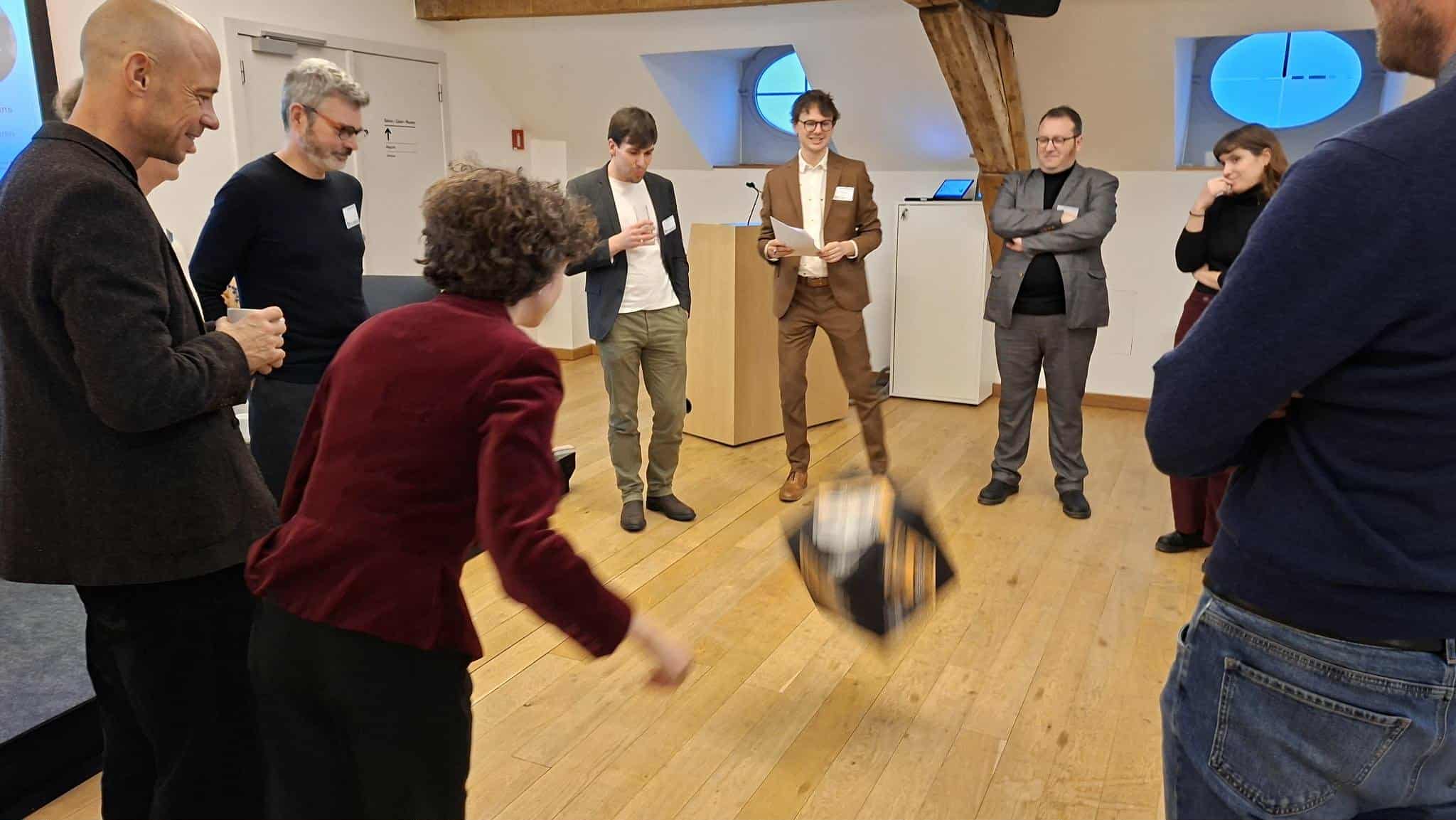
Let the dice roll!
Financial risk-sharing is crucial for deploying shared mobility in underserved areas. Shared mobility operators are often hesitant to become active in low-income areas because they fear economic viability risks. Public–private agreements, in which housing companies or municipalities guarantee a minimum revenue per vehicle, could be a solution.
Social housing residents must be co-creators, not passive recipients. When shared mobility simply replaces parking without consultation, residents may perceive it as “taking something away from people who already have little.” Active listening, co-design workshops, and pilot programmes allowing residents to test services mitigate this risk.
Aligning mobility and housing planning is not optional. It is urgent. Parking norms, local transport planning, land-use decisions, and housing development are still too often handled in silos. Affordable housing and sustainable mobility are mutually dependent, and reforms in one domain require coordinated reforms in the other.
Shared mobility alone cannot fix structural poverty, but it can reduce its symptoms. Cheaper rent means little if residents spend €300 a month on fuel. While shared mobility cannot solve the underlying inequalities, it can lower the financial burden of car ownership and expand access to work and social opportunities.
What’s next?
The transition to sustainable housing is inseparable from a radical rethink of urban parking. By repurposing car-related infrastructure and replacing rigid parking mandates with flexible mobility management, cities can unlock vast areas for affordable homes and green spaces. Integrating these shared mobility solutions ensures that housing remains truly affordable by reducing the long-term financial burden of car ownership for all residents.
Are you ready to implement these insights in your own development projects? Visit our Resources Page to access practical toolkits, policy templates, and technical guidance designed to help you integrate shared mobility and optimise land use effectively.
Credits
Text by Jelten Baguet (Mpact) and Clara Mafé (Housing Europe).
Pictures by Jelten Baguet (Mpact) and Cornelia Cordes (City of Bremen). Banner picture provided by Housing Europe.