

At the invitation of MEP Marcos Ros Sempere, mobility experts, policymakers, and housing providers gathered at the European Parliament for the "Beyond the Doorstep" symposium organised by Housing Europe, a SHARE-North Squared project partner.
Our message was clear: solving the European housing crisis is impossible without fundamentally rethinking our mobility patterns and behaviour.
A Unified Policy Agenda
MEP Marcos Ros Sempere opened the session with a call for systemic integration. He argued that mobility and housing are no longer separate silos but are deeply interconnected within urban design. "If we want to design cities for people and not cars, we must acknowledge that mobility and housing are not separate topics but are intertwined and connected to urban mobility", Sempere stated. He highlighted a significant shift in Spain, where new legislation mandates two bike spaces per home - a direct challenge to traditional regional laws that often prioritise two car parking spaces.
Sorcha Edwards (Housing Europe) reinforced this message by emphasising the need for ‘systems thinking’. She cited a compelling research metric: every €1 million invested in cycling infrastructure leads to €38 million in health savings. For Edwards, the role of Europe is to show leadership by focusing on the affordability of housing and mobility to make sustainable living the default, not a luxury.
The Space Wars
Researcher Michael Johannsson (Lund University) set the scene by describing the current situation in our cities as ‘Space Wars’. He presented startling figures on the societal cost of parking:
-> One parking space occupies 20–30 m².
-> Each parking space adds 12.5% to 25% to the price of a housing unit.
-> An underground parking spot at a 1:1 ratio costs roughly €40,000 per dwelling. Reducing this to a 0.3 ratio brings the cost down to €12,000.
Johannsson demonstrated that “lower-income residents pay for the overuse of space by wealthier households through inflated rents and house prices" and stated that ‘free’ parking supply is a market distortion that increases solo driving by 60%. For Johannsson, the real question we should ask ourselves is how much potential housing development do we want to sacrifice to parking?
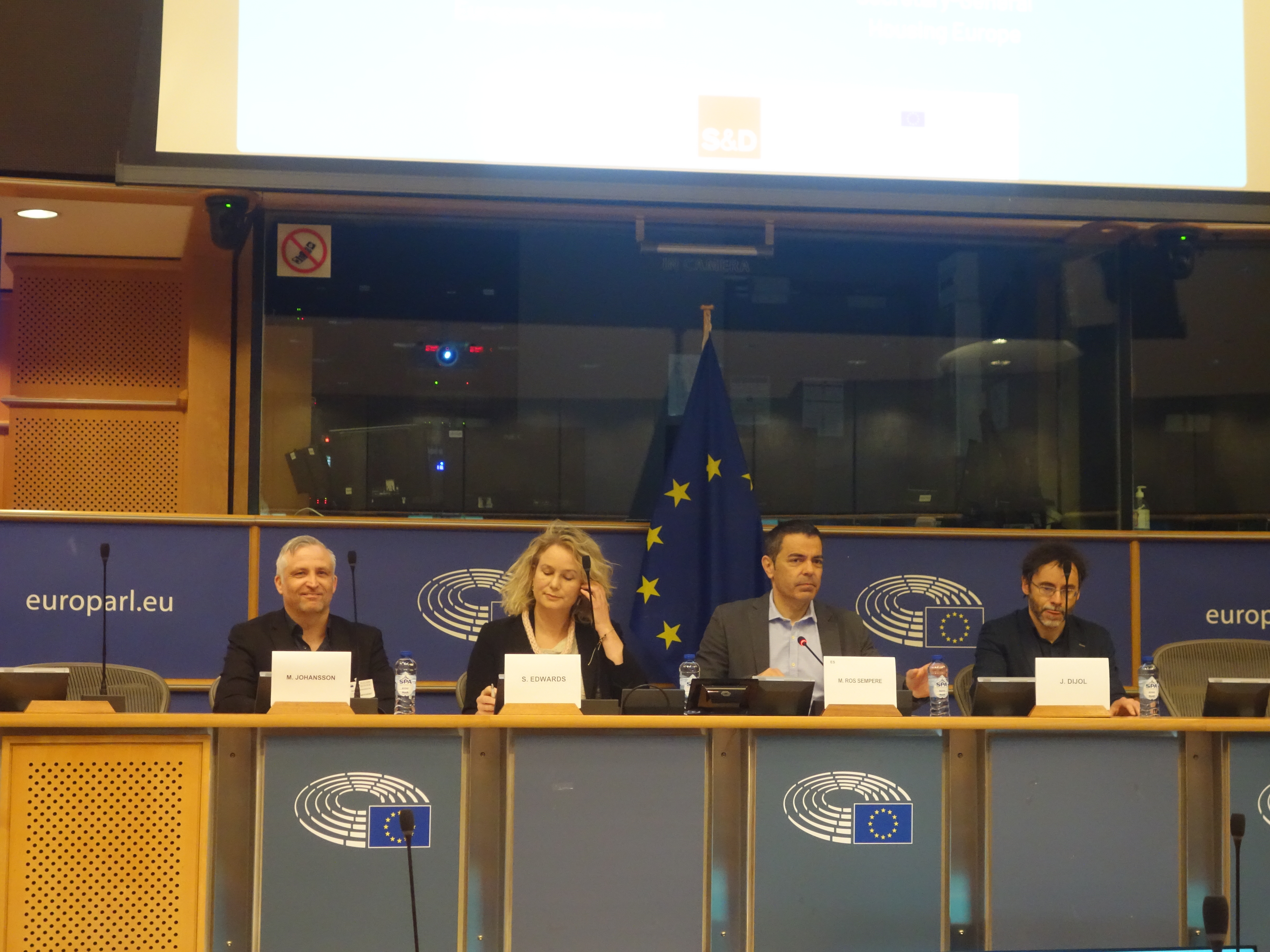
Michael Johansson, Sorcha Edwards, MEP Marcos Ros Sempere, and Julien Dijol from Housing Europe, who skillfully moderated the session.
Innovation in Action
The event moved from theory to practice with deep dives into the cases of Bremen and Mechelen.
Bremen: The Most Innovative Bylaw
Cornelia Cordes (City of Bremen) and Kai Manal (GEWOBA) detailed the Mobilitäts-Bau-Ortsgesetz, arguably the most innovative parking bylaw in Europe. Instead of focusing on how many cars we can fit in a housing project, the law focuses on mandatory mobility management.Concretely, the number of required spaces is calculated and then in part converted into car-sharing stations, public transport subscriptions, a bike sharing offer, high-quality bike infrastructure, etc. Alternatively, developers pay a fee to the city, which reinvests it in local shared mobility hubs.
GEWOBA, Bremen’s social housing company, demonstrated how this works in practice in their new Q45 project. Initially facing a demand for 136 parking spaces at about €50,000 each, they opted for just 30 underground spots. The budget for the non-built parking spots - €441,000 - was channelled into bike sharing, cargo bikes, and a social bike repair café.
The impact of this approach is clear: in residences with a shared mobility offer, car usage dropped by 11%, while bike and public transport usage both rose by 7%!
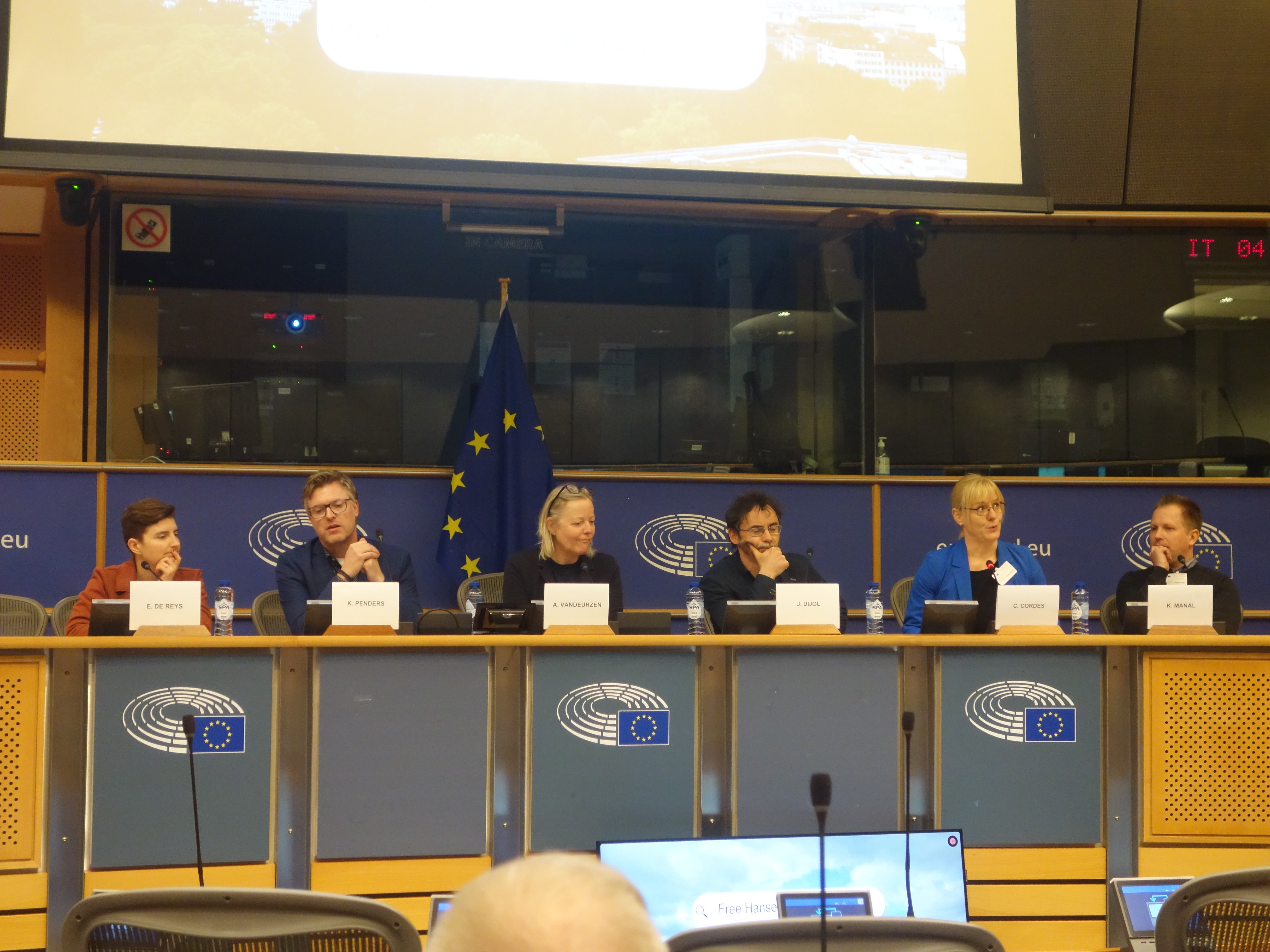
The Mechelen and Bremen teams in action!
Mechelen: Reaching the Vulnerable
Ann Vandeurzen (City of Mechelen), Kristof Penders (Woonland), and Esther De Reys (Way To Go) showed how the city transformed from a car-centric hub to a people-oriented one. Unsurprisingly, Mechelen has one of the most innovative mobility policies in Flanders. For instance, their urban legislation now mandates shared mobility for any development with 12 or more parking spaces.
As a part of the SN² project, the Mechelen partners are working actively to bring shared mobility to low-income neighbourhoods like Gandhi and Oud Oefenplein. This is done in collaboration with Woonland, the local housing provider, and Way To Go, a Belgian NGO promoting shared mobility. The latter provides one-on-one assistance to social housing residents who want to test shared mobility. Through the partnership with the City of Mechelen, financial barriers (like warranties) are waived for social housing residents who want to test a shared mode.
Despite the progress in the field, significant challenges remain in Flanders: social housing organisations can be funded to build houses, but not to install the shared mobility services that are necessary to ensure the connectivity of social housing neighbourhoods, which are often located in the less well-connected urban periphery.
Europe’s View
The second half of the event focused on how these local successes can be scaled through EU policy.
Constantin Heitzer (DG CLIMA) discussed the Social Climate Fund (SCF). The fund is designed to address the regressive effects of carbon pricing by focusing on vulnerable households and transport users. He noted that Member States are currently drafting National Social Climate Plans, which should prioritise energy-efficient housing and zero-emission transport.
Edit Lakatos and Mariangiola Fabbri (DG ENER, Housing Taskforce) introduced the European Affordable Housing Plan. They acknowledged that while the EU has limited competence in housing, it is now one of their most important political topics. The European Union wants to simplify planning, zoning, and permitting rules, prioritising renovation, and support revised car-oriented parking norms. A housing simplification process will be launched next year, and input from SHARE-North Squared and similar projects is warmly welcomed, the EU representatives stated.
The Stakeholders’ View
The session concluded with a panel of diverse voices:
Björn Berggren (Public Housing Sweden) called for a shift from 'parking to parks', noting that roughly 50% of public housing tenants do not own a car, yet subsidise those who do.
Laurianne Krid (European Cyclists Federation) emphasised the need for continuous investments in multimodal transport solutions and stressed the importance of safe and secure bike parking, especially as e-bikes become more valuable.
Ivo Cré (POLIS Network) stressed that 431 cities on the TEN-T (Trans-European Transport Network) must deliver Sustainable Urban Mobility Plans by 2027, providing a massive opportunity for integrating sustainable mobility in housing projects.
Emiliano Rocchetti (International Union of Tenants) reminded the audience that tenants in the outskirts often face the highest mobility costs. "It is about being able to lead a good life. We need to rethink the ecosystem from the tenant’s perspective."
What's next?
Our exchange with representatives of the European Institutions and international stakeholder networks proved that shared mobility is not merely a transport ‘add-on’ but a fundamental pillar of affordable housing.
The SHARE-North Squared project is glad to share its hands-on insights so that they can be translated into policy action on a European level. Together, let us keep on making housing and mobility more affordable and sustainable.
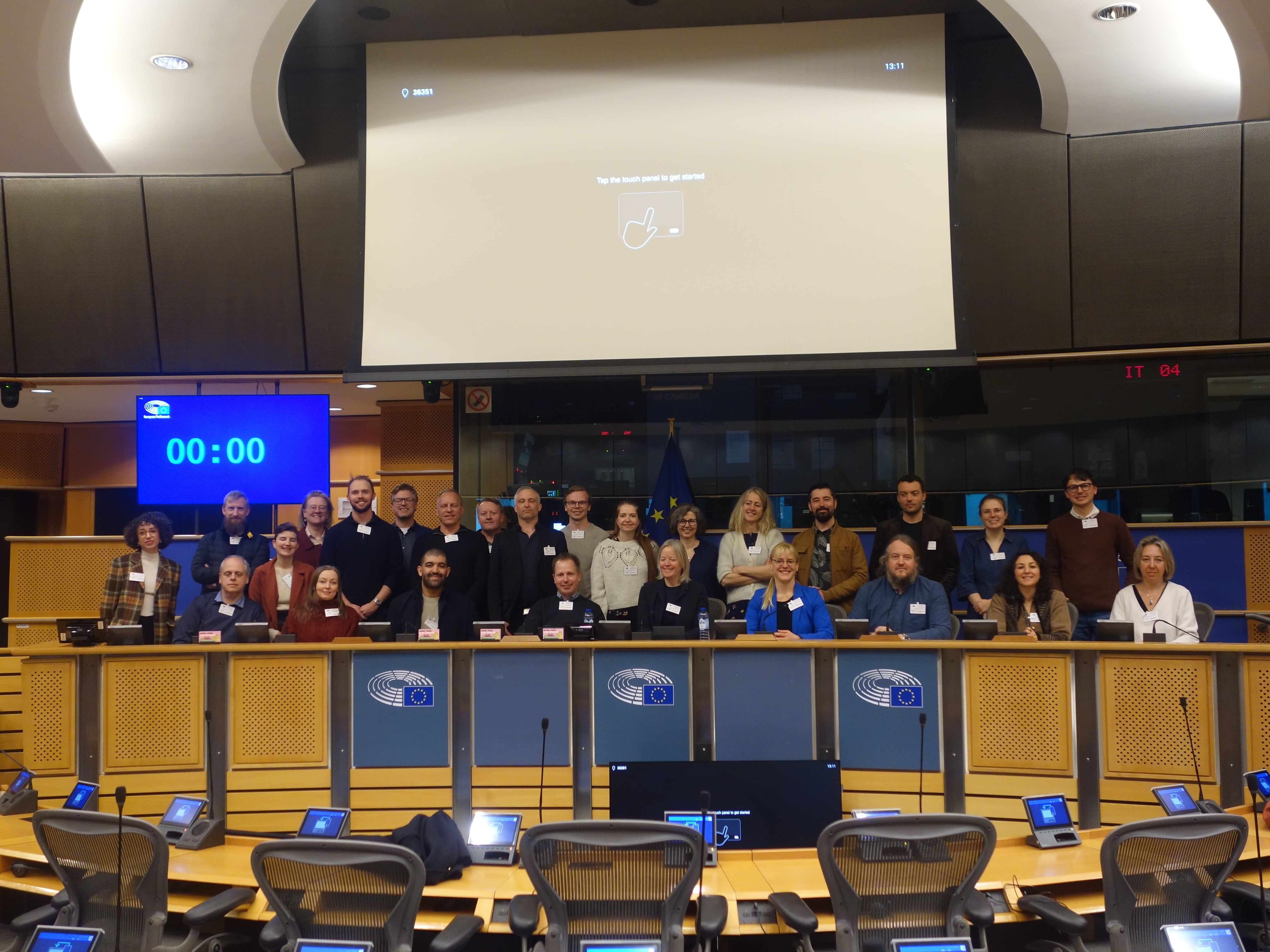
The SN² team at the European Parliament.