

Research is a fundamental part of the SHARE-North Squared project. It allows us to scientifically compare the bylaws in our seven pilot cities and disseminate the learnings to a wider audience. For this, we can rely on two academic partners: Université Gustave Eiffel from France and Lund University from Sweden.
For this interview, we sat down with Alain L’Hostis and Heythem Adjeroud from the Université Gustave Eiffel to learn more about their role in the project.
Welcome, messieurs! Can you briefly introduce yourself?
Alain L'Hostis - I am Alain L’Hostis from the University Gustave Eiffel - UGE in short. We are a French university with headquarters in Marne-la-Vallée near Paris and a campus in Lille, which is relevant for the North Sea Region Programme. The thematic focus of our university is the ‘sustainable city’. I am research director at LVMT – Laboratoire Ville Mobilité Transport(City Mobility Transport Lab) and specialise in urbanism, transport, and the interaction between them.
Heythem Adjeroud - And my name is Heythem Adjeroud. I work as a postdoctoral researcher at UGE. My background is in urban planning and geography: I graduated from an urban planning school and wrote a PhD thesis in transportation studies, focusing on the interaction between urban planning and mobility systems, and especially on the optimisation of collective transportation systems. After defending my thesis, I joined the SHARE-North Squared project as well as the DREAMS project, which focuses on 15-minute city concepts.
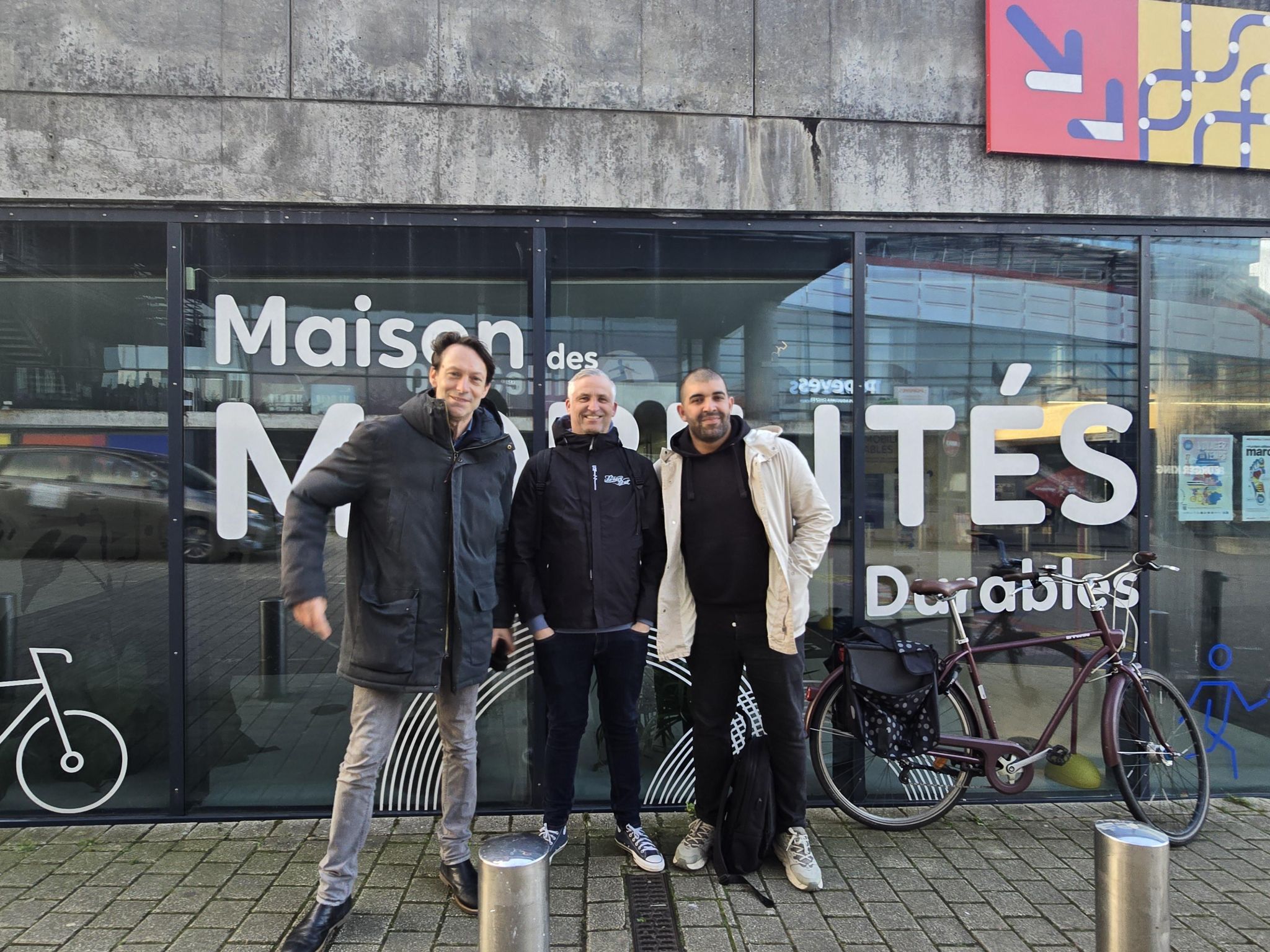
Alain L'Hostis (left) and Heythem Adjeroud (right) from Université Gustave Eiffel, together with Michael Johansson from Lund University.
How did you get involved in SN²?
Alain L'Hostis - UGE gained some European visibility by participating in the Interreg MOBI-MIX project. Because of this, the City of Bremen contacted us to join the developing SN² consortium and asked if we could find a French partner city to have a French living lab.
Unfortunately, despite multiple efforts and meetings, we did not find a local partner. We used to have a good collaboration with the city of Valenciennes, but our contact with them was heavily dependent on one person. As soon as that person left for another job, contact with the city was lost as well. I think this is an issue that many local partnerships are dealing with: collaborations are mostly based on personal networks. These networks are valuable, but also vulnerable because, unfortunately, international collaboration is not always the core business of local authorities.
Heythem Adjeroud - Adding to that, the number of medium-to-larger sized cities is limited. If two or three cities refuse to collaborate, there are not many options left. Also, many cities do not want to be involved in multiple European projects at the same time due to capacity issues, which is complicating matters further. Therefore, as UGE, we decided to rethink our contribution to the project: instead of trying to develop a local northern French living lab, we repositioned ourselves as the research partner for the SN² project, together with Lund University from Sweden.
Université Gustave Eiffel is the research partner for the SHARE-North Squared project, together with Lund University from Sweden.
As the project's research partner, what do you want to achieve?
Heythem Adjeroud - One of the main goals for us is to identify transferable approaches between partners and cities. As a research partner, we have an overview and can see which policies are successful under which conditions. We can identify best practices as well as challenges in each city and put them in a comparative framework. This will inspire cities within and beyond the project to put in place planning policies and governance structures that reduce car dependency.
Alain L'Hostis - SN² is also an interesting project for us because it forces us to think out of the box. In SN², we can link different topics, ‘housing’ and ‘mobility’ to be more precise. A concrete example is cycling: as mobility specialists, we are convinced about the advantages of cycling and think that bike parking or shared bikes should be integrated in every residential development project. Yet, in practice, many people will not make use of this shared infrastructure and keep their own bike at their flat. So, as mobility researchers, the project forces us to think about behavioural change and practicalities like bike parking facilities at their homes and flats as well.
What is your most important contribution to the project?
Heythem Adjeroud - Our most important contribution is developing the comparison framework: it gives an overview of the parking policies in different partner cities. We asked how they tackle things, how financing mechanisms work, what challenges the cities face, which communication concepts they develop, and so on. We bring all insights together per theme, so that the reader gets an insight into the diversity of policy approaches that can be developed.
Alain L'Hostis - To develop the comparison framework, we set up a serious dialogue between us, academics, and the cities. Together with the colleagues from Lund University, we organised in-depth interviews with the partner cities. It is the first time in my career that we had the opportunity to develop such an extensive dialogue with practitioners, which allows us to connect operational issues faced by practitioners to research issues in the academic field. And this is essential in my opinion: our comparative framework as well as our recommendations are based on what is happening in the field, and not just on literature research.
We set up a dialogue between us, academics, and the cities. Our recommendations will be based on what is happening in the field, and not just on literature research.
What are you currently working on?
Heythem Adjeroud - I am currently completing the comparison framework, which we just discussed. More precisely, I am finetuning the thematic comparisons and asking for additional input for some cities. Structuring the information is quite a challenge due to the different levels of advancement in each city, regulatory differences, normative versus more flexible approaches, and so forth.
Alain L'Hostis - We also want to show how cities get things done in practice. For instance, imagine that a city decides to provide car sharing in residential developments, as is the case in Mechelen. From a regulatory perspective, this is doable. Yet, to make this policy measure effective, you will need to explain the new policy to staff as well as residents, organise workshops, and set up collaborations with providers and social housing organisations. In our comparative analysis, we wish to integrate these ‘practicalities’ as well.
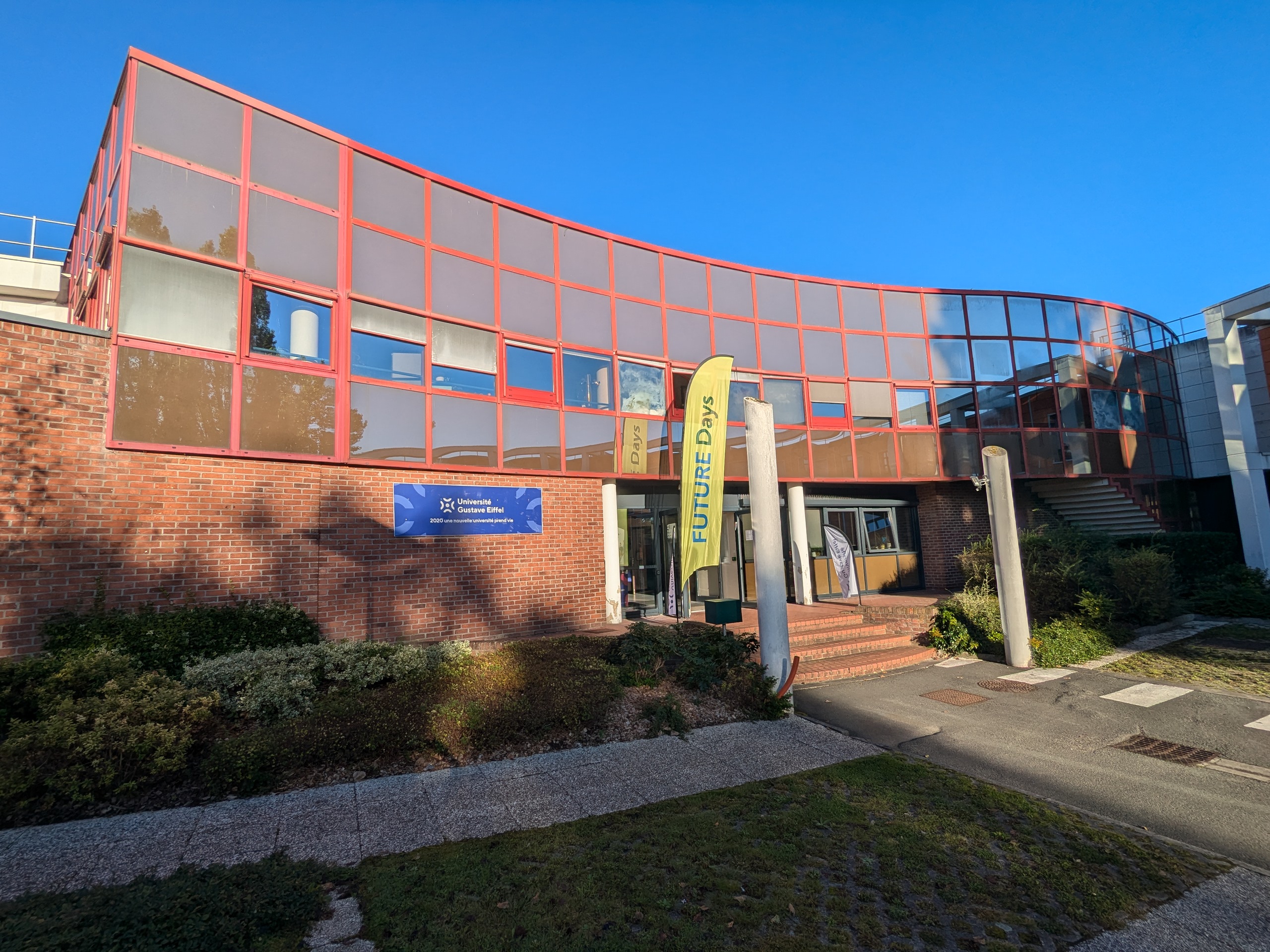
Entrance of the Université Gustave Eiffel.
What are your learnings so far?
Heythem Adjeroud - A key learning is that context is of huge importance: you cannot take the policy from Bremen and implement it in any other city. Every city has its particularities, to which policymakers must adapt. Also, fostering a shift in mobility behaviour is mostly a matter of political courage: technically, we know what to do and which benefits active and shared mobility have. Finally, the project has taught me that collaboration between developers and policymakers is essential: where we have close collaboration between them, we tend to observe fast and satisfactory results.
Fostering a shift in mobility behaviour is mostly a matter of political courage.
And which challenges do you continue to face?
Heythem Adjeroud - In my opinion, one of the main issues is that we are only talking with municipalities, and not with the developers or mobility providers. If we want our conclusions to be effective, we will need to integrate their vision as well, especially because they carry most of the financial burdens and operations risks. So, our main challenge will be to place ourselves in the position of each of the actors in a city so that our recommendations are supported by every actor in the ecosystem and can push things forward in the field.
Merci beaucoup, messieurs. And keep up the good work!
Interview done by Jelten Baguet (Mpact)
Pictures by Université Gustave Eiffel.