

In the Spring 2026 issue of EU Research, our project lead Mike Müller-Petke and project manager Ilke Borowski-Maaser were invited in sharing knowledge about how Europe is redefining water resilience and how our project tackles it
From system understanding to action on the ground
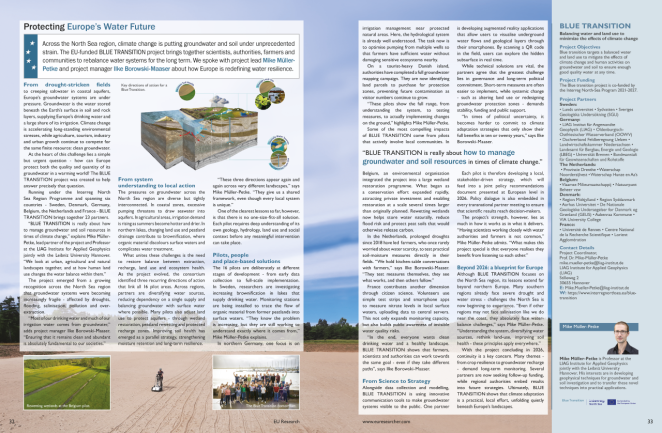
Article summary
Across the North Sea region, climate change is placing unprecedented pressure on groundwater and soil systems. Prolonged droughts, flooding, salinisation and pollution are increasingly affecting the quality and availability of Europe’s most important source of drinking and irrigation water. Within our project we tackle this challenge by bringing together scientists, water authorities, farmers and local communities to develop practical, place‑based solutions.
Alongside fieldwork and modelling, we develop innovative communication tools to make invisible groundwater systems more tangible. One partner is working on augmented‑reality applications that allow users to visualise underground water flows and geological layers using their smartphones.
At the same time, we know that technical solutions alone are not enough. Long‑term groundwater protection depends on governance, political commitment and public support. Each pilot is therefore developing a stakeholder‑driven local strategy, feeding into a joint set of policy recommendations to be presented at European level in 2026.
Although BLUE TRANSITION focuses on the North Sea region, its lessons extend far beyond northern Europe. Many regions already face severe water stress, and the project demonstrates how understanding water systems, diversifying sources, rethinking land use and improving soil health can build resilience under changing climatic conditions. As the project moves towards its conclusion we will embed results into long‑term regional strategies and secure continuity through follow‑up initiatives.
Copyright EU Research - Müller-Petke, M. (2026) ‘Protecting Europe’s Water Future‘, EU Research, Spring 2026 vol. (45), pp. 32 - 33.