

Since the start of the Interreg North Sea Clancy project in 2023, several additional crab traps have been installed in Flanders (Belgium), all based on the first trap design installed in Grobbendonk and it slightly altered design used in Merelbeke. These model traps have proven to be particularly efficient, with high numbers of crabs caught during the migration season right from the start.
Local conditions require local solutions
However, we have since learned that the installation of new traps really requires a customised approach and that local conditions must be taken into account. So simply copying the design of one trap to another location is not an option.
Challenge in Afsnee
The conditions for installing a retour trap in Afsnee seemed ideal: the mouth of the Rosdambeek stream flows into the Leie river via a pumping station, and the concrete stream bed in the lock is extremely suitable for installing a trap. However, the installation did not go smoothly. Lowering the water level and creating proper conditions for installing the trap was the first hurdle because the lock gates were leaking water, requiring a lot of expertise from the contractor to adapt the local conditions in order to be able to install the trap.
After four attempts, the trap was up and running, and crabs were caught almost every day for a few months. Mission accomplished, it seemed. Until the catches unexpectedly stopped completely. Because lowering the water level again was not an option, there was only one way to check the trap: with a diving suit and air tanks on our backs!
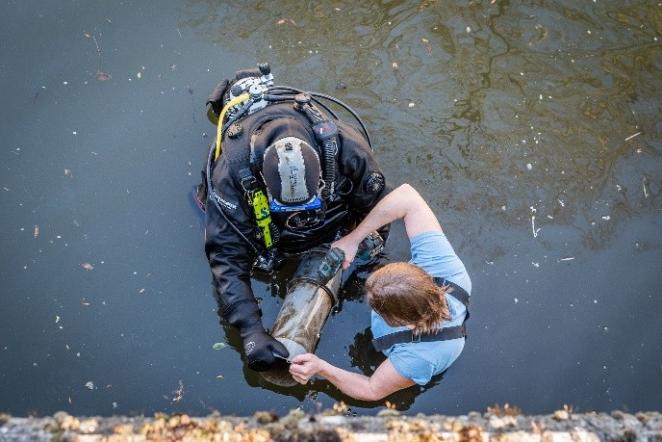
Underwater, the problem was quickly found: the access pipe from the trap to the collection tank was completely clogged with dead crabs. Presumably, the way out to the surface was too difficult for the crabs to climb, so the pipes were modified: the smooth, closed pipes were replaced by ribbed, perforated drainage pipes. In the meantime, the trap itself was also cleaned to remove silt and leaves. Plexiglass plates were installed along the concrete walls to prevent the little climbing champions from bypassing the trap.
No more crabs?
Despite all the adjustments, only very small numbers of crabs were caught in 2025, just a fraction of the previous year's catch. A second scuba dive did not reveal any new problems: the pipes were clear, the trap was clean and the collection tank was accessible, as evidenced by the few crabs that did pass through. Since it was a very dry spring and summer the water velocity was very low and there was hardly any current. After all, the spring and summer of 2024 were exceptionally wet and warm, while the same period in 2025 was also warm but very dry (source: meteovista.be).
The flow matters
The Rosdambeekvalley is fed by seepage water with little flow, and with little additional inflow of rainwater, there may have been insufficient lure flow for the crabs to choose that direction. The lack of sufficient flow also seems to discourage crabs elsewhere.
In the spring of 2025, two temporary traps were placed on tributaries of the Scheldt, one downstream (Schellebellebeek) and one upstream (Schragenbeek) of the Melsenbeek, where a permanent trap catches up to 11,000 crabs per day during the peak of migration. Although the Schellebellebeek is a small, heavily polluted stream, few crabs were caught there regularly. In the Schragenbeek however, no crabs were found while the water quality is remarkably better.
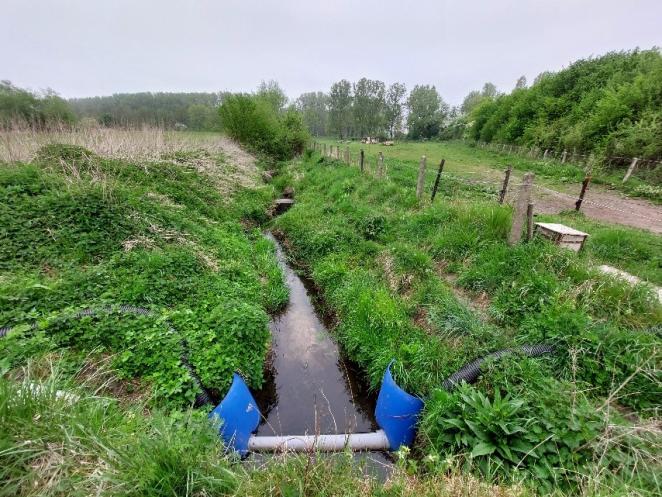
Here too, improvements were made after installation such as shielding the banks and securing the collection tanks from curious passers-by. But still no crabs were caught. Therefore it seems plausible that the flow, or the lack thereof, could be the cause for the low numbers.
Next steps
In order to get more insight in the influence of flow on the migration behaviour of Chinese mitten crabs we suggest to do a lab experiment in cooperation with our partner University of Antwerp to disentangle the role of flow on the migration of crabs to tributaries.