

E.DSO's white paper on city-DSO collaboration
This E.DSO white paper examines the synergies and opportunities for cooperation between Distribution System Operators (DSOs) and cities, advocating the development of joint City-Grid Interfaces as a tool to overcome existing barriers of the energy transition. Local grids are critical for delivering green and affordable energy to households and businesses, yet the current state of European grids risks becoming the number one bottleneck for electrification in the future. Given that 40% of the grid is over 40 years old (European Commission, 2023), increasing electrification can cause significant issues of grid stability and availability as well as congestion.
In this context E.DSO interviewed seven European DSOs which have explored modes of collaboration with local authorities to prevent further disruption of city activities.
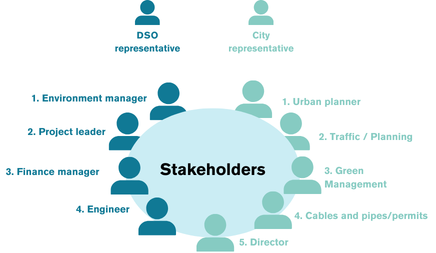
Representation of possible city and DSO stakeholders coordinating
The white paper goes into:
Challenges in advancing city-DSO cooperation
the opportunities for cities and DSOs that more collaboration brings
Innovative examples from all over Europe of how cities and DSOs are re-establising their relationship
The city-grid interface (CGI) as a tool for streamlined collaboration
Policy recommendations for a better establishment of the CGI
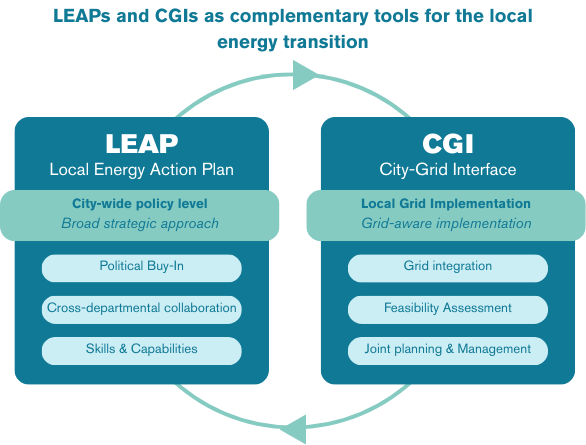
The city-grid interface as a part of LEAPs
The CGI is a core component of local energy action plans (LEAP). LEAPs can be defined as a combination of interrelated strategies from cities to tackle the local energy transition. Within this context, the CGI specifically focuses on the relationship between the LEAP and the grid, providing a structured framework to translate strategic ambitions into grid-aware and implementable actions. Put simply, LEAPs define the local energy transition from a policy perspective, while the CGI translates these policy ambitions into concrete actions that can be implemented within the local grid.