The KielRegion, the Heinrich Böll Stiftung Schleswig-Holstein, the German Aerospace Center (DLR), aconium and the University of Oldenburg work together in a pilot that promotes sustainable forms of mobility such as public transport, cycling, while at the same time making motorised private transport more efficient and environmentally friendly.
This is done with a particular focus on the football stadium. On Holstein Kiel home match days, a special traffic situation regularly arises around the stadium, because up to 15,000 people have the same destination and an above-average proportion of fans (36–51%, according to different surveys) used their cars to travel to the stadium. This led to CO₂ emissions, traffic congestion, considerable parking pressure and overcrowded busses and bike lanes in the stadium area. The challenges underlined the need for targeted planning and traffic management on match days based on reliable and interoperable mobility data. The fan mobility use case shows how data-driven solutions can improve local mobility challenges.
What was the challenge?
The transport sector accounts for a significant proportion of global CO₂ emissions and contributes significantly to air pollutant limits being exceeded. In Kiel, for example, particulate matter limits were exceeded at several measuring stations in 2019. Motorised private transport is a key contributor to this and despite increasing climate and sustainability efforts, it continues to grow. The transport infrastructure in cities such as Kiel and its surrounding areas regularly reaches its capacity limits, especially at peak times.
A concrete example of this situation is match day traffic around the Holstein Stadium. Between 36 and 51 percent of fans travel by car, which leads to CO₂ emissions, traffic jams, parking pressure and pollution for residents. At the same time, there is currently a lack of networked traffic data and digital control options to respond appropriately to these peak loads and derive data-based mobility measures.
The data provided is largely gathered by state-owned public transport providers. To add to this, due to a lack of programmatic and governance clarity data sovereignty of the public sector is at best only partially given or only slightly exploited.
These range from private transport, lendable bicycles and e-scooters to public buses and ferries. These mobility options are supported by various smart and digital components, such as real-time parking information or multi-modal real-time schedules.
New applications that use the existing systems in new and innovative ways have to manually integrate access operations and data schemas for these systems. This requires considerable effort for each new application and represents a major impediment for new developments.
Often, legal and organizational changes are costly and lengthy. Furthermore, the different responsibilities of federal, state and local governments are often not well described. The necessary knowledge and information on the subject are not widespread enough, public pressure to make these changes is yet only small.
There is a lot of commuter traffic via car. This is partially due to the fact that so far there has been little public attention and or interest to the underlying issues and problems of sustainable mobility. Participation opportunities are only partially available.
How did Data for All help?
As part of the pilot project on fan mobility around the Holstein Stadium, we have succeeded in identifying a specific and socially relevant field of application that can also serve as a practical real-world laboratory for the further development of the regional data platform Mobility Live Access.
In terms of organisation, we were able to establish a structured dialogue with a wide range of stakeholders, including mobility providers, city authorities, fans and the football club. Through joint needs assessments, a broad understanding of the opportunities offered by data-driven mobility was created, laying the foundation for collaboration on data preparation and provision.
Technically, the existing Mobility Live Access data platform has already been applied specifically to fan mobility, demonstrating great potential for further development. The platform is fundamentally capable of processing a wide range of mobility data, such as traffic counts, parking space data, weather information and public transport locations, in an interoperable manner. The aim was to combine these data sources in a targeted manner for fan mobility in the future, for example to generate capacity forecasts or provide user-oriented information services.
For more details please check: Data-driven fan mobility in Kiel, DE. Pilot Strategy and Action Plan
Participating partners
Provides all necessary resources for the development of an interoperability concept, apply concept to use cases, contact relevant stakeholders and partners.
Generates awareness, inform, open discourse and provide educational opportunities with a special focus on socio-political, ethical and regulatory issues.
The University of Oldenburg functions as a research partner for the planned interoperability concept as well as for the query approach.
The DLR functions as a research partner providing overview on status quo in relevant fields and providides accordance of interoperability concept to Gaia-X standards.
aconium has a supervising role for the pilot management and partner activities. Furthermore, it provides the partnership with support in content.
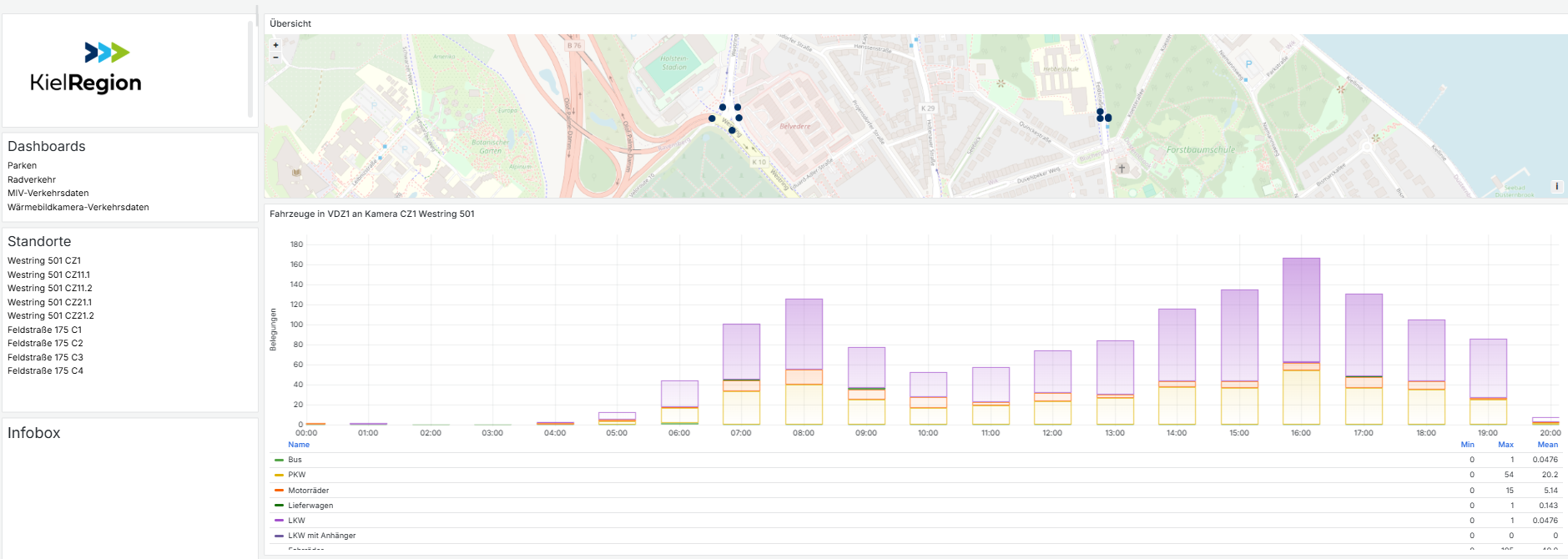
Dashboard of FLIR-Cameras

Mobility data related to fan mobility on the data platform