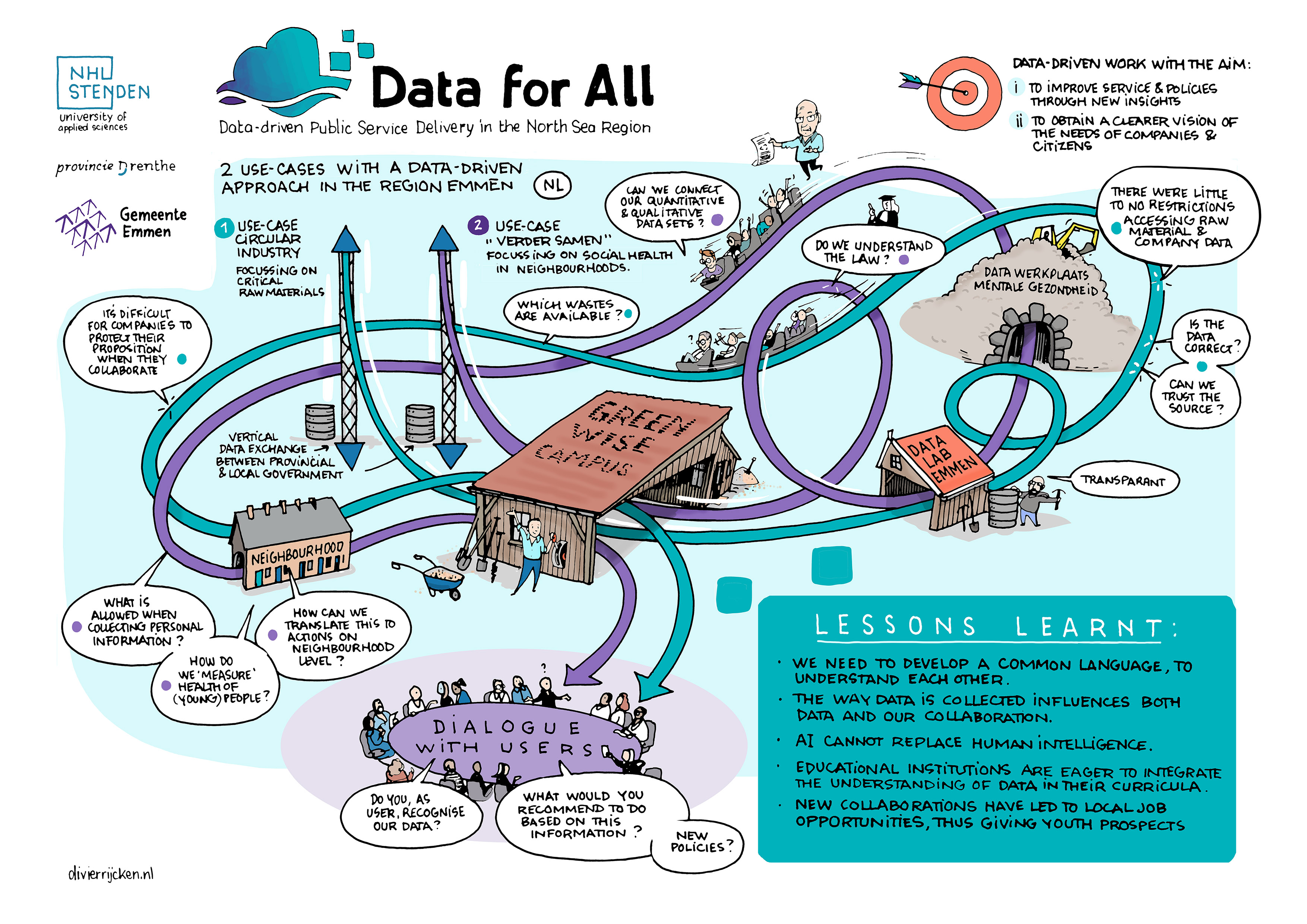
By sharing data across local regional government organisations, the Province of Drenthe, the Municipality of Emmen and NHL Stenden help better understand community needs and tailor their services to meet those needs more effectively.
The pilot partners tackled the challenges around the legal, technical and ethical aspects around data sharing. Knowledge created in this pilot laid the groundwork for future data collaborations in the region. Partners are combining different data systems into one platform that contains all energy saving measures taken. A first version of "a house passport" for this system was created. The data solution is being developed and will be launched soon.
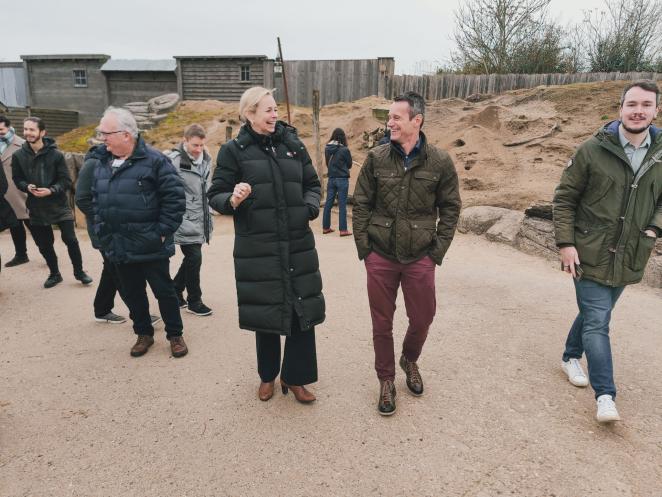
Data for All partners from the Netherlands
We are most proud of our work around the energy initiative. In this we brought a variety of local actors together and are working on a proper data solution so we can see and manage our efforts around energy savings way better. Prior to this project, all the institutions working on energy savings worked in their own systems. Therefore, we didn't know of each other's activities in the region and the work that was being done on the houses. We are working to connect all of these systems into one central database so we can improve our decisions on where to do efforts in the region, as this makes it so that we have better insight into the neighbourhoods that still have the most issues around their energy bills. The customer journey is also improved in a major way, as we are now working on a way so that they can provide the required information only once, after which it can be shared to the other involved organisations. This sharing of data will only be done with the approval of the citizens.
What was the challenge?
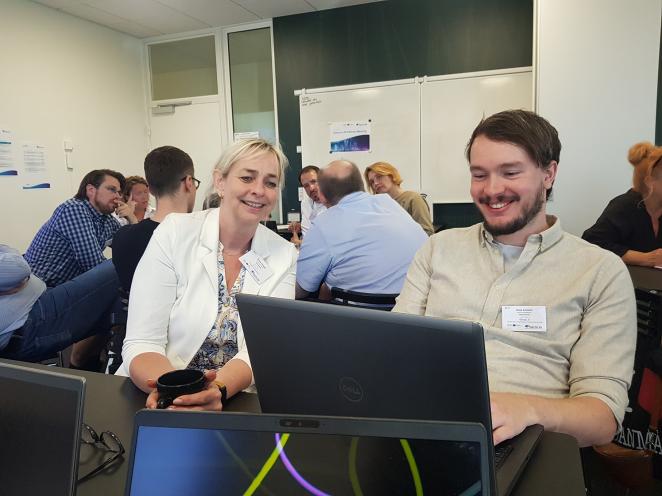
Data for All partners from the Netherlands
The challenges we have in the region are major transitions towards renewable energy and the circular economy. For both of these challenges the responsibilities and actions are split between the provincial and the municipal level. There is already a lot of cooperation between these levels of government on the policy side, but prior to this project there was little to no contact on the data side of these challenges.
The Data for All project allowed us to start such a collaboration on the data questions that we have in tackling the energy and circular economy transitions. It is incredibly valuable to gain a handle on regional data so we can formulate targeted policies.
For the energy transition, this for example means that the province of Drenthe has now created an energy dashboard that supplies all the municipalities with all available data regarding energy. In the project around circular economy, we successfully set up a system where all the project partners got together and shared both knowledge and data to get a better grasp of valuable minerals in residual products in the region.
For more details please check: Regional data exchange Pilot Strategy and Action Plan.
Participating partners
The municipality of Emmen is one of the twelve municipalities in Drenthe, the Netherlands and is responsible for tasks such as public safety, social welfare, and waste management. In the Data for All pilot project, the municipality plays a crucial role in sharing data related to these tasks, providing insights into community needs and data value at the municipal level.
The province of Drenthe in the Netherlands is a regional government organisation responsible for a range of tasks, including spatial planning, infrastructure, and public transportation. In the Data for All pilot, the province plays a key role in data sharing with its municipalities. In the pilot project, the province works closely with the municipality of Emmen to establish a framework for data sharing that addresses technical, legal, and ethical challenges, ultimately improving public service delivery across the region.
The Greenwise Campus Emmen of NHL Stenden supports the regional pilot in Drenthe and Emmen by providing specialised knowledge and expertise in the areas of data sharing, privacy, and security. It also works to integrate the latest academic research and best practices into the pilot project, helping to ensure that the framework developed is based on the most current and effective approaches.