

2025 has been an exciting year for the partners of the GRITH project. Partners met in Borås and Wesermarsch this year, as continuous efforts are being put in the goals of the projects through masterclasses and other regional activities. The project remains delivering to its promise of awakening industrial sites as the sleeping beauties of the energy transition. Much ground can be gained on these sites as there is a lot of opportunities for collaboration and innovation. Energy transition is a rapidly developing and changing industry, even within Europe different countries face different challenges and chances, and our partners operate at different levels. This results in a diverse array of situations. To reflect on what is possible in green renewable industrial transition hotspots, some of our partners will highlight their 2025.
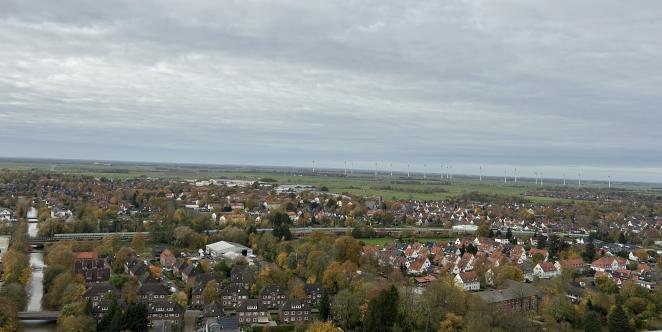
Wesermarsch is making promising moves towards Net Zero status.
Wesermarsch:
The implementation of the energy transformation is already in full swing here, as the Wesermarch is also home to a special alliance of business and politics called H2Marsch. Its goal is the decarbonization of an energy-intensive industrial region while at the same time maintaining and expanding high-quality jobs. Together with our partners in the H2Marsch alliance we achieved to put the Wesermarsch on the map to be part of the German hydrogen grid and we continue together to work on more infrastructure projects to come. However, it is also clear that the transformation cannot be realized on an industrial scale without targeted funding for research and development, pilot plants and scalable test facilities. As part of Northern Germany's Net Zero Valley Nordwest, Wesermarsch is aiming to be a pioneer in the development of net-zero technologies and accelerated project approvals. Alongside our several regional partners we achieved to finalize an application to become a hotspot for Net Zero Technologies in Europe.
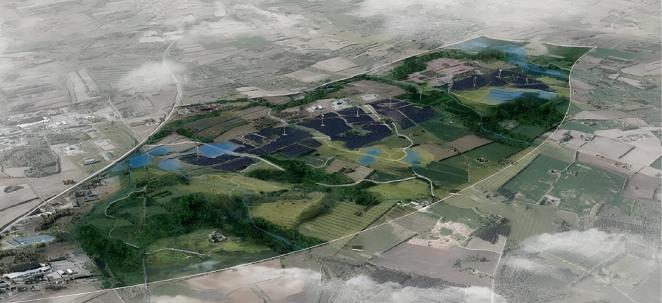
Give/Thyregod area. Give town left – Thyregod village in the right of the visualisation. Visualisation production: Eurowind A/S.
Vejle:
The initiative in Vejle South demonstrates that local energy communities can deliver substantial climate benefits while also improving business competitiveness. However, the project also makes clear that current regulatory conditions limit companies’ ability to fully realise these opportunities. For energy communities to play a central role in the green transition, political and regulatory adjustments are needed to make electrification and shared energy solutions economically viable. To read more about what Vejle has achieved in 2025, see here.
Pôlénergie:
As a part of the GRITH project, we have developed a set of tools to support economic actors, participants, and territories in their decarbonisation and energy transition efforts. Among these tools, we can highlight:
- The territorial energy assessment, based on Sankey diagrams, which matches local energy production and consumption, energy by energy, in a dynamic way (it does so through current situation and future projections based on decarbonisation targets). This tool makes it possible to assess the robustness of a territory’s energy strategy.
- Polaris, a strategic compass for energy-consuming economic actors seeking to compare and prioritise different decarbonisation and energy transition solutions. This tool allows companies to input their strategic drivers and visualise, for each selected action, the associated economic, energy, and carbon impacts.
The French partner stays in motion as other tools developed by Pôlénergie or sourced externally were also presented throughout the programme, including the Carbon Footprint assessment (Bilan Carbone). Which is a benchmark of energy transition solutions, as well as various mapping tools. These tools are now being deployed in the Hauts-de-France region and in other North Sea regions to support energy transition in business parks and industrial areas.
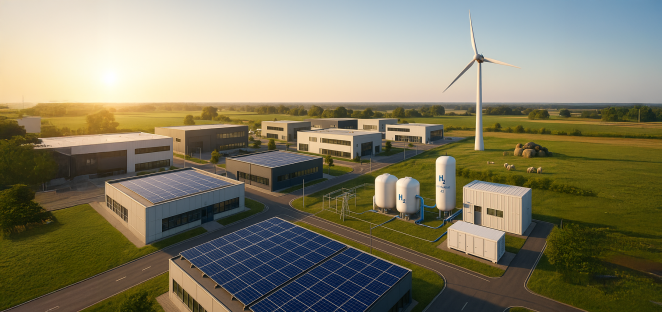
Drenthe has visualised its energy hub future.
Drenthe:
The province of Drenthe has achieved multiple successes in 2025. Of important note are the establishment of a community of practise with 13 energy hubs. The continuous developments in energy policy in the province have resulted in a closer cooperation with local grid operators. Additionally, the province is furthering collaboration with northern provinces and partners in the Netherlands. More on this specific development will be communicated in 2026, so keep your eyes on this website!
Borås:
In November, GRITH Borås held a workshop with two companies in Viared on the theme of energy sharing in an own grid (non-concession electricity grid). In January, we will follow up on the workshop and conduct a study visit to the Brunnshög district in Lund, in southern Sweden, where a project on energy sharing in an own grid has been implemented. This can be a part of the future of energy sharing in Sweden.
Emsland:
One of the main tasks of the project for 2025 was to analyse and develop solutions for the energy transition in the three model regions of Rhede (Ems), Meppen and Spelle. This was to be done in close dialogue with local authorities and companies and with the help of the commissioned consultancy AVERDUNG, Hamburg. The project plan from November 2024 envisaged completion of this task for December 2025 or January 2026. Currently, in December 2025, we are working on the few remaining subtasks of this important sub-project within the overall project and are therefore 100% on target with the goal defined more than 12 months ago.
Mechelen:
Nearly half of CO₂ emissions from companies in Mechelen originate from the heat demand of buildings. Through the GRITH project, the city therefore aims to decarbonize heat supply in the Mechelen North business park and Mechelen South industrial area by developing sustainable, collective heating solutions. In 2025, the City of Mechelen, in collaboration with engineering consultant Kelvin Solutions, conducted feasibility studies and developed implementation strategies for both industrial areas, which will be delivered in the short term. In Mechelen North, the city further explored the potential of the wastewater treatment plant as a heat source, while in Mechelen South the development of a new data centre has created new opportunities for the use of residual heat. Initial works on this data centre and the associated heat extraction infrastructure are currently underway, creating opportunities for heat supply to the industrial area from 2028 onwards.
To accelerate the roll-out of district heating networks in these zones, the City of Mechelen entered into a strategic partnership with distribution system operator Fluvius through a management transfer. From January 2025 onwards, both parties have collaborated within the framework of a broader district heating programme. In 2025, the development and negotiation of the associated governance structure and agreements formed part of the city’s activities under the GRITH project. In 2026, the City of Mechelen will continue its efforts to develop these projects and establish the necessary governance and legal frameworks. In addition, the city will further assess the impact of these developments on the local electricity grid, in order to better understand the risks of grid congestion and the potential opportunities for additional green electricity generation.
As 2025 comes to a close, a final opportunity arises to wish all GRITH partners, associates, stakeholders, and any other interested parties a very happy holiday season and a productive, green 2026!