

As part of the Megabits programme, the municipality of Enschede and Zwolle are both testing a Virtual Message Sign (VMS; a counting pole with a display). The VMSes are intended for collecting data (counting), and the displays can communicate with cyclists along the route. The VMSes are used to enhance the experience of cyclists. The goal is to provide real-time data and encourage cycling through visibility.
Both municipalities aimed to explore whether the display of a counting pole could double as a VMS to enhance the cycling experience and potentially encourage more people to cycle. Initially, a bicycle counter was considered, but Zwolle and Enschede quickly saw opportunities to inform cyclists with free text messages via a VMS along the F35.
Several suppliers were approached in Enschede and ultimately Multisensors appeared to be able to supply the right product. The VMS uses a radar counter to count cyclists in both directions. This also ensures compliance with GDPR regulations. Time and temperature are displayed continuously, as are the number of cyclists per month, per direction and the total. There is also a large free field where text, icons and places or photos can be placed. This allows us to inform cyclists about travel times calculated via the dashboard of the Enschede Fietst app, another implementation of the MegaBITS project. Other messaging options include informing cyclists about slippery conditions, roadworks or events.
The Enschede Fietst app was used to conduct a questionnaire that asked F35 users for feedback and ideas. The results show that the F35 is intensively used by frequent cyclists, mainly for commuting, which makes the VMS a relevant communication tool. Although the current information largely meets users’ needs, a small but meaningful group (7–8%) experiences readability issues, indicating opportunities for optimization in text length and size. The many suggestions highlight that users see the VMS as a promising instrument for added value, particularly for safety messages and up‑to‑date information such as events.
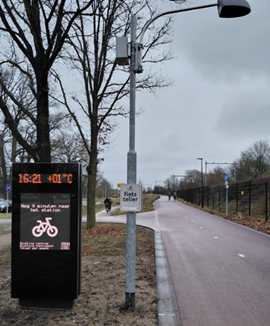
VMS sign in Enschede
Zwolle followed a similar process in its procurement, and here too Multisensors emerged as the supplier with the right product. Zwolle chose a display mounted on a pole, flag-shaped, double-sided, and installed at a height of 2.5 metres above ground level, whereas Enschede installed a totem-style unit. The VMS uses two Signum radars, positioned approximately 43 metres on either side of the display, to count cyclists. The information screen (display) provides real‑time bicycle counts to users of the cycle path, along with additional information such as time, temperature, and free‑text messages. The combination of measurement and communication places different demands on a system than a traditional counter. The display had to show the count at the exact moment a cyclist passes by, rather than a delayed display of a previous cyclist. This requires a technical approach in which sensor placement, speed measurement, and display control are precisely aligned.
The collected count data is visible in an online data environment where traffic data is visualised and analysed in real time. The platform supports integration with external systems for example the NDW Dexter and meets GDPR standards. Motivational messages are shown in the free‑text field to encourage bicycle use.
Zwolle’s VMS is installed along a cycle path at the edge of a large business park where plans for the future are being developed for a cycling‑promotion project, “out of the car and onto the bike”, in cooperation with the local business association. Within the VMS project, the aim is to create a direct link between the bicycle counter and the display. Through the display, promotional and encouraging messages can be shown to stimulate cycling.
To gain insight into cyclists’ opinions about the VMS, an online questionnaire was used. The online questionnaire was administered via a tablet to users of the cycle path location by students. The investigated hypothesis was: ‘The VMS improves cyclists’ experience because the (combined) use of measurement (counting pole) and communication (display) ensures that cyclists feel informed, which results in increased cycling stimulation’.
Based on the findings, the hypothesis does not appear to be fully confirmed. Because the cycling promotion initiative at the business park is still under development, some of the respondents do not yet see the added value of a bicycle counter. The expectation is that the added value will be increased when connected to broader cycling‑promotion programmes.
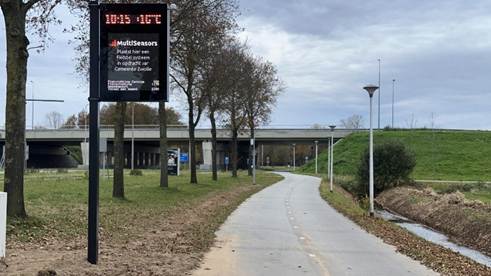
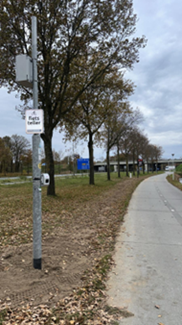
VMS sign in Zwolle @Pedro Sluiter Signum radar @Pedro Sluiter
Conclusion: the Smart Cycling Corridor F35 has contributed to a safer, more attractive, and more data‑driven cycling network. The project underlines the importance of collaboration, adaptive implementation, and combining behavioural and technological interventions. These principles provide a strong foundation for future work towards smarter and more sustainable regional mobility
Find or showcase connected mobility solutions for free in the BITS Directory .