

Preparing installers and construction companies to collaborate more effectively in sustainable building and renovation is essential for Ameland’s ambition of becoming fossil-free by 2035. To equip future installers and builders with the necessary skills, Firda lecturer Maartje Berenschot has developed the Short Advanced Course (SAC) Integral Construction — a practice-oriented programme that teaches engineering students how to make smart, sustainable choices together.
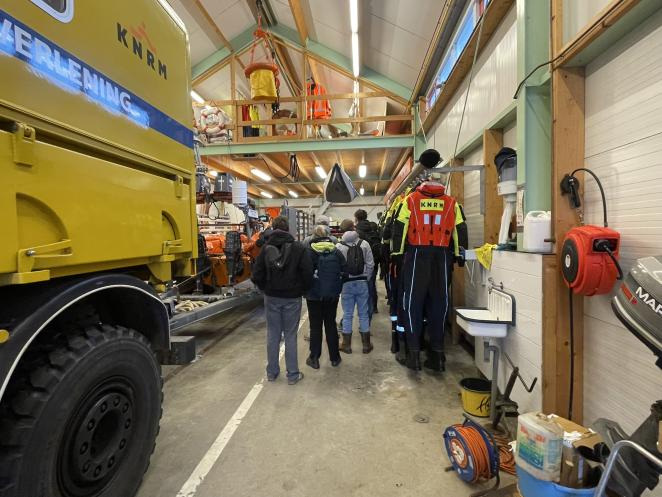
The course officially kicked off on Wednesday 11 February 2026 with a field visit to both the old and new KNRM (Royal Dutch Rescue Company) lifeboat stations on Ameland, located in the town of Nes in the center of the island. What functions does the old KNRM station in Nes currently fulfil? Why does the existing building no longer meet today’s requirements? And what does a new building demand from both builders and installers? Erwin de Boer from the Municipality of Ameland and Pieter Mosterman, a contractor on the island, guided eight Firda students through these key questions. Using the old station as a reference point, they explored what the new station must accommodate: a large truck with a lifeboat, spaces for crew suits that must be heated day and night, and additional facilities. And crucially: the new station must be sustainable.

The group then visited the new lifeboat station at the Ballumerbocht. Here, students received an explanation of the new energy system, the construction approach, and how the lessons learned from the old station have been integrated. “Very interesting,” one student said. “Seeing it in real life, being able to ask questions — it immediately makes clear why we’re doing this project.”
The Assignment
Now that the students understand how the old and new KNRM station function and what facilities they contain, it is time for them to undertake their mission: to make the new KNRM station even more sustainable. The construction of such a building starts with a well‑thought‑out plan. The work preparation phase involves many steps: choosing materials, selecting equipment, understanding regulations, and developing a realistic planning framework.
Building on an island works differently than on the mainland. That makes this project more challenging. For example, students must consider the restrictions in a protected nature and wildlife breeding area, the island’s soil conditions, and last but not least, the logistics: how do you get materials to Ameland? Large machinery does not fit on the ferry, and many materials are produced on the mainland.
All of this requires substantial analysis and highly accurate planning. Students will have ten weeks to prepare the new station, which already exists, for construction and develop proposals to make the building more energy efficient, with sustainably sourced materials. To support this process, they will travel to Ameland three more times:
- Visit 2: Q&A session with contractor Mosterman
- Visit 3: On-site measurement and development of a multi-year maintenance plan
- Visit 4: Final presentation of their construction plans
This real world project and application highlights the need for specialized solutions in island contexts and gives students hands-on application in the world of sustainable construction.
Contributing to a Fossil Free Future
By implementing the SAC Integral Construction within the NESSIE framework, Firda strengthens the capacity of future technicians and builders to contribute to Ameland’s long‑term sustainability goals. The course equips students with interdisciplinary collaboration skills, critical thinking competencies, and the ability to make informed decisions in real‑life energy transition contexts.