

Historic underwater munitions are increasingly recognised as a growing environmental risk. In Arctic waters, corroding World War II-era ammunition continues to release explosive compounds into fragile marine ecosystems. Despite mounting awareness of this legacy pollution, the in situ detection of dissolved explosive residues remains technically challenging, particularly under the harsh and remote conditions of polar regions.
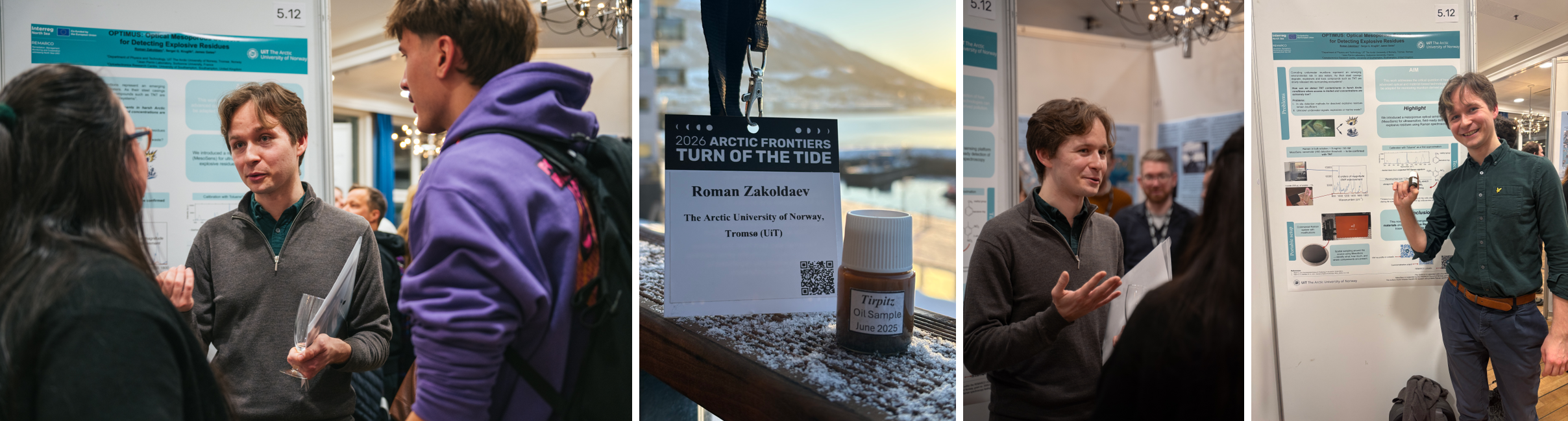
At Arctic Frontiers 2026 in Tromsø, scientists from UiT – The Arctic University of Norway (University of Tromsø) presented a promising new approach to address this monitoring gap: MesoSens, an innovative optical interface designed to bridge ultra-low concentrations of ammunition-related contaminants with light-based detection systems. By enhancing how dissolved explosive compounds interact with light, MesoSens aims to make trace-level residues measurable outside controlled laboratory environments.
You can learn more about the technology here:
Norinnova Portals
The development responds to a critical need in environmental monitoring. While advanced analytical methods exist in laboratory settings, transferring these capabilities into the field has proven difficult. Effective monitoring solutions must work with small sample volumes, operate through simple and robust workflows, and generate reliable data that can directly inform environmental risk assessments and decision-making processes. By improving sensitivity in a manner comparable to portable spectroscopy techniques, MesoSens seeks to enable practical, field-ready detection of dissolved explosive residues.
The environmental context underscores the urgency of this work. Corroding wartime munitions continue to degrade on the seafloor, gradually releasing compounds into surrounding waters. Yet current in situ detection capabilities remain limited, especially in polar regions where logistical and technical constraints are significant. Field-deployable optical sensing platforms have the potential to close this gap and provide a more immediate understanding of contamination levels in affected areas.
As part of the REMARCO initiative, MesoSens will be validated using real seawater samples collected near the wreck of the Tirpitz outside Tromsø. This site serves as a striking example of the long-term environmental legacy associated with submerged wartime materials. By combining advances in photonics with the practical demands of marine environmental monitoring, the researchers at UiT and their REMARCO partners aim to contribute to more effective assessment and protection of Arctic marine ecosystems in the decades to come.
© jensenmedia, 2026. All rights reserved
© Roman Zakoldaev, UiT, 2026. All rights reserved