

We stay in Stavanger with our interview series. After an interesting talk with Christin Berg and Imme Diks Eskeland from the City of Stavanger, we sat down with Espen Strand Henriksen, Project Manager at Kolumbus.
Espen explains how Kolumbus developed from a traditional public transit organisation into a multimodal mobility provider, how to successfully integrate e-bike sharing into new real estate developments like the Jåtun Living Lab, and why collaboration between transport providers, public authorities and real estate developers is essential!
Welcome Espen! Can you tell us about yourself and your organisation?
I am Espen Strand Henriksen and I have worked at Kolumbus for around 10 years. Kolumbus is the Public Transport Authority owned by the County of Rogaland, in which Stavanger is located. Until 2017, Kolumbus was a traditional public transport company, running buses and boats. It then evolved into a mobility company, which has public transport as a core activity, but also develops and provides shared mobility solutions.
My job is to develop new mobility concepts for Kolumbus. Concretely, I used to work with our B2B Home-Work-Home concept, HjemJobbHjem in Norwegian. I have also been involved in Kolumbus car sharing as well as the autonomous bus project, but now almost all my time is focused on our bike sharing scheme.

Espen Strand Henriksen (Picture by kollektivtraffik.no).
Which shared mobility services do you provide?
We experiment with different new mobility solutions, alongside running buses. Developing a car sharing scheme was the most challenging for us. We started the scheme in 2019 and, at our peak, we had 40 shared cars on offer. Yet, it has proven difficult to make car sharing work in Stavanger, so our politicians decided to stop it about a year ago. We are now curious whether ride-hailing would be a workable alternative.
Our city bike system is more successful. We gradually started deploying e-bikes in 2014, initially with bikes from a Danish company. In February 2020, we launched our own bike that is more suitable for the Nordic environment. We will now upgrade the existing bikes and more than double the offer in the next six months!
And of course, we have the Home-Work-Home initiative, which gives employees access to a B2B public transport ticket and our city bikes, all via the Kolumbus ticketing app. It is our biggest project in terms of impact, including about 650 companies and 70,000 employees.
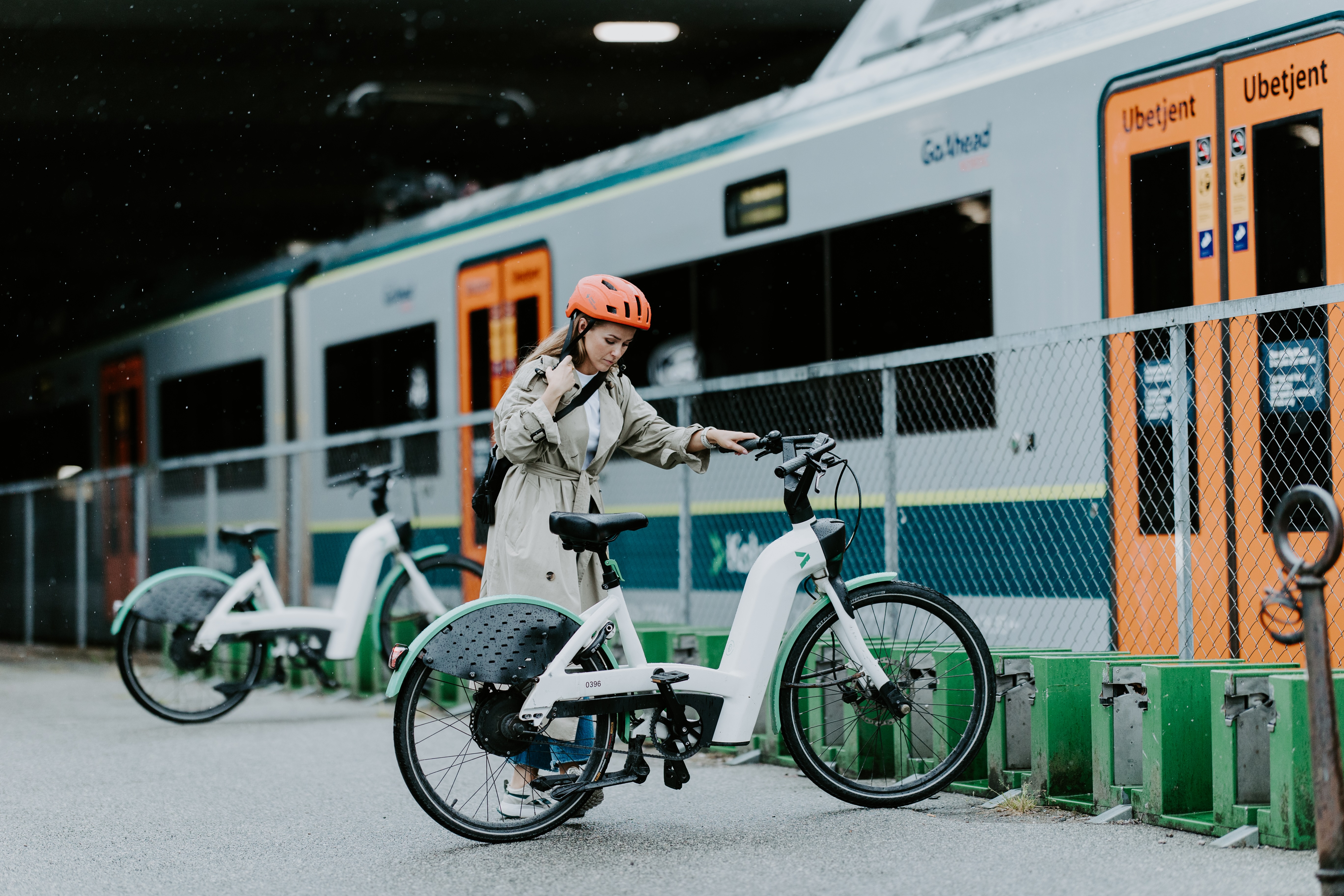
Stavanger is deploying a city-wide e-bike scheme (Picture by Line Owren).
How did you get involved in the SN² project?
We and the City of Stavanger were already quite familiar with the first SHARE-North project because Bergen, one of the other big Norwegian cities, was part of it. When Stavanger decided to join, they asked us if we at Kolumbus wanted to be involved as well. Having both the city and us as the mobility operator involved made sense because you need both parties to get things done in the field: the City of Stavanger depends on us for operating the public transport and shared mobility services.
Conversely, Kolumbus needs the city, because they own much of the land and real estate on which we wish to develop our mobility solutions. In short, you need different kinds of players to make things happen. Together with the third local partner in the project — a private estate developer called Base / JUS, who owns the area where we plan to deploy mobility solutions — we cover many of the players in the mobility ecosystem.
You need both the City of Stavanger and Kolumbus to get things done in the field!
What is your main objective in SN²?
Our main objective is to develop our e-bike network in Jåtun, a new housing development on the outskirts of Stavanger. In doing so, it is crucial for us to work together with the real estate developers. The city wants real estate developers to provide alternatives to private car parking. Developers can then collaborate with us to provide these alternatives, such as our city bikes.
This is a win-win-win situation: the city can reduce the pressure of car traffic, the real estate developer can build fewer parking spots, and we can deploy our bikes.
Which challenges did you face in implementing the bike sharing system?
In general, it is crucial for us to be involved in the planning process when implementing a mobility service, such as e-bike sharing in the case of Jåtun. We can then easily add a docking station from the start, which is much easier than having to do this when buildings have already materialised, which is far more time-consuming. The cost is also higher when you implement mobility services into an already developed area than when you can plan upfront. In the latter case, you can simply add extra power cables and construct the docking for the e-bikes when the cranes are already there and before concrete constructions have been built.
The challenge in Jåtun is that we are working at two speeds. Firstly, there are people who have been living there for a few years. Secondly, there are massive real estate developments taking place right now. This means that we must talk to two different groups: people already living here, and the developers of the new housing projects. When talking to residents, they are less familiar with the technical details of installing docking stations; they might be worried about everyday costs (for example, common costs for the residents), or they might refuse to have a docking station on their premises. Talking to developers is different as they are more familiar with these matters, and the focus is more on investments.
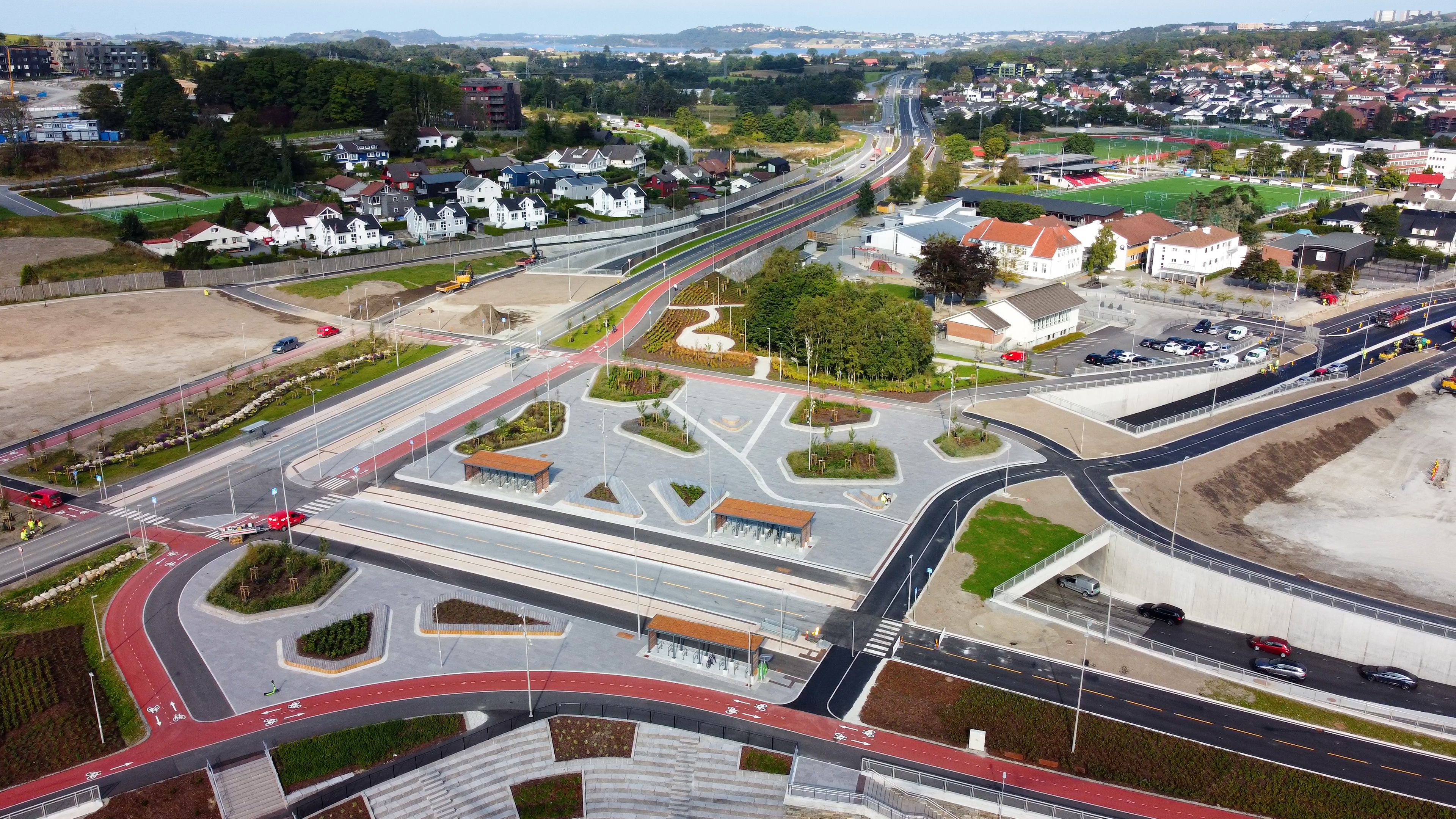
The 'Lokket' mobility hub with stops for the Bus Rapid Transit and local train, electric city bikes, scooters, bike parking and recreation. The Jåtun-pilot will be built next to this hub (picture by Rogaland fylkeskommune).
What is Kolumbus’ biggest contribution to SN²?
We bring the insights of a mobility provider to the table. We show how to implement municipal policies in practice and provide insights into the business case for shared mobility services in connection to the more traditional public transport services.
Our insights are based on learnings from e-bike deployment in the Jåtun Living Lab area, but also from other developments, such as the autonomous bus project. This is a six-kilometre-long corridor from the mobility hub Hinna Park / Jåttåvågen, passing next to Jåtun, and going up to the university campus and the site where the new hospital has just opened.
By participating in SHARE-North Squared, we bring the insights of the mobility provider to the table.
What are your main learnings so far?
As I mentioned before, the project reaffirmed that planning is essential to keep good track of the timing process and to plan well in advance. Also, the project showed once again that the landowners, both public and private, as well as real estate developers, are important stakeholders for us. There is a mutual dependency between us: we at Kolumbus depend on them for the supply of land, and they depend on us to provide mobility services.
In the end, we all need to work together to get things done! Thank you, Espen.
Credits
Interview done by Jelten Baguet (Mpact)
Picture in banner by SHARE-North Squared.