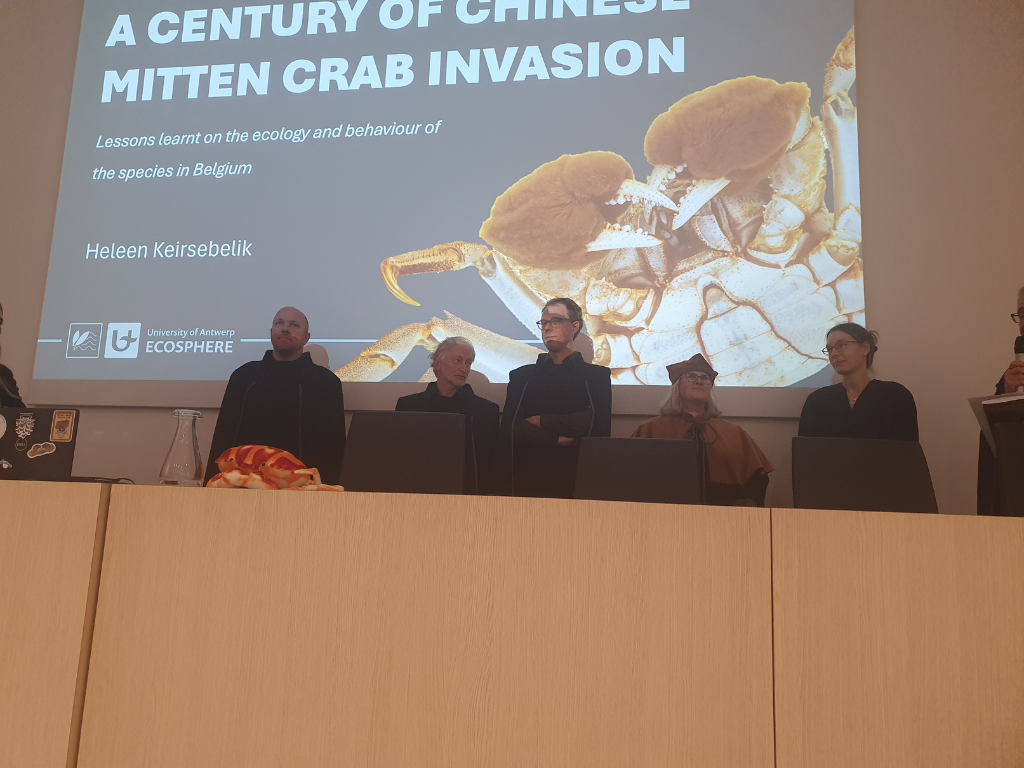
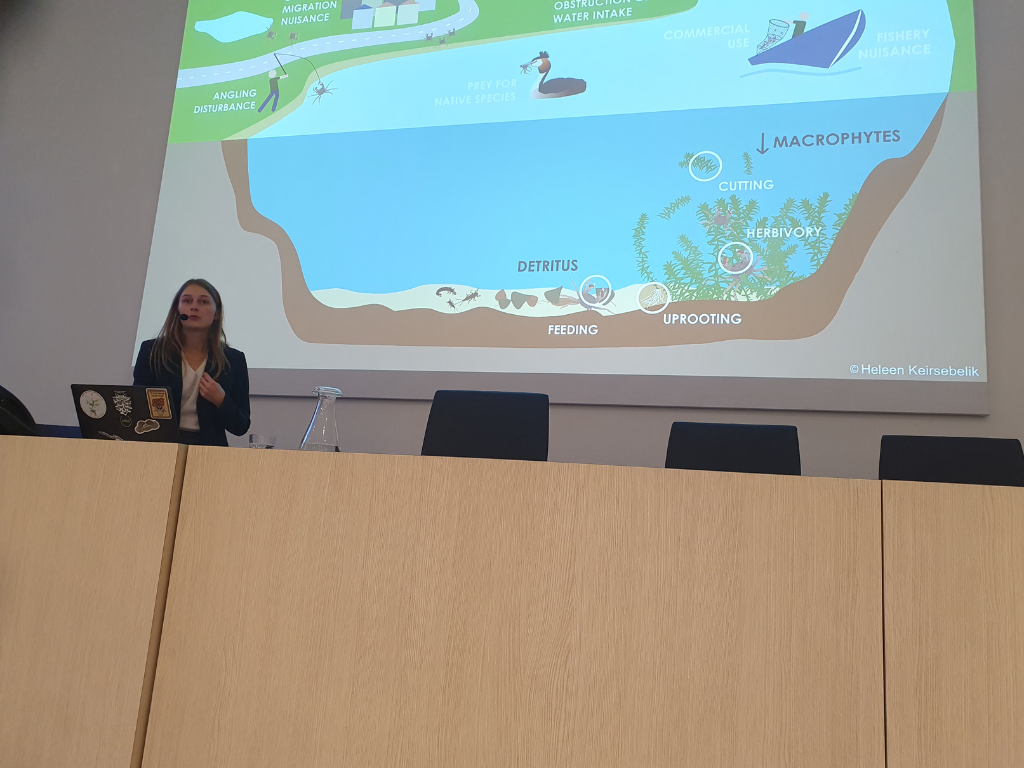
On 27 October 2025, Heleen Keirsebelik successfully defended her PhD before an international examination jury. Her doctoral research made partial use of data collected by the CLANCY partners, and the resulting insights help project partners across Europe to better understand the species and the challenges it creates in their respective countries. Her PhD defense took place immediately after the CLANCY symposium earlier that day.
Abstract of the PhD dissertation — A century of Chinese mitten crab invasion. Lessons learnt on the ecology and behaviour of the species in Belgium
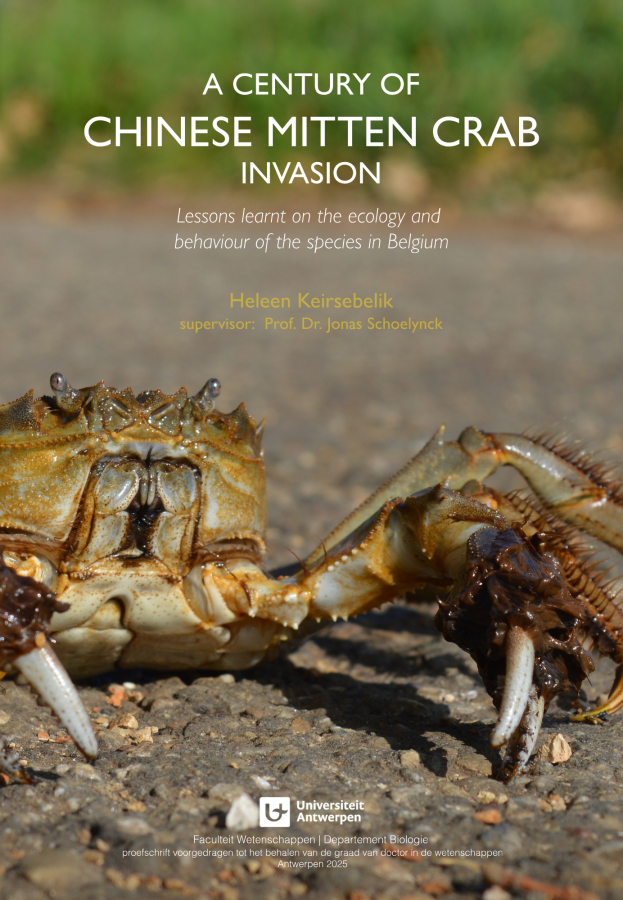
Non-native invasive species threaten biodiversity and ecosystem services worldwide. The Chinese mitten crab (Eriocheir sinensis), listed by the European Union as a species of ‘Union concern’, is a highly successful aquatic invader that has established populations across Northwestern Europe and North America. Despite its long invasion history, much of its ecology and impact within its non-native range remain poorly understood. This study investigates its life cycle, behaviour, and impact in Belgium, where the species has been present for almost one century, providing an exemplary case for understanding its dynamics elsewhere in Europe.
Monitoring at multiple sites across Flanders identified the timing of key phases in the species’ catadromous life cycle and variation in size and age at maturity. Reproduction occurs in brackish to marine waters between October and May. Juveniles migrate upstream to non-tidal freshwater habitats from February to June, though some individuals reach maturity in tidal zones. Size and age at maturity increase along the longitudinal gradient of the river basin. Adult crabs begin their downstream migration between September and December. Acoustic telemetry revealed that they adapt their migration strategy to local conditions: nocturnal movement in non-tidal rivers versus selective tidal stream transport in tidal rivers, which likely reduces the energetic costs of migration. Experimental work showed that adult crabs accelerate breakdown of diverse leaf litter types, increasing fine particulate organic matter, dissolved nitrogen, and biological oxygen demand, thereby potentially enhancing nutrient cycling. Juveniles had weaker effects but are more numerous. Field and laboratory studies linked crab burrow dimensions to crab size and revealed spatial and seasonal variation in burrow characteristics. High densities in a restored marsh were associated with riverbank erosion, suggesting burrowing can alter sediment dynamics and ecosystem functioning. A survey of Hepatospora eriocheir, a microsporidian pathogen, revealed infection prevalences of 27–38% in two European crab populations. Infected crabs had a reduced aerobic scope and depleted energy reserves, likely due to resource use by the parasite. This may impair energetically demanding activities like migration, exposing a weak spot in this otherwise resilient invasive species.
These findings provide new insight into the biology and ecological role of the Chinese mitten crab in its non-native range, identify traits that underpin its invasion success, and highlight impacts on freshwater and tidal ecosystems in Belgium. Continued research and targeted management, such as improved trapping strategies, are essential to limit the effects of this invasive species where it is established.