

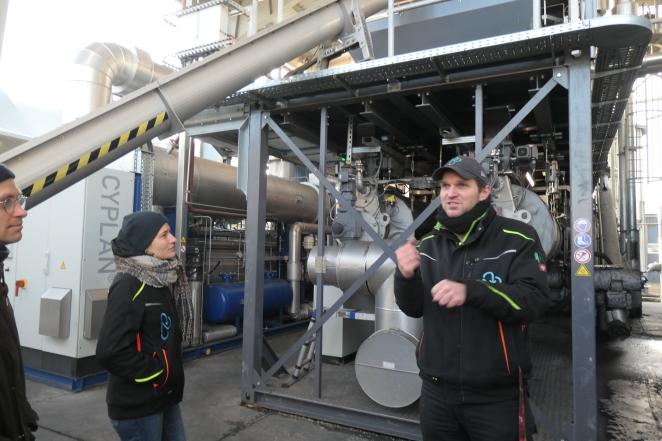
On the 16th of January, the CLOSECYCLE team of University of Hamburg organised an excursion to the Novocarbo company in Grevesmühlen. The visit aimed to facilitate connections between students and experts in biochar production and utilisation. And to encourage intensive discussion between the German Closecycle teams.
Pictures and text: Bodo Saake
Large interest in biochar
The students are participating in a master's course on biorefineries at the University of Hamburg (UHH), in which they were studying biorefinery technology, including thermochemistry, and farm biorefinery concepts. Other Closecycle partners included representatives from the TUHH and the waste management company EBL. Additional participants included Jörn Appelt, the thermochemistry expert at the Thünen Institute of Wood Research, and Jörn Einfeldt, professor of technical environmental management at the HAW.
Novocarb is a young company that specialises in the pyrolytic production of biochar. The process also generates electricity and heat. The Grevesmühlen plant began operating in October 2023 and has now exited the start-up phase. As a first step, Chief Operating Officer Benjamin Reinke provided a tour, offering valuable insights into all aspects of the plant and its start-up experiences.

Biochar proces
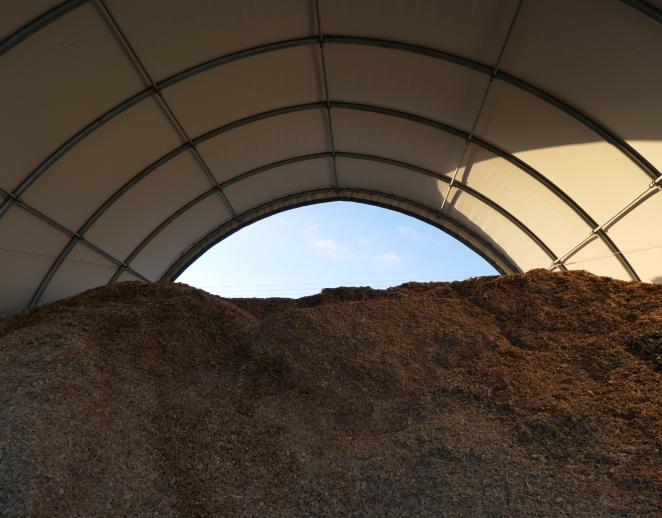
Currently, wood chips from thinning wood are used as the input material. The pyrolysis process is carried out at approximately 650 °C for 20 minutes. Under these conditions, biochar and a gas fraction are produced. Oil and tar do not result from this process at such high temperatures, but instead decompose into gas. Due to the high temperatures, the charcoal yield is relatively low (approximately 1 part biochar to 5 parts input by dry mass), but the quality of the charcoal is excellent. The plant also produces electricity and heat. The electricity is fed into the grid, while the heat is transferred to the district heating network of the nearby town. Biochar is primarily used as a component of plant substrates and as a soil additive. This is particularly interesting for urban green spaces and tree planting, as the charcoal's ability to store water promotes the development of a 'sponge city'. Additionally, the excellent water retention properties mean that city trees grow better and can survive dry periods more easily.
Following the tour, there was an in-depth discussion about potential raw materials, particularly whether EBL's sieve overflow from composting processes could be used for pyrolysis. Further contacts on this topic were agreed upon between Novocarbo and EBL at the end of the discussion. As the two companies are located approximately 50 km apart, cooperation could represent a perfect sub-segment for a Territorial biorefinery network TBN.