

Gräflich Bernstorffsche Betriebe (GBB) has extensive areas of organic farming, pasture management and sustainable forestry. In CLOSECYCLE, the aim is to further develop internal operations and cycles. One of the main aspects is the farm's own composting system with rotating windrows to prevent nitrate leaching. A short update!
Pictures: Leander Raisfirooz
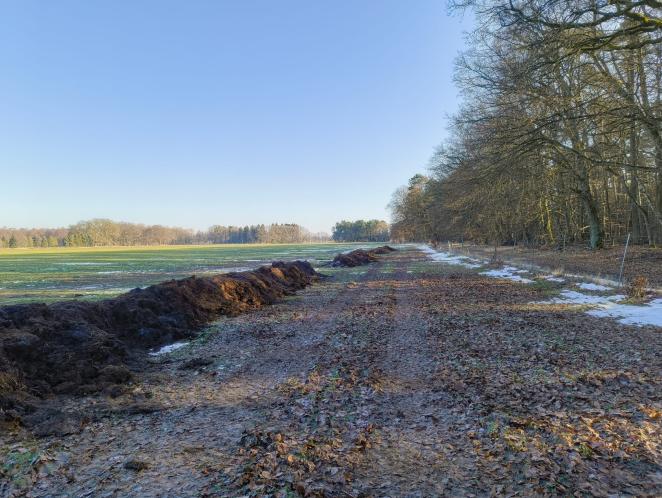
Measurement of nitrogen loss
In January 2026 a new series of open windrow composting started. Six distinct compost windrows were constructed on an agricultural field that is surrounded by a forest. The composition of the first and second windrow comprised cattle manure, old hay/straw, wood chips and a small amount of wool. With regard to the remaining four, the composition is identical, with the exception of the absence of wood chips. In the present experiment, the nitrogen loss should be analysed with the three most significant factors being open windrow composting, turning frequency and composition. With regard to the frequency of turning, it should be noted that each windrow has its own specific frequency, which ranges from two times per week during the initial period to only one time per month in the subsequent stages. In contrast, other subjects were turned less often, if at all.
Once the maturation of the windrows has been achieved in April, the compost is then distributed on the field where the plies are located. The field will be used for the cultivation of beetroot. Furthermore, the beetroots will be analysed for nitrogen. In addition, all samples will be dispatched to LUFA (Lower Saxony Chamber of Agriculture) for further analysis.