
On Thursday, 25 September 2025, during the guided visit on alternative lettuce at PSKW, the results of this year’s long-term compost trial were presented. In addition, the design of the most recent silage trial was introduced.
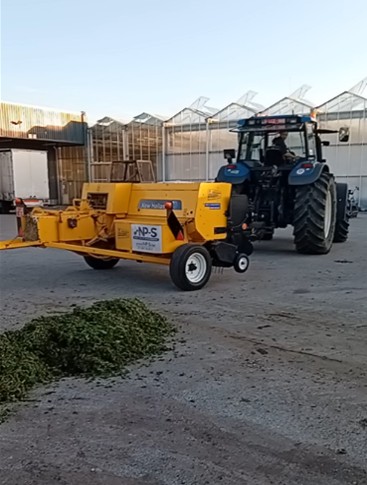
Silage experiment
Beyond the longterm compost trials carried out bij PSKW, the CLOSECYCLE project also explores how residual streams from fruit vegetables such as tomatoes, peppers, and cucumbers can be sustainably transformed into compost. This compost can then be applied in horticulture to improve soil structure. Working with harvest residues from fruiting vegetables, however, poses a challenge: these materials are typically only available once or twice a year. Since composting all residues immediately is impractical and may cause logistical challenges, several exploratory trials have been initiated. These trials aim to identify effective methods for preserving and storing foliage over extended periods to ensure a consistent supply beyond the harvest season.
To preserve greenhouse foliage, PSKW carried out a series of tests using shredded cucumber plants collected at the end of the cultivation cycle. After conducting several silage trials in June, July, and August, they explored an alternative preservation method: pressing the residues into bales, similar to hay bales. For this, we collaborated with three partners: De Ceuster, RKW Hyplast, and local contractor. De Ceuster, among other activities, provides contract work for greenhouse growers, while RKW Hyplast supplies silage materials and introduced several of their products for us to test. They also provided stretch film, which were used to tightly wrap the cucumber residues in bales. The main challenge in preserving greenhouse residues, particularly cucumber foliage, lies in their high moisture content, which makes compact bale pressing difficult. On the 12th of September, the cucumbers were harvested, but the plants remained in the greenhouse until the 17th of September to allow the growing mats to dry before disposal or reuse. This drying period also affected the moisture content of the cucumber foliage: at harvest it was still around 90%, but after five days it had dropped to 80%. Allowing the foliage to dry even longer could potentially improve conservation quality. These insights will guide our upcoming experiment in November, when larger amounts of pepper foliage will become available. The aim is to conserve this material more efficiently so it can later be used in composting in successive phases.