

On 12 February 2026, the Research Station for Vegetable Production (PSKW) hosted a field academy as part of Delhaize’s initiative to support Belgian growers in the transition to regenerative agriculture. Through this programme, Delhaize aims to help farmers reduce the environmental impact of their production. In this first year, five growers and six crops were guided, with promising results for soil health, biodiversity and crop quality.
Written by S. van Lommel and J. De Nies, PSKW. Pictures: PSKW
Delhaize Academy
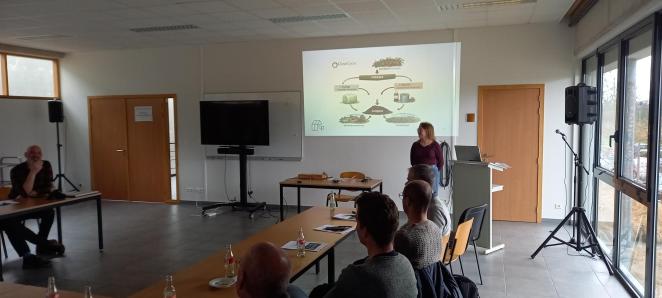
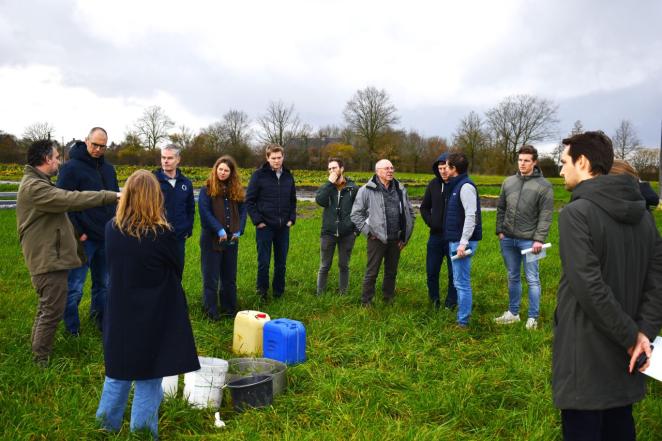
During the academy, PSKW organised an afternoon workshop focusing on fractional fertilisation, compost use and cover crops. After an introductory presentation, participants visited the field for a demonstration of how to measure soil infiltration capacity in the multi‑year compost trial studied in the Closecycle project. This offered growers an opportunity to exchange experiences, learn from experts and see practical applications directly in the field. Results from the CLOSECYCLE project and the multi‑year compost trial were presented to show the benefits of compost, as well as PSKW’s efforts to enhance circularity by storing greenhouse crop residues for later composting.
Multi annual compost trial
The long‑term trial on organic fertilisation has been running at PSKW since 2006. Over the years, the results have shown a clear cumulative effect of sustained organic matter inputs. Plots receiving no organic fertilisation consistently show insufficient mineralisation to support optimal yields. In contrast, plots amended with compost or manure display higher and more stable moisture levels, improved soil structure, and a gradual nutrient release throughout the growing season. Leafy vegetables in particular respond strongly to these long‑term organic inputs. For growers, correctly accounting for mineralisation in fertilisation planning is therefore essential to achieve high yields while maintaining acceptable nitrate residue levels.
A striking illustration of this long‑term effect is the soil’s infiltration capacity. Earlier measurements (2021) showed that, after 15 years of applying organic amendments, infiltration rates in organically fertilised plots were up to 30 times higher than in the unfertilised control. Improved infiltration reflects several structural improvements: lower bulk density, better aeration and a soil that allows water to enter more quickly. This is an especially valuable property during dry periods. These measurements will be repeated this year within the Closecycle project.
During the field academy, PSKW demonstrated the method used to assess infiltration capacity (Figure 1). The test is performed with a double‑ring infiltrometer. Two concentric metal rings are inserted into the soil and filled with water. The inner ring measures vertical infiltration, while the outer ring minimises lateral water movement. By recording the decline in water level over time, both infiltration rate (mm/min) and infiltration capacity can be calculated. Using three sets of rings allows multiple simultaneous measurements, resulting in a reliable averaged value.
The study afternoon was highly successful and informative. We demonstrated to growers the long‑term benefits of organic fertilisation and showed the cumulative impact of years of compost application in practice. At the same time, we learned from growers about their own experiences with composting and the challenges they face. Current legislation still makes it difficult for farmers to start on‑farm composting, although a revision is expected by the end of this year.