

On 13 November 2025, Vlaco had the opportunity, together with CIC (the Italian Composting Consortium), to visit two compost producers in Northern Italy.
Digestion and composting
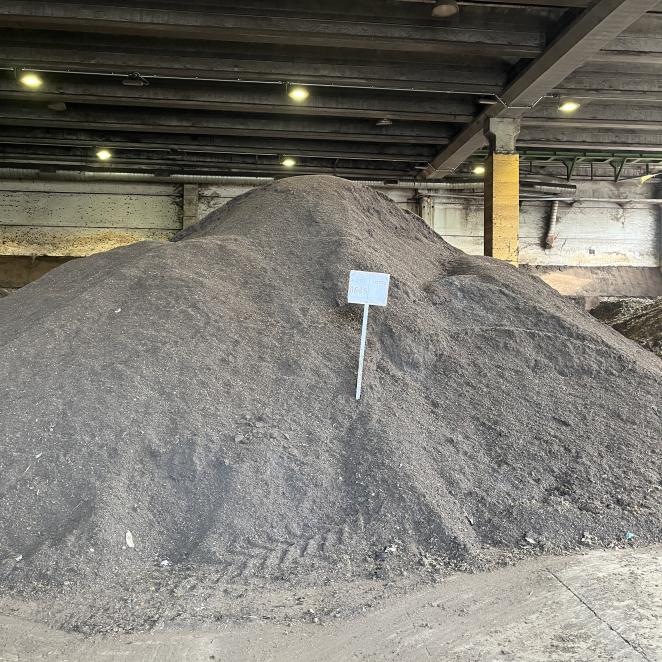
CIC assures and monitors quality of biowaste treatment in Italy based on company audits and sampling/analysis of compost and digestate. CIC holds the ECN-QAS Conformity Label, which demonstrates that we operate as a quality control organisation in accordance with the guidelines of the ECN-QAS Quality System. CIC staff members Alberto Confalonieri and Jenny Campagnol guided Vlaco through the composting facilities of Etra SpA in Bassano del Grappa (province of Vicenza, 44,000 tonnes input/year) and Contarina SpA in Trevignano (province of Treviso, 73,000 tonnes input/year). Both processing plants apply anaerobic digestion of selectively collected biowaste, followed by post-composting of the digestate (with the addition of a quantity of green waste). In both cases, the biogas produced is upgraded to biomethane and then injected into the natural gas grid or used as fuel for collection vehicles.
Photo: Vlaco
Collection and waste quality
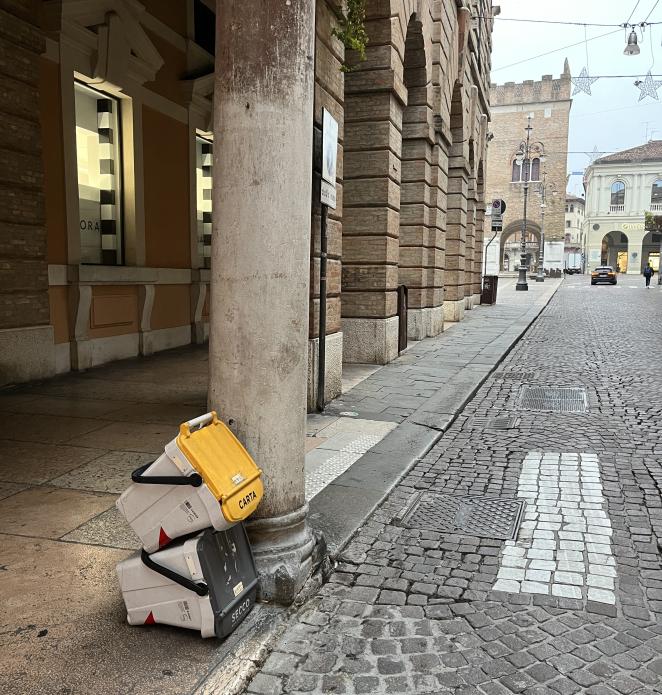
Kitchen waste is collected door-to-door and is of very high quality, with less than 1.5% impurities. This result is achieved through intensive communication and awareness-raising among citizens regarding correct waste separation.
From biowaste to compost in Italy
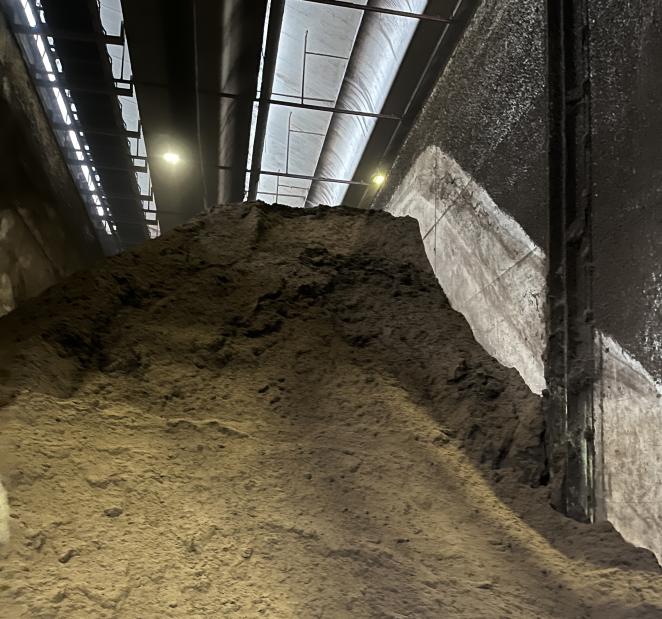
The ratio between input streams differs from that in Flanders: Italy processes significantly more kitchen waste (57% of the input) compared to green waste (22%), whereas in Flanders the share of biowaste (including kitchen waste) is 29% of the input and green waste accounts for 69%. One explanation is that a large portion of green waste in Italy is not collected for composting, resulting in a lack of structural material for post-composting. CIC explicitly points this out in policy recommendations to the Italian competent authorities. In some regions of Italy, it is also possible to co-process sewage sludge from municipal wastewater treatment plants. This share accounts for approximately 14% of the total input to processing installations. Processing these 7.5 million tonnes of input results not only in 1.99 million tonnes of compost but also in energy production: 201 million m³ of biomethane and 667 GWh of electricity, as well as 81 GWh of thermal energy. As in Flanders, Italy has also seen a shift in recent years from composting towards pre-digestion with post-composting: in 2013, 37% of the input material was pre-digested, rising to 59% by 2023.
The 1,99 million tonnes of compost produced are distributed as follows: 25% green compost, 43% biowaste compost, and 32% sludge compost. The origin of the input streams clearly determines the end market for the compost. Less than 50% of green compost is used in agriculture. Other applications include public green spaces, topsoil, and private gardens (40%). Eleven percent is used for the production of fertilisers, soil improvers, and growing substrates. Biowaste compost, on the other hand, is mainly used in agriculture (85%). Use in gardens, parks, and green areas is significantly more limited compared to green compost.