

On 4 March, during the AIVP River Port Cities Working Group meeting in London (UK), a workshop was organized to introduce participants to the Connected River project and the innovation methodology Flow Forward, developed within this project.
The session focused on how ports and cities can better collaborate and innovate when facing increasingly complex challenges on and around urban waterways.
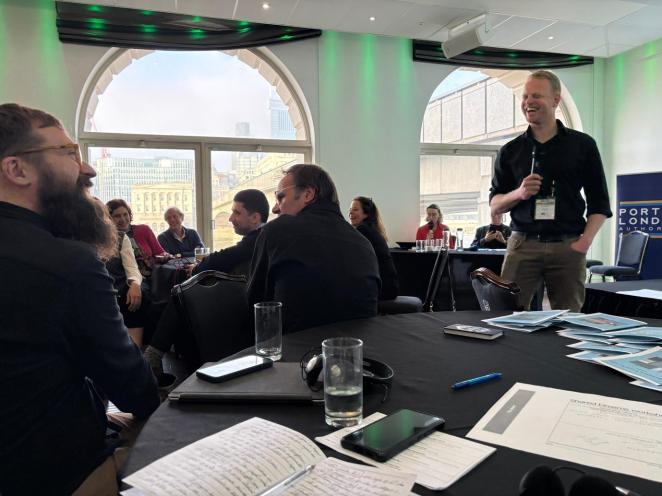
The workshop was facilitated by partners from the Connected River project: Antwerp Management School, represented by Wouter van Bockhaven, and InnoValor Advice, represented by Ruud Kosman. Participants included representatives from several major European river port ecosystems, such as:
- Port of London and Greater London Authority
- HAROPA PORT
- PACO (Port Autonome du Centre et de l’Ouest - Belgium)
- The Port and Metropolitan Area of Lyon (France)
- The Metropolitan Area of Bordeaux (France)
- The Port and City of Bilbao (Spain)
The need for new approaches to innovation
A key theme of the workshop was the growing complexity of river-based environments. Waterways are becoming increasingly crowded, with a wider range of users and stakeholders, each bringing different values, goals, and operational realities. Traditional top-down innovation models, often based on linear waterfall approaches, struggle to address these dynamics.
Instead, the workshop emphasized the need for more collaborative and adaptive innovation processes. These approaches acknowledge uncertainty, bring multiple stakeholders into the process early, and focus on experimentation and learning while working toward practical implementation.
Introducing the Flow Forward methodology
During the workshop the innovation methodology Flow Forward approach was introduced. The methodology combines two complementary components.
Strategy
First, it offers structured innovation strategies (building blocks) that guide stakeholders through different phases of the innovation process, from exploring shared ambitions to developing experiments and scaling solutions. These strategies are supported by practical tools, canvases, and methods designed to facilitate collaboration between diverse actors.
Energizers
Second, the methodology incorporates energizers: inspirational insights and practices drawn from the pilot areas within the Connected River project. These include examples such as monitoring systems, the use of AI during ideation phases, and governance approaches that distribute responsibility among stakeholders.
Participants were also introduced to concrete experiments carried out within the project that could be replicated elsewhere. Examples include initiatives focused on measuring water quality and improving communication and coordination among waterway users, both on the water and along the waterfront.
Recognizing innovation anti-patterns
One of the interactive elements introduced during the workshop was the concept of innovation anti-patterns. These are recognizable behaviors or dynamics that often prevent innovation initiatives from progressing effectively.

© ChatGPT
Examples discussed included situations where no stakeholder wants to take ownership of a challenge, or where organizations continue experimenting indefinitely without a clear intention or pathway toward implementation and scaling. By identifying such patterns, participants can more easily recognize when “old” habits are blocking progress.
Within the Flow Forward methodology, these anti-patterns are used as a starting point. Once identified, they help determine which approaches and interventions are needed to move the innovation process forward in a more productive way.
Testing the approach on the River Thames
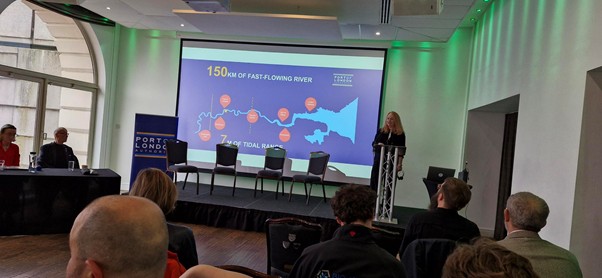
To make the session practical and interactive, participants were invited to test elements of the Flow Forward approach themselves. Using several challenges introduced by the workshop host in London, participants explored opportunities and issues on and around the River Thames.
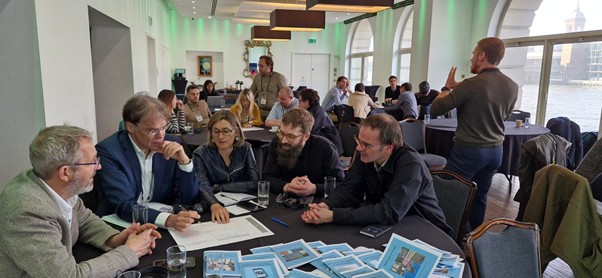
One of the example challenges focused on the electrification of vessels operating on the river. Over the course, participants worked through a condensed version of the Flow Forward process. Starting from a shared vision of a desired future, they gradually translated this vision into early experiments, a Minimum Viable Ecosystem of stakeholders needed to realize the vision, and a prioritized portfolio of projects that could move the ambition forward.
Learning through iteration
Workshops like this play an important role not only in sharing the methodology but also in refining it. The development of Flow Forward itself can be seen as an ongoing experiment. Over time, the project partners have gone through multiple iterations. Each time improving how the methodology is explained, how the tools are used, and how the story resonates with organizations that are new to the project.
Although there are always opportunities for improvement, for example, dedicating even more attention to the urgency of adopting new innovation approaches. The workshop also confirmed that many elements of the Flow Forward method resonate strongly with port and city stakeholders. The fact that participants expressed they “would have liked more time for the workshop” is in itself a great compliment, reflecting a highly motivated and engaged group eager to explore the methodology in depth.
Given the complexity of challenges faced by river port cities today, the session demonstrated the value of bringing diverse stakeholders together to explore new ways of innovating. As pressures on waterways continue to grow, collaborative methods such as Flow Forward may play an increasingly important role in helping river port cities move from shared challenges to shared solutions.
Source: InnoValor Advice