

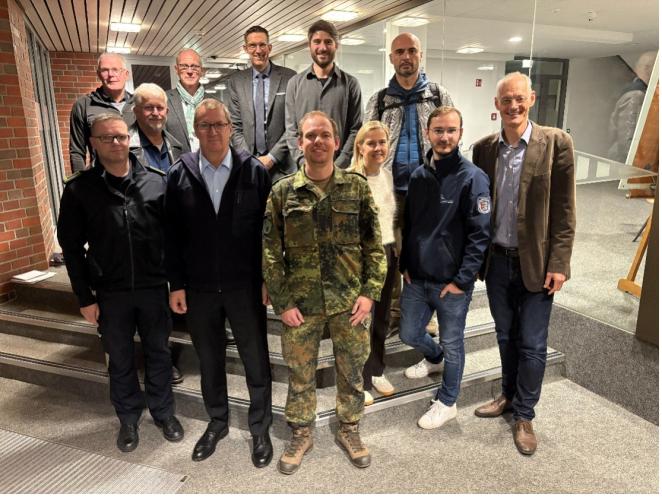
The second FIER Regional Forum in Brake (county town of Wesermarsch in Germany), on the 13th November, brought together regional emergency-management stakeholders, to assess the operational value of hydrological simulations for evacuation planning during extreme rainfall events.
The county of Wesermarsch, located in northwestern Lower Saxony, covers an area of 822 km² and has a population of approximately 93,000. The county, which is dominated by agriculture, is largely surrounded by water, including the Jadebusen (a large bay), the North Sea, and the river Weser. In addition, many of the county’s marsh and moorland areas lie below sea level, making it vulnerable to inland floods.
©: Jade Hochschule
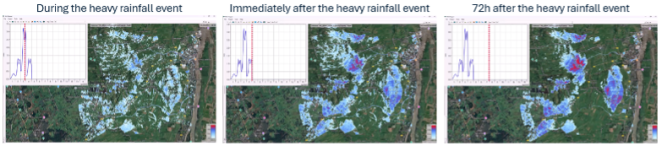
Heavy Rainfall Scenario Modelling
Jade University presented three dynamic flood scenarios for the Brake water management area, which is one of six such areas in the Wesermarsch region and is located in its central west:
- a 72-hour rainfall event with 90 mm of precipitation (100-year return period),
- an extreme 3-hour event with 100 mm,
- a scenario based on observed precipitation from winter 2023/24.
All scenarios assumed saturated winter soils and elevated water levels of the river Weser, resulting in significantly limited drainage capacities. The simulations illustrated water movement pathways, expected flooding patterns, and potential overload points in the regional drainage system.
Relevance for Evacuation and Flood Protection Planning
The aim of the following interactive part of the regional forum was to discuss the perceived risks of the scenarios and the extent to which evacuation plans need to be improved with the stakeholders, such as the municipality, the fire department, the German Life Saving Association, the German Red Cross, the German Armed Forces, dike and drainage boards and the local water supplier,. To this end, questions were addressed as to whether detailed plans already exist for such scenarios, what actions can be taken within what timeframe, and what resources are actually available or may still be needed.
The stakeholders emphasized the lack of detailed plans and the suitability of the scenarios for developing the region’s first evacuation plan. Despite modelling uncertainties - primarily spatial data resolution and necessary simplifications - the 72-hour/90-mm scenario was deemed sufficiently robust for designing an extended flood-protection and evacuation strategy The simulations revealed critical vulnerabilities, such as flooded access routes, houses and farms, in low-lying areas and demonstrated where existing water management infrastructure may fail during prolonged or intense rainfall. The participants concluded that it would be very helpful to draw up a list of possible actions, including responsibilities and timeframes, in the case of the scenarios presented.
“The dynamic simulations give us a much clearer picture of how water moves during extreme rainfall. This insight is crucial for designing evacuation strategies that actually work under real conditions.”
— Helge Bormann, Jade Hochschule
©: Jade Hochschule
Next Steps and Strengthened Cooperation
The forum reinforced cooperation among regional emergency-management actors. The next phase will focus on translating simulation results into actionable measures, including:
- developing a comprehensive, phased action plan (warning, response, evacuation, recovery),
- identifying time-critical decision points,
- conducting structured consultations with key stakeholders to ensure operational feasibility.
The need for structured decision-making support, taking into account time constraints for planning actions, as expressed by stakeholders, is aligned with the activities of Safety Region Zeeland in the FIER project. This once again underscores the importance of the FIER project and the value of cross-border cooperation.