

Construction plays a crucial role in urban growth and renewal, yet the transport flows that support it are rarely addressed in urban logistics strategies. During the GLEAM NSR webinar on 24 February 2026, speakers from Stad Mechelen, Vrije Universiteit Brussel, Dura Vermeer and Shipit shared perspectives from cities, research, and industry on how construction transport can be better understood and made more sustainable.
Roos Lowette and Esmée Hof from Stad Mechelen highlighted the growing importance of construction logistics in cities undergoing rapid development. In Mechelen, construction logistics already represent a significant share of urban traffic and this will only increase as the city plans for population growth and new housing. Construction activities also have very visible impacts on public space, from blocked sidewalks to unsafe conditions for cyclists. Through the UNCHAIN and GLEAM NSR projects, the city engaged both large companies and SMEs, revealing a gap between policy ambitions and the day-to-day realities faced by businesses.
Key takeaways:
- Construction logistics are not a marginal issue, they already shape how streets function, and will increasingly define urban liveability as cities grow.
- There is a clear mismatch between the policy focus so far (e-commerce, last-mile delivery) and the realities of construction transport, a new priority of the city.
- SMEs are often misunderstood: their barriers are practical, not ideological, requiring support, clarity and workable solutions rather than just regulations - highlighting the importance of dialogue between the city and SMEs.
- Managing construction logistics is also about protecting public space and accessibility, not just reducing emissions.
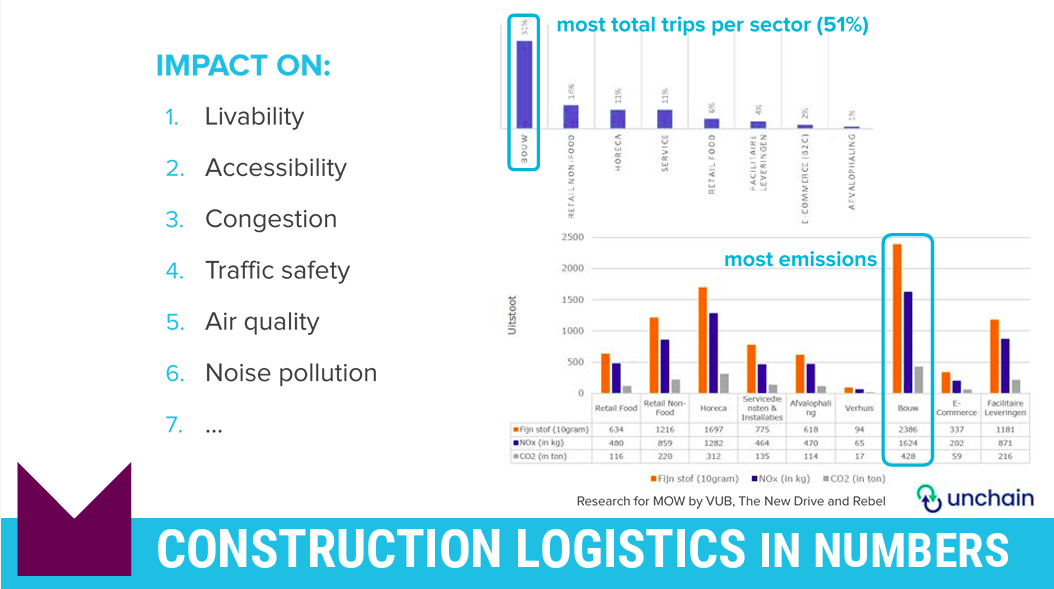
Construction logistics in Mechelen. Bouw = construction.
Dr. Nicolas Brusselaers from Vrije Universiteit Brussel demonstrated how data can transform the understanding of construction transport. By analysing GPS data from heavy goods vehicles across Belgium, his research quantified the scale, costs and impacts of construction-related traffic. This evidence makes it possible to move beyond assumptions and design targeted interventions that deliver measurable environmental and health benefits.
Key takeaways:
- Construction transport represents a disproportionate share of urban freight impacts, making it a high-leverage target for policy action.
- Better data enables cities to quantify environmental and health impacts with precision to move from generic restrictions to targeted, high-impact measures.
- Small operational changes, such as rerouting vehicles, can deliver outsized public health benefits, even when emission reductions seem modest. In one example, rerouting construction traffic around air pollution hotspots reduced emissions by just over 5%, but lowered associated health costs by more than 25%.
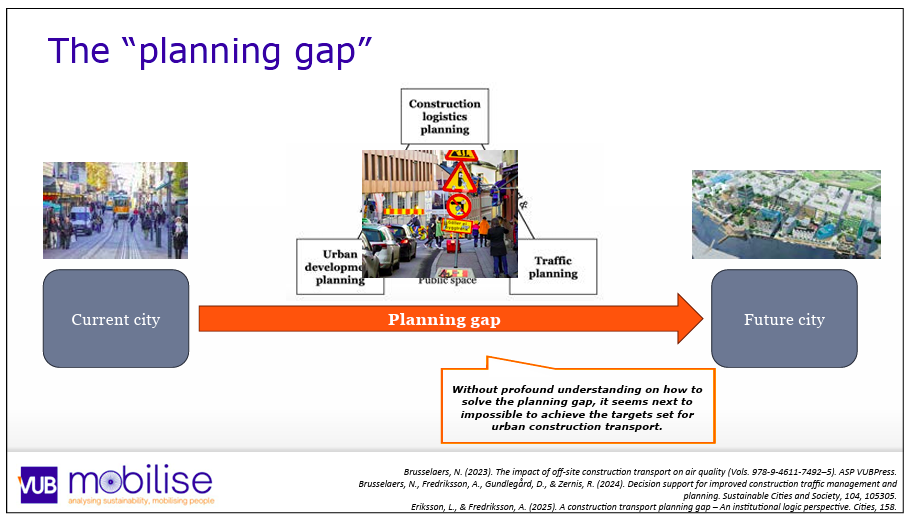
The planning gap between: traffic, construction logisitics, and urban development.
Sam van Hoofffrom Dura Vermeer shared a real-world example of how logistics can be reorganised through consolidation hubs. In The Hague, materials for a 170-unit social housing renovation project were coordinated through an off-site hub, drastically reducing the number of deliveries to the construction site. While the environmental and operational benefits were clear, the case also exposed the financial challenges of implementing such models within current market structures because these are challenging to monetize.
Key takeaways:
- Consolidation hubs can dramatically reduce traffic and emissions, but require a fundamental shift in how construction logistics are organised.
- Many benefits like cleaner air, safer streets, and less disruption remain invisible in traditional cost calculations.
- Scaling these models will depend on aligning procurement, policy and market incentives to recognise broader societal value.
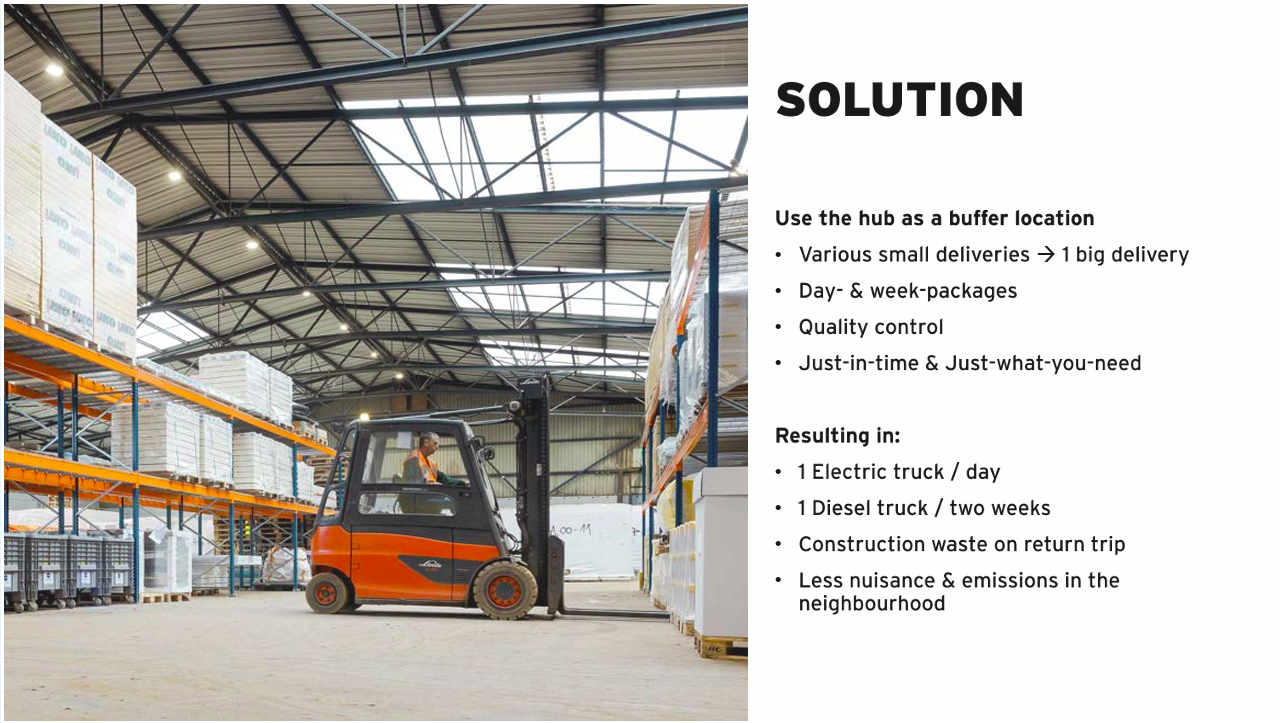
Construction consolidation hub solution.
Mark Goossenaertsfrom Shipit presented a city-scale approach through the Brussels Construction Consolidation Centre. Operating from an urban terminal that can reach 70% of Brussels construction sites within 30 minutes, it consolidates materials arriving by ship and truck before coordinating last-mile delivery. The result has been a 50% reduction in trucks, CO₂ emissions and accidents, alongside improved quality control and efficiency. By centralising deliveries and coordinating last-mile transport, the model reduces inefficiencies that are deeply embedded in construction logistics. Combined with return logistics and waste sorting, it also supports circular economy objectives.
Key takeaways:
- Construction logistics are currently highly inefficient by design, with fragmented deliveries and repeated handling of materials.
- Consolidation centres show that efficiency gains and sustainability improvements can go hand in hand.
- Logistics solutions can also unlock circular economy opportunities, particularly through return flows and material recovery.
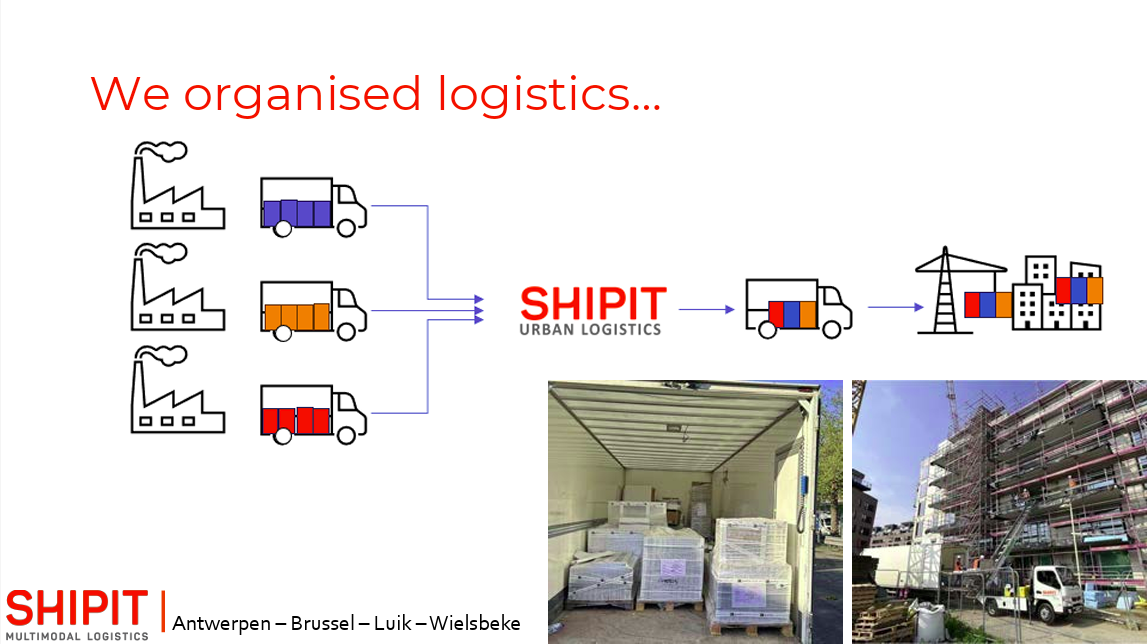
Shipit's innovative Construction Consolidation Centre logistics approach.
Across all speakers, one message stood out: the challenge is not only technical, but institutional. To bridge the gap between ambitious urban development goals and sustainable transport targets, cities must integrate construction logistics into zero-emission strategies, align procurement policies with health and environmental objectives, and allocate space for consolidation solutions. As cities grow and decarbonize simultaneously, how construction materials move through urban streets will shape liveability as much as what is ultimately built. Greening construction logistics is therefore not a marginal adjustment, it is a foundational step towards cleaner, safer and more resilient cities.
Find the recording and presentation slides on the Our Work page.