

Maintain and Prolong
Newbuild Van der Sluis Transport, Staphorst (NL): Maintain and Prolong
As part of the Good Practices for Circular Planning and Construction outcome, CircleBIM highlights practical projects that show how circular strategies are applied in real planning and construction contexts.
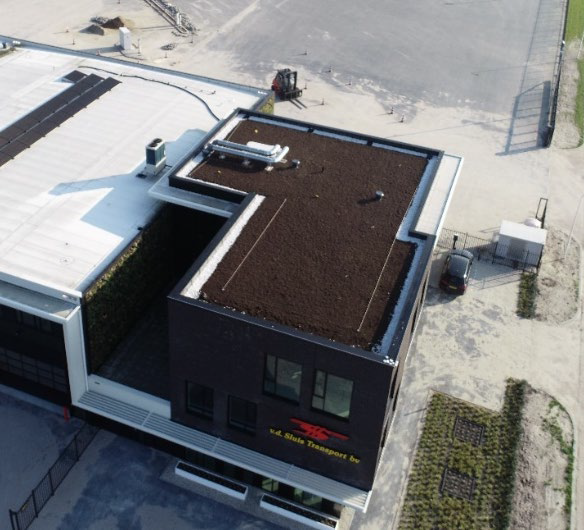
Green roof Van der Sluis transport Buro de Haan. Archive photo. (Buro De Haan Architectuur | Ontwerp Van der Sluis Transport, 2024)
- Client: Van der Sluis Transport
- Architect: Buro de Haan (Staphorst)
- Installations: Bisschop Installatie (Punthorst)
- Location: Staphorst, The Netherlands
- Function: Office / industrial building
- Size: 2,680 m²
- Completion: 2024
Circular strategy in practice
This project focuses on the circular strategy maintain and prolong, implemented through durable, low-maintenance material choices and protective design measures.
A key intervention is the green roof, which protects the roof construction from UV radiation, temperature fluctuations, and precipitation, significantly slowing material degradation and extending the roof’s lifespan. The green roof also improves insulation and rainwater retention, increasing resilience to extreme weather conditions.
For the window frames, aluminium was selected due to its exceptional durability and minimal maintenance requirements. Aluminium frames do not require sanding or painting, are resistant to all weather conditions, and maintain their functionality and appearance over a long service life. In addition, aluminium is fully recyclable, supporting the project’s circular ambitions beyond the use phase.
Together, these material choices minimize maintenance while actively contributing to the extended lifespan of the building.
Added circular value
In addition to the main strategy, the project also applies:
- Reuse and redistribution
- Refurbish and remanufacture
- Recycling
This combination shows how multiple circular strategies can be integrated within a single newbuild project.
Why this project matters
This example demonstrates how circular ambitions can be translated into practical, achievable project-level decisions that extend building lifespan, reduce maintenance, and limit environmental impact.
This project is one of the analysed cases in the “Good Practices for Circular Planning and Construction” document.