

Reuse and Redistribute
Temporary Courthouse, Amsterdam → Enschede (NL): Reuse and Redistribute
As part of the Good Practices for Circular Planning and Construction outcome, CircleBIM highlights practical projects that show how circular strategies are applied in real planning and construction contexts.
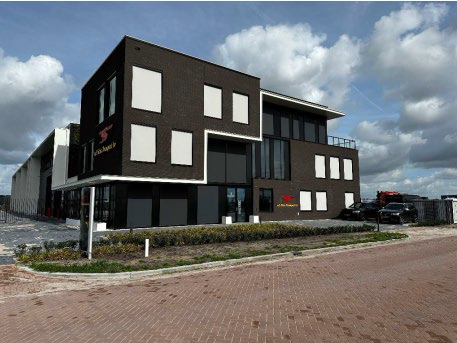
New build project of Van der Sluis transport. (Buro De Haan Architectuur | Ontwerp Van der Sluis Transport, 2024)
- Primary client: Rijksvastgoedbedrijf (Government Real Estate Agency)
- Architect: cepezed
- Structural engineering: IMd Raadgevende Ingenieurs
- Installations: Ingenieursbureau Linssen
- Location (first use): Amsterdam, The Netherlands
- Location (second use): Enschede, The Netherlands
- Function (first use): Courthouse
- Function (second use): Office and knowledge lab
- Size: 5,400 m²
- Completion: 2016
- Rebuild: 2022
Circular strategy in practice
This project focuses on the circular strategy reuse and redistribute, implemented through a fully demountable building design that enables components to be reused in a different location and function.
The temporary courthouse in Amsterdam was designed to be dismantled after its initial period of use. After four years in operation, the building was carefully disassembled in 2022, ensuring that nearly all components (including the steel structure, façade panels, floor elements, and technical installations) remained intact. These elements were subsequently transported and reconstructed in Enschede, where the building was repurposed as an office and knowledge lab. The modular design allowed the building to be taken apart and reassembled like a kit, giving it a second life with minimal material loss.
Added circular value
In addition to the main strategy, the project also applies:
- Refurbish and remanufacture
- Recycling
This combination shows how multiple circular strategies can be integrated within a single project.
Why this project matters
This example demonstrates how circular ambitions can be translated into practical, achievable project-level decisions that minimise waste, reduce environmental impact, and create flexibility for future use. It serves as a strong blueprint for future-proof construction based on adaptability and reuse.
This project is one of the analysed cases in the “Good Practices for Circular Planning and Construction” document.