Image

Green transitions


It took visionary people, intrepid entrepreneurs, scientific rigour, advocacy, and lucky stars to get there. Now, with the EU acknowledging wind as a green fuel and 10,000 wind propulsion installations forecast by 2030, wind-assisted shipping is taking off in a big way. This is the story of WASP, an Interreg North Sea project that played no small part in this development.
The idea of using the wind to propel your ship forward is certainly not new. On the face of it, wind could be key to decarbonising today's European shipping sector, improving its energy independence and mitigating global warming.
And yet, for the longest time the prospect of harnessing the wind to fuel modern ships seemed like a mirage conjured up by dreamers. The idea was initially met with great scepticism, says Robbert van Hasselt, the mastermind behind two consecutive Interreg North Sea projects pioneering wind-assisted shipping, SAIL and WASP.
While both projects explored modern counterparts of soft sails - rotors and wings - WASP provided crucial third-party validations enabling policy and industry breakthroughs to follow.
To better understand how Interreg helped transform shipping, we spoke with some of the people who were involved in WASP.
Consultant Robbert van Hasselt plays a leading role in our story as the initiator of not only WASP but also its precursor, the project SAIL.
Between 2008 and 2012, SAIL explored wind-assisted shipping techniques and business cases, producing prototypes and conducting tests. Based on this, van Hasselt envisioned WASP would build critical mass for a market-ready technology.
“I brought all the partners together and convinced them about the urgency of collaborating further,” he explains.
It was a challenge to find interested shipowners, “because the shipowners always take the risk. They are the ones getting the wing or rotor on board.” In the end, he found five brave shipowners willing to join WASP: van Damm, Boomsma, Rörd Braren, Scandlines, and Tharsis.
Frank Nieuwenhuis is a Dutch entrepreneur whose part of the story started almost as a fun experiment. After he had sold his medical company, he was contemplating what to do next in life when he met Robbert van Hasselt and Guus van der Bles at a sailing race.
“Guus said he wanted to try modern sails with big ships. I said, I can make a model for you,” says Frank. “That is what I do – I build things. So, I made a 1-metre model, and we tested it at the top of my car.”
“We then built a 5-metre model on top of my boat trailer. And it worked, it was amazing! So, we formed a company together and built a containerised unit with two wings of 10 metres each. Once the container is on the ship you press a few buttons, and two wings come out. This is a serious thing - it's still in use.”
However, finding investors to grow the startup turned out to be hard. This was partly due to shipping's economic model: Shipowners typically rent out their ship, and hence do not pay for the fuel; on the other hand, although the renters benefit from fuel savings, they will not invest in retrofitting a rented ship.
At this point, Frank Nieuwenhuis had sunk considerable funds into the venture, now called Econowind. “We decided not to invest any more without external support. A year later, Robbert invited me to join WASP. Shipowner Jan van Dam was there too, and said, ‘if you do that, I want to be your first customer.’ When the WASP project grant came through, we went for it and built six wings on three ships in two years.”
“And it was a great success! Our university partner SSPA [now part of RISE] measured fuel savings of up to 15-20% under the best wind conditions. These were all prototypes allowing us to find out what works and what doesn’t. Based on that, we redesigned and improved the products."
If WASP had not happened, we would not have survived the corona crisis. Because nobody wanted to invest in the next wind-assist container.
When the market finally took off post-Corona in 2023, Econowind was able to deliver 8 systems within that year. "In 2024, we produced around 25 systems. By now, we have delivered over 70 and sold 150," says Frank Nieuwenhuis.
Today, Econowind sells their products on the world market. "About half of the units are sold in Asia, with the biggest part in Japan. It moves from shipper to shipper now. The four major shipowners in Japan have bought our wind-assist systems," he explains.
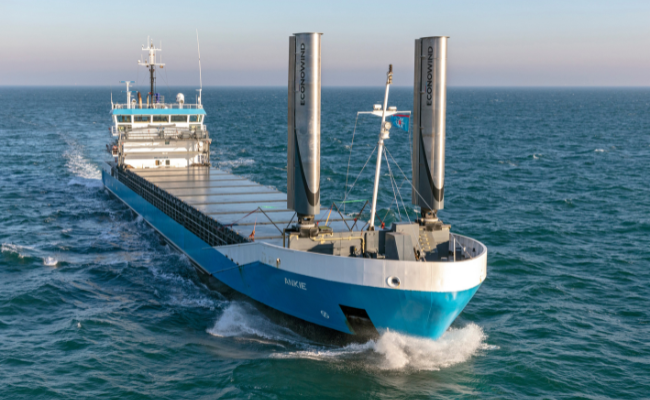
Econowind's suction wings mounted on the ship Ankie, owned by Jan van Damm. Photo © Econowind.
Marko Möller is Head of Corporate Program Management Office at Scandlines, which operates ferries between Denmark and Germany. He explains that Scandlines engaged in WASP as part of their green shipping ambitions.
“We were not quite sure about which technology is the best fit for us, “he says. “There are always uncertainties with new technology, and you aren’t fully assured of success. So, when Robbert van Hasselt approached us, we joined in. The EU funding was a decisive element to say, OK, we give it a try and hope that our expectations will be met.”
He was impressed by the speed with which the Flettner rotors were finally mounted on the ferry. “We did this while the vessel was put out of service for a few departures. It took half a day only,” he recalls. This was possible because the preparatory work on the vessel had been carried out during a previous shipyard stay.
But for Scandlines, the most important outcome of WASP were the independent validations of the performance of the rotor sail.
“It’s very complicated to measure the real fuel savings of wind-assist technology. During each crossing there are more than 100 variables influencing fuel consumption. Are there other vessels on the route? Is it windy? And so on. The validations gave us the confidence to install another rotor sail on the second vessel – this time without any external funding.”
“For me personally, WASP was a fantastic experience because I met so many experts and even got to witness the experiences of the other shipowners.”
In the future, the cost of using fossil fuels will go up. As a shipowner, doing nothing will turn out to be very expensive.
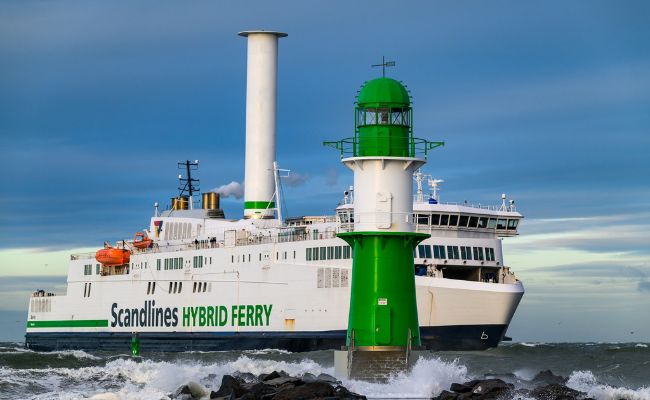
"The crew is proud to have the rotor sails on board. Our passengers like them, too,” says Marko Möller. Image © Scandlines.
Independent validation of the technology was clearly going to be a necessary step to build trust in wind shipping, so the partners invited several universities to help on rigorous tests and sea trials.
Sofia Werner, head of strategic development at the Maritime Department of RISE, Sweden, was one of the scientists involved.
“When we engaged in WASP there was no procedure in place for sea trials of wind-assisted ships. So, we had to first develop the method. The first trial was of the Scandlines ferry Copenhagen. It went well, so after that we just refined the method for each ship tested in WASP.”
A full-scale sea trial is a comprehensive assessment of multiple operative aspects, including safety. “Structural safety - making sure that things don't break - is one thing,” explains Sofia Werner. “Another thing is to make sure that the ships can always manoeuvre safely. What happens if there are strong gusts of wind or a change of wind speed?”
“Later, we brought the sea trial methodology into ITTC, the International Towing Tank Conference. We created the first draft ITTC guidelines for wind-assisted ships based on the work we did in WASP.”
As a partner in WASP, the International Windship Association (IWSA) played a crucial role in advocacy by putting the project's insights in front of the right people.
General Secretary Gavin Allwright commends the project for its tangible proof points. “WASP wasn’t just a desktop study. It went into the real world with five installations of wind propulsion technologies put on to vessels, adding about a quarter of the total number of wind-assisted vessels to the fleet in the early 2020s,” he says.
“There’s nothing better for a shipowner or a shipyard than to actually see a technology in action. So, this gave a real boost to the information available on the market and also a very tangible, hands-on experience for everybody involved."
"Also, the convening power of WASP resulted in a lot of learning and capacity building. In IWSA, we have thousands of experts who looked at this project, learned from it, and are now developing new projects."
See the five WASP wind-assist technology installations in action:
Much of Gavin Allwright’s work is about stating the obvious, he says. For example, he points out that the economic case for wind is inherently very strong: “Wind is a zero-cost system. Of course, there are costs of building and installing it. But usually, a few months of operation would pay back the embedded energy, and a few years would pay back the total cost.”
“Wind is the only energy source you can put on a ship that actually pays for itself. It’s a no-brainer, it’s no-risk. It’s a solution that’s only available to shipping.
“In shipping, we can use the wind directly without converting it. It doesn’t have to be mined, refined, transported, bunkered, or stored on board. It’s delivered directly to the point of use at no cost and with no emissions for the life of that vessel."
"We are putting a carbon price into the market now, via the EU ETS [Emissions Trading System] and elsewhere. And wind is acknowledged, in part, as a green fuel in the FuelEU Maritime package. That improves the business case for wind propulsion."
However, he stresses that policy frameworks still fail to address other forms of fossil fuel based pollution, such as nitrogen oxide, oil spills, or underwater noise impacting marine life forms.
"Wind propulsion reduces all emissions and that includes the noise. So, if we took a more holistic view, wind propulsion would come out as the lowest of the low-hanging fruit - the most non-risk, no-regret technology choice that you could make."
Gavin Allwright represents IWSA in the International Maritime Organisation (IMO) and the European Sustainable Shipping Forum (ESSF) hosted by the EU's DG MOVE.
“At the IMO, a lot of the stakeholders were aware of WASP showcasing the technologies with third-party verification. They could see the results and start to feed those into the regulations that were under development. The net-zero framework passed by the IMO includes wind and the WASP project absolutely contributed to that," he says.
"Also, the ESSF were very aware of the WASP project. Indeed, this led to the setting up of a wind propulsion workstream feeding into EU policy discussions."
In October 2025, the European Commission issued guidelines to the FuelEU Maritime directive that effectively reward wind-assisted ship propulsion as a green fuel.
IWSA now lobbies for the EU to extend the reward system to ships of less than 5,000 GT, as most larger ships are built outside of Europe.
Gavin Allwright expands on his views in the video below:
“We are seeing 2026 as the real inflection point in the market. We will have between 100 and 200 vessels with wind-assist installations, effectively doubling the number every year now," says Gavin Allwright.
"That will happen at a time when the EU ETS is being charged at 100%, and the first payments under the Fuel EU Maritime have to be made; and we await a strong decision in the IMO as well on the net-zero framework and the carbon price.”
“If the installations continue to double, we should approach 10,000 installations in the early 2030s,” predicts Gavin Allwright. “To put this in perspective, up until 2023 when we ended the WASP project there were round about 20 + ships installed for wind propulsion, including the five vessels retrofitted through the WASP project. It took 12 years to get to that point. In the following 12 months, we doubled that."
“The technology has proven to be robust, the first movers have already moved, and we have policy and regulations backing that up. Altogether, that creates a bit of a perfect storm. “
And, as you might have guessed, the far-sighted Robbert van Hasselt did not rest on the WASP laurels. He has moved on with his next vision: Scaling up from WASP. To this end, he put together the project Wind4Shipping, funded by Interreg North West Europe.
"In this project, we are looking to scale up the European industry manufacturing rotors and sails," he explains. With a solid business case for wind propulsion now in place, the race is on globally to win shares of the burgeoning market. Thanks to van Hasselt and his partners, Interreg funding continues to support the European industry to stay in the game.
At the Interreg North Sea Programme, we are super proud of everything WASP achieved. We wish all WASP partners and the Wind4Shipping project all the best of luck - or, as they say in the business, fair winds!
In WASP, five wind ship propulsion technologies were validated and proven feasible as well as competitive, so long as the policy frameworks treat wind on par with other fuels.
WASP was instrumental in changing attitudes. Wind-assisted shipping is now taken seriously by the industry, including some of the world’s largest players. Today, the market for wind-assisted technology has taken off.
WASP provided proof points leading to rewards for the use of wind in the FuelEU Maritime policy. It also inspired the International Maritime Organisation (IMO) to set up its net zero framework.
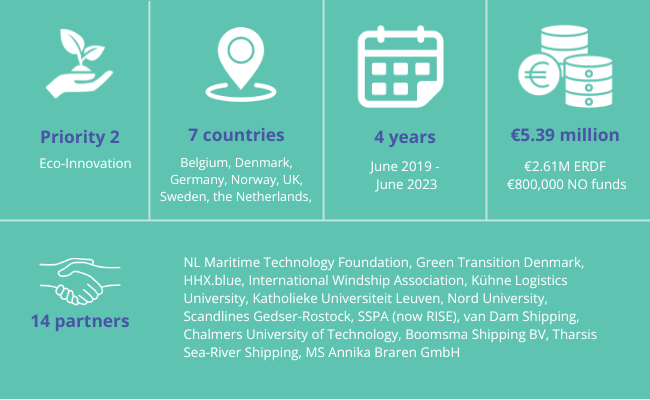
Icons ©Noun Project
Visit the project's website to find out more about this seminal project.
Top image ©Scandlines.