Image

Green transitions


Middelfart Municipality is of average size and located far from any city hubs, yet it stands out for its green transformation. What's up with Middelfart? Cooperation across borders is key, says Morten Westergaard, Head of Climate at the municipality.
Middelfart Municipality has a surprising array of green achievements under its belt.
For example, it won the first climate prize ever awarded by the Danish Association of Municipalities; it received the European Destination of Excellence (EDEN) Award for its sustainable tourism; and it organises the annual People’s Climate Festival drawing 40,000 participants in 2025.
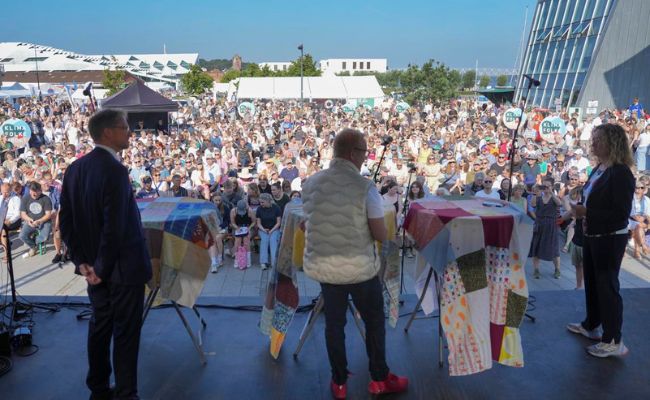
People's Climate Festival in Middelfart opens (2024). Photo © Claus Fisker.
One of the main people behind this trajectory is Head of Climate Morten Mejsen Westergaard. He sees European cooperation as a vital part of the municipality's green journey:
His first Interreg North Sea project was Shared Space (2003-2008). "It was great to experience first-hand how ideas could travel across Europe!" he recalls.
"The next project was North Sea Sustainable Energy Planning where we co-developed the first strategic energy plans in Europe. We worked in a data-driven way across five Danish municipalities. Since then, strategic energy planning has taken off across Denmark.”
The project CORA (2017-2023) on digital transformation in rural areas followed. "In CORA, we developed a ridesharing app which is still in use and an integrated part of our local climate plan," says Morten Westergaard.
He sees European projects as a chance to innovate and experiment. "Let's take another North Sea project, EMPOWER 2.0 that supported energy communities. Our pilot focused on green heating in the village of Føns, with just 50 households."
Through this project, the villagers drilled deep into the ground to capture geothermal energy for heating. "EMPOWER put things in motion in the real world, something I cherish about European projects." The project ended in 2023, but Westergaard says citizens and villages are still visiting Føns as an example of a smart village.
Nobody thought that district heating in a small village was possible. But we did it!
EMPOWER 2.0 had an unexpected spillover effect.
"We met colleagues from other parts of Denmark who also worked with community energy. And we said, 'this is simply too good to stop!' So, we set up an independent organisation, Danish Energy Communities," says Westergaard.
After just two years, the organisation was designated a National Centre of Expertise. "It's super interesting that we've come this far in such a short time. That would never have happened without EU funds that supported this work from the get-go."
Middelfart Municipality is currently part of the project WaterWarmth which explores thermal energy in surface water for heating and cooling.
"We don't have much experience with this in Denmark," says Morten Westergaard. "We've learned a lot from our Flemish, Dutch, French and German partners."
In the village of Fjelsted, a small pond now provides the energy to heat a community building.
The pilot may be small, but "micro-actions can have maximum effect. A heat pump at work in a village pond is something you can understand and that we can bring delegations to see. This pilot demonstrates that we can get energy from lakes, rivers, and the sea, if we dare to think across sectors and regulations," he says.
The pilot has just passed its first winter exam. It works smoothly despite freezing temperatures:
One concern is that the system might cool the pond, degrading the habitat for aquatic wildlife.
Westergaard points out that the cooling effect will be less than 1.5 degrees Celsius, while global warming has already caused the water to heat up. The University of South Denmark is conducting research on the pilot, providing proof points.
He adds: "One of the biggest challenges in the green transition is that we want to use the same areas for different purposes. In this case, we have a village pond that can absorb excessive rainfall and which can also provide green energy for local heating. And we have learned about this ingenious idea by tapping into European thinking."
We need to combine energy production with climate resilience, otherwise we will run out of space.
"What I find especially interesting about many EU projects is that they invite citizen engagement," says Morten Westergaard.
"We are in the lucky situation that the villagers here are spotting opportunities themselves; so, instead of us involving citizens, the citizens are involving the municipality! When a project is based on the communities' own ideas, the results are much more likely to live on after the grant has expired."
Westergaard also highlights job creation. "There are lots of jobs in the green transition. Every time a solar park is established, we create 50 to 100 new jobs, from installing the panels to regular cleaning and tending the sheep that graze the areas." Energy renovation of buildings is another area providing many jobs.
Throughout our 1.5 hours of conversation, Morten Westergaard's unswerving enthusiasm for European cooperation shines through.
He has a hand in many initiatives beyond his duties as Head of Climate the municipality. He is also president of the Danish Association of Energy Communities, co-initiator of Termonet Denmark promoting thermal energy, and a member of several advisory boards - among much else.
After two decades, he is as passionate as ever about the green transition. And he puts European cooperation squarely as a key reason for his tenacity:
Powered by transnational cooperation, Middelfart Municipality is driving innovation inspiring others far and wide. The municipality has been part of numerous EU-funded projects in the past 20+ years, including six co-funded by the Interreg North Sea:
Shared Space (2003-2008)
North Sea Sustainable Energy Planning (2009 - 2013)
CORA (2017 - 2023)
EMPOWER 2.0 (2019 - 2022)
WaterWarmth (2023 - 2026)
CircleBIM (2024 - 2027)
Sofie Forfang is a communications advisor at the Interreg North Sea Joint Secretariat.