Image
Image

Green transitions


How an Interreg North Sea project pilot is sparking a city-wide transformation in Hamburg.
What happens when a temporary pilot proves so successful that letting it disappear is no longer an option?
This is the story of Tower to the People, an initiative I started together with my colleague Mathias Rüsch. It grew out of a small-scale experiment within the Interreg North Sea project MoLo Hubs, and evolved into a city-wide conversation about circular economy, governance and the future of one of Hamburg’s most controversial buildings.
To be clear from the outset: We do not have the tower yet.
What we do have is a rapidly growing, concrete initiative that is now being discussed seriously at political, institutional and investor level. And that, in itself, is a story worth telling.
Within MoLo Hubs, the Hamburg pilot took the form of a Pop-Up Circular Hub, located in a former department store in the city centre (JUPITER).
From April 2024 to April 2025, we brought together circular economy actors, start-ups, researchers, public administration and citizens in one highly visible, physical space.
Through this pilot, we tested a simple but powerful assumption: The circular economy needs such spaces to collaborate, experiment and scale.
The pilot demonstrated several things very clearly:
When the pop-up phase came to an end, one question stayed with us: Where next? And how do we scale what worked?
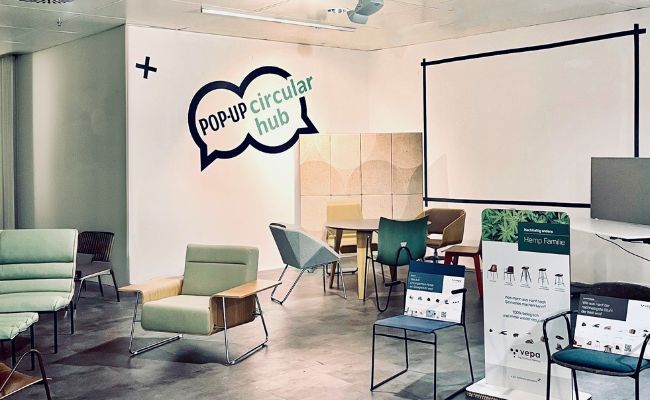
The centrepiece of the MoLo Hubs Hamburg pilot was a pop-up circular hub.
Around the same time, Hamburg was facing a very different challenge.
Construction of the Elbtower, a large investor-driven real estate project at the southern entrance to the city, had stopped following the bankruptcy of its developer. What remained was a 100-metre-high concrete shell, unfinished, highly visible, and increasingly perceived as a symbol of failure.
When demolition was discussed publicly, many of us were stunned. Massive amounts of embodied CO₂ were already locked into the structure.
Standing in front of a city model during an event, a question emerged in my mind almost naturally: What if this were the place to scale what we had tested in MoLo Hubs?
I shared this thought with Mathias Rüsch, with whom I also work in another Interreg North Sea Region project Circular Economy Office, where he leads communications through his agency mattrs. He was immediately as excited as I was. We had both seen through other projects that ideas which initially sound unrealistic can become reality if people rally around them.
That moment marked the beginning of Tower to the People (TTTP).
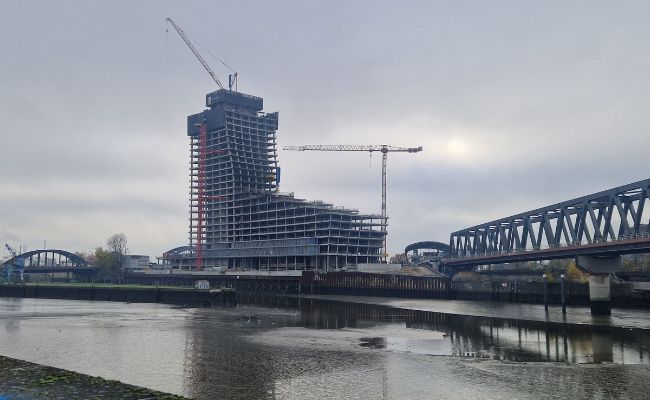
The prestigious project Elbtower was called off midway. Image © Reinhard Krug (VANDUER).
From the outset, TTTP was conceived as an open initiative. We invited Hamburg’s circular economy community of planners, architects, researchers and communicators to think together.
A single LinkedIn post by Michael Fritz, a social entrepreneur experienced in turning bold, community-driven ideas into reality, triggered unexpected momentum. Within days, hundreds of people joined the discussion, offering expertise, encouragement and visibility - all pro bono.
Following this open call, the communications team VANDUER joined the initiative and helped translate the idea into powerful visual narratives that made the concept tangible for a wider audience.
What stood out throughout this phase was the breadth of resonance — not only among professionals, but also among citizens who had long perceived the Elbtower as a symbol of stagnation rather than possibility.
Tower to the People says everything. People immediately understand that this is not another prestige project, but an invitation to participate, to contribute, and to rethink what this building could stand for.
Media coverage followed, including articles in major Hamburg newspapers and a local TV interview. What had started as a thought experiment was becoming part of a broader urban debate.
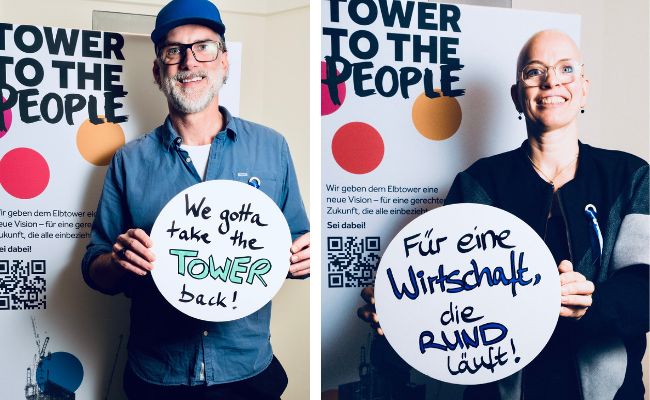
Mathias Ruesch and Britta Peters bring out the message at a public meeting discussing the idea of the TTTP. Image © Mathias Rüsch/mattrs
When the City of Hamburg announced that the Natural Science Museum would move into the lower floors of the Elbtower, my first reaction was uncertainty. Would this make TTTP obsolete?
Instead, it forced a crucial shift.
Rather than positioning ourselves in opposition, we adapted the concept: a Circular Hub above the museum, forming a functional and narrative alliance between knowledge and action.
The building is large enough for both uses and together they are stronger:
This reframing turned TTTP from a perceived alternative into a potential partner.
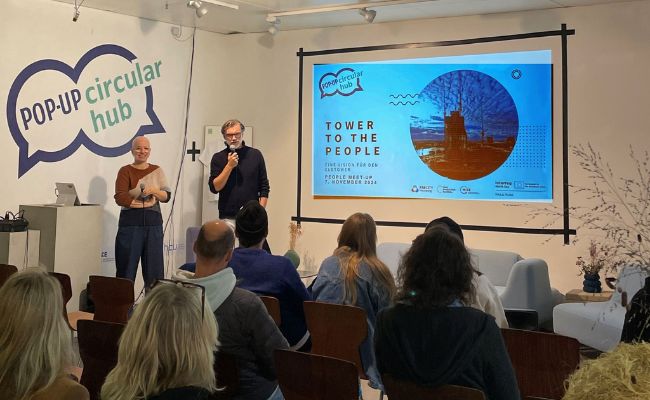
Britta Peters and Mathias Ruesch presenting the idea of the TTTP. Image © Mathias Rüsch / mattrs
Through public exchange and dialogue with cooperatives and practitioners, another insight became clear: A sustainable use concept needs sustainable governance and financing.
Inspired by existing cooperative and commons-based approaches, we proposed a cooperative model as one possible pathway. Not as a fixed blueprint, but as a modular structure that allows participation, safeguards public interest, and supports long-term stewardship.
As one architect put it during the discussion:
If we continue to assess innovative projects using the same methods and tools that produced our current problems, we should not expect innovation as an outcome.
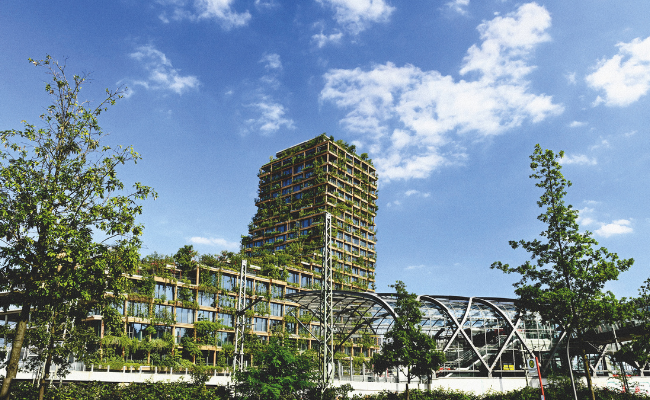
Visualisation of the circular Tower to the People. ©Reinhard Krug (VANDUER)
This trajectory culminated in a stakeholder dialogue on 18 December. Around 60 key stakeholders from business, finance, civil society, academia and public administration took part, among them Hamburg’s Finance Senator Andreas Dressel.
The exchange was intense, informed and constructive. A shared sentiment emerged quickly: If we continue to think and assess projects in the same way, we will not get different outcomes.
Most notably, the Finance Senator expressed strong interest, announced his willingness to support discussions with the investor, and proposed follow-up conversations ahead of a scheduled January meeting. Ideas such as phased implementation or interim use were discussed openly.
At that moment, it became clear to me: this was no longer just a vision, it had become a credible option.
Tower to the People exists because a small-scale Interreg pilot was designed to experiment, to learn and to build trust before scaling.
MoLo Hubs did not deliver a building. It delivered capacity, networks, confidence and evidence.
As one participant summarised it:
What this initiative shows is the power of thinking big again. Instead of managing decline, it creates a positive future scenario - one that invites confidence, collaboration and the courage to imagine a different outcome.
This is exactly what EU programmes are meant to enable:
Whether or not TTTP ultimately becomes reality in the Elbtower, one thing is already clear: Thinking big, collectively and constructively can change the trajectory of urban transformation.
And that is a result worth sharing.
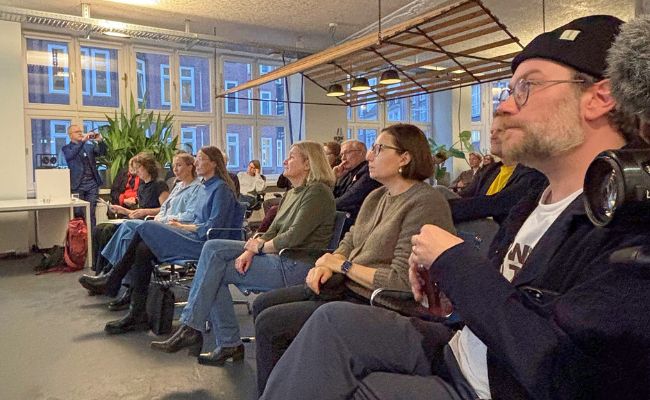
The meeting on 18 December 2025 created further impetus for the vision of the Tower To The People. Image © Mathias Rüsch / mattrs
Are you curious? Find out more in the links below:

Britta Peters is a Senior Advisor at HiiCCE – Hamburg Institute for Innovation, Climate Protection and Circular Economy. She works on circular cities, urban transformation and cross-sector collaboration. She is the initiator of Tower to the People — an open initiative exploring how large-scale buildings can be repurposed for climate action, circular economy and societal value through new governance and financing models.
Top images: © Reinhard Klug.